QUESTION IMAGE
Question
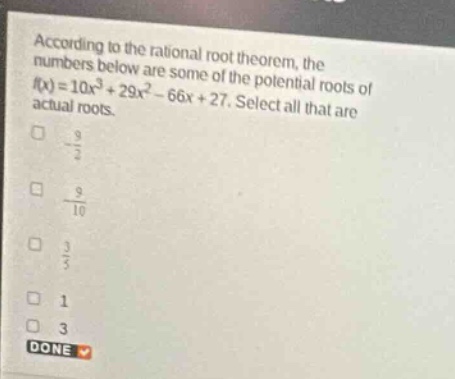
according to the rational root theorem, the numbers below are some of the potential roots of \\(f(x) = 10x^3 + 29x^2 - 66x + 27\\). select all that are actual roots.
\\(-\frac{9}{2}\\)
\\(-\frac{9}{10}\\)
\\(\frac{3}{5}\\)
1
3
🆕 New Concept Discovered: Rational Root Theorem and Finding Polynomial Roots
Finding where a polynomial equals zero using factors of the constant and leading coefficient.
Step 1: Test integer candidates
We evaluate the polynomial \( f(x) = 10x^3 + 29x^2 - 66x + 27 \) at the given integer options to see if they yield zero.
For \( x = 1 \):
Since \( f(1) = 0 \), \( x = 1 \) is an actual root.
For \( x = 3 \):
So, \( x = 3 \) is not a root.
Step 2: Factor the polynomial
Since \( x = 1 \) is a root, we can divide \( f(x) \) by \( (x - 1) \) using synthetic division or polynomial long division to find the remaining quadratic factor.
Dividing \( 10x^3 + 29x^2 - 66x + 27 \) by \( x - 1 \):
The remaining quadratic is \( 10x^2 + 39x - 27 \).
Step 3: Find the remaining roots
Set the quadratic equation to zero to find the other roots:
We can factor this quadratic by grouping. We look for two numbers that multiply to \( 10 \times (-27) = -270 \) and add to \( 39 \). These numbers are \( 45 \) and \( -6 \).
Solving for \( x \):
Step 4: Compare with the given options
The actual roots of the polynomial are:
Comparing this to the given choices:
- \( -\frac{9}{2} \) (Correct)
- \( \frac{9}{10} \) (Incorrect)
- \( \frac{3}{5} \) (Correct)
- \( 1 \) (Correct)
- \( 3 \) (Incorrect)

Snap & solve any problem in the app
Get step-by-step solutions on Sovi AI
Photo-based solutions with guided steps
Explore more problems and detailed explanations
- \( -\frac{9}{2} \)
- \( \frac{3}{5} \)
- \( 1 \)