QUESTION IMAGE
Question
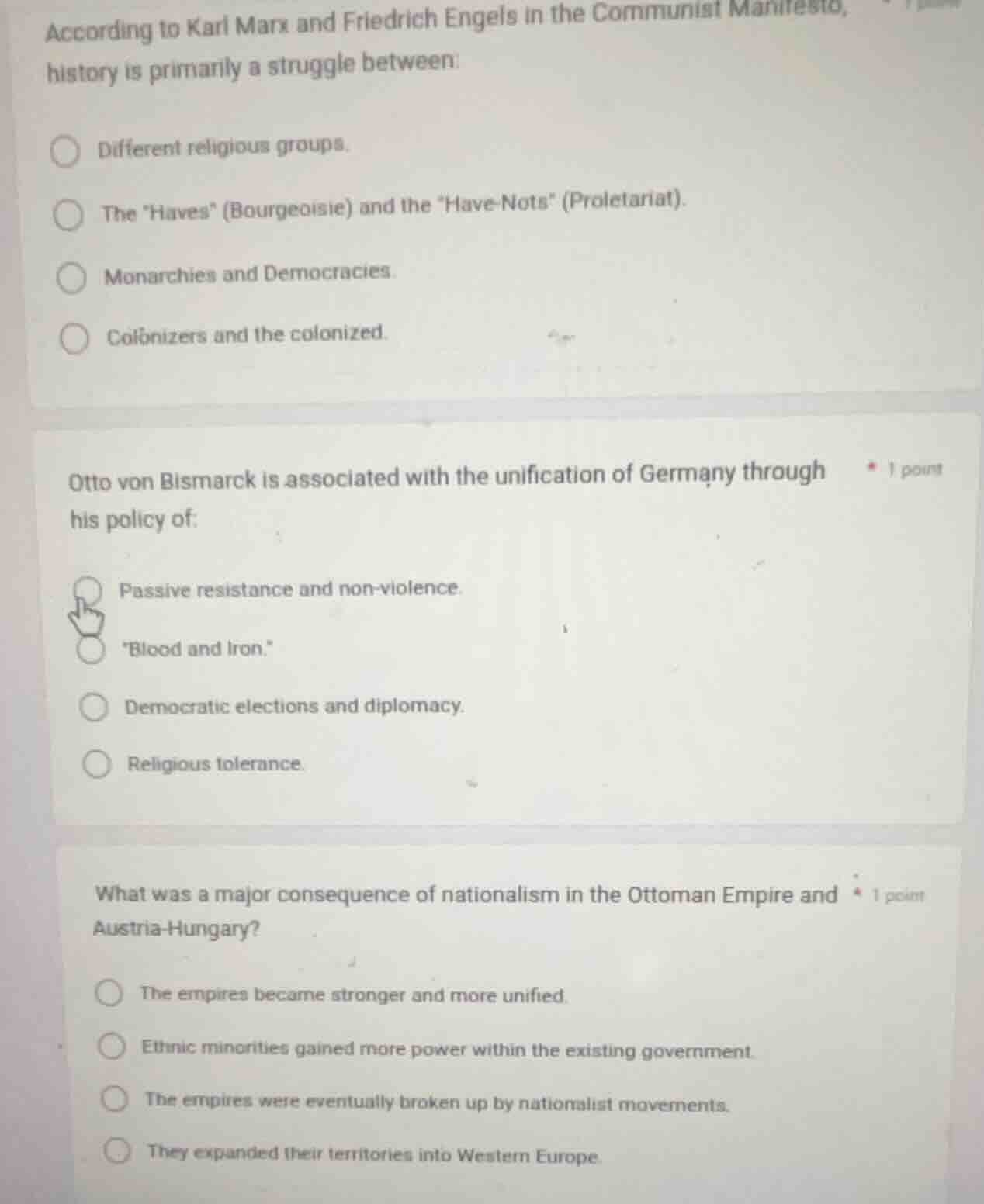
according to karl marx and friedrich engels in the communist manifesto, history is primarily a struggle between:
- different religious groups.
- the \haves\ (bourgeoisie) and the \have - nots\ (proletariat).
- monarchies and democracies.
- colonizers and the colonized.
otto von bismarck is associated with the unification of germany through his policy of:
- passive resistance and non - violence.
- \blood and iron.\
- democratic elections and diplomacy.
- religious tolerance.
what was a major consequence of nationalism in the ottoman empire and austria - hungary?
- the empires became stronger and more unified.
- ethnic minorities gained more power within the existing government.
- the empires were eventually broken up by nationalist movements.
- they expanded their territories into western europe.
First Question (Communist Manifesto)
In the Communist Manifesto, Marx and Engels posit that history is a class struggle. The bourgeoisie (Haves) own the means of production, while the proletariat (Have - Nots) are the working class. Religious groups, monarchy - democracy conflicts, and colonizer - colonized dynamics are not the primary historical struggle as per their theory.
Otto von Bismarck used the "Blood and Iron" policy for German unification. This involved military force and political maneuvering. Passive resistance, democratic elections/diplomacy, and religious tolerance were not his unification methods.
Nationalist movements in the Ottoman Empire and Austria - Hungary (multi - ethnic empires) led to their fragmentation. Nationalist groups sought self - determination, breaking the empires. They didn't become stronger, ethnic minorities didn't gain power in the existing govt, and they didn't expand into Western Europe.

Snap & solve any problem in the app
Get step-by-step solutions on Sovi AI
Photo-based solutions with guided steps
Explore more problems and detailed explanations
B. The "Haves" (Bourgeoisie) and the "Have - Nots" (Proletariat).