QUESTION IMAGE
Question
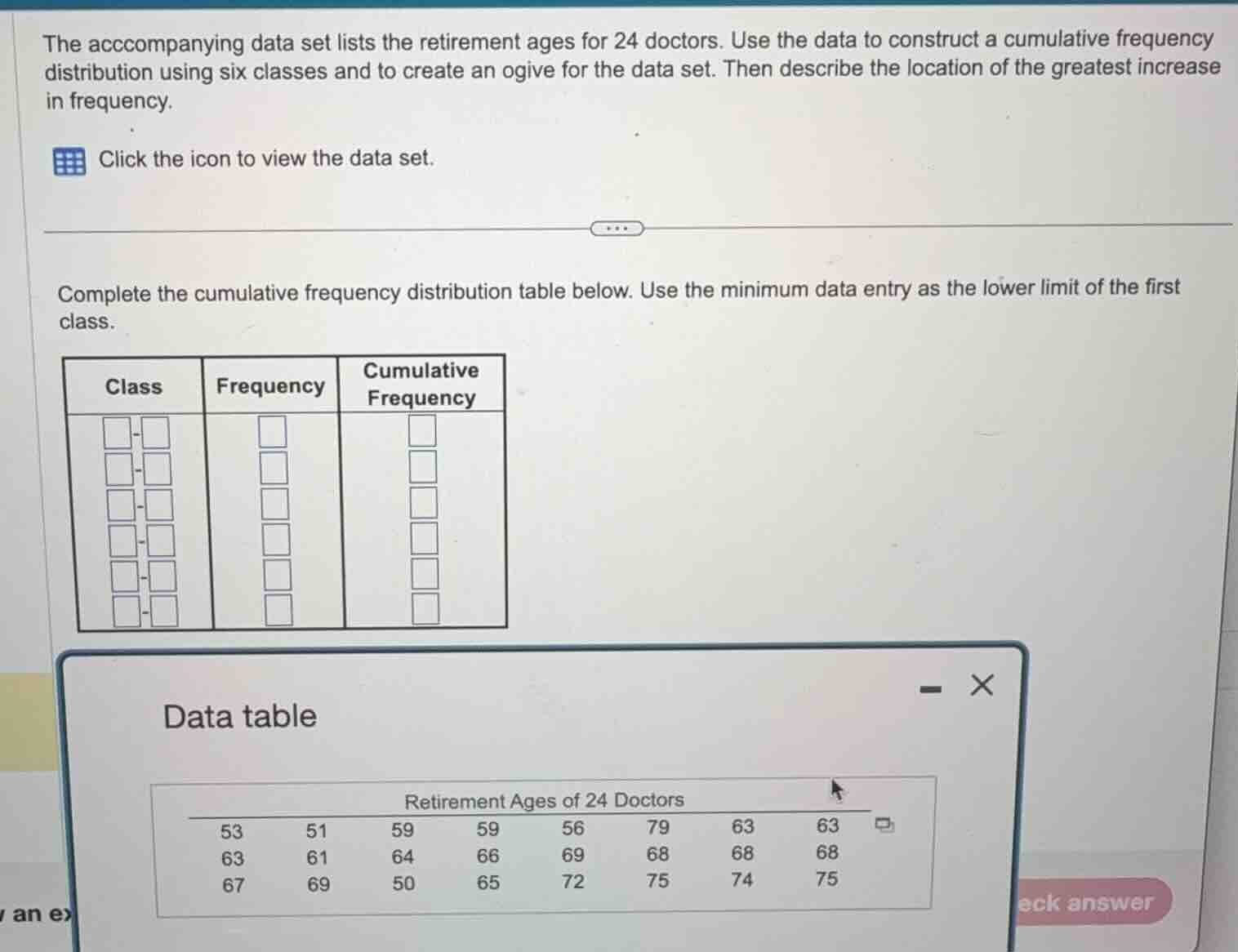
the acccompanying data set lists the retirement ages for 24 doctors. use the data to construct a cumulative frequency distribution using six classes and to create an ogive for the data set. then describe the location of the greatest increase in frequency.
click the icon to view the data set.
complete the cumulative frequency distribution table below. use the minimum data entry as the lower limit of the first class.
retirement ages of 24 doctors
53, 51, 59, 59, 56, 79, 63, 63
63, 61, 64, 66, 69, 68, 68, 68
67, 69, 50, 65, 72, 75, 74, 75
Determine the class width
To construct the frequency distribution, we first find the minimum and maximum values in the data set of 24 retirement ages:
- Minimum value: \(50\)
- Maximum value: \(79\)
Using the Class Width Calculation concept, we calculate the class width for 6 classes:
Rounding up to the next whole number gives a class width of \(5\).
Establish the class limits
Using the Class Limits concept, we start with the minimum value \(50\) as the lower limit of the first class. Since the class width is \(5\), the lower limits of the subsequent classes are found by repeatedly adding \(5\):
- Class 1: \(50\) to \(54\)
- Class 2: \(55\) to \(59\)
- Class 3: \(60\) to \(64\)
- Class 4: \(65\) to \(69\)
- Class 5: \(70\) to \(74\)
- Class 6: \(75\) to \(79\)
Count frequencies for each class
We sort the 24 data points to make counting easier:
\(50, 51, 53, 56, 59, 59, 61, 63, 63, 63, 64, 65, 66, 67, 68, 68, 68, 69, 69, 72, 74, 75, 75, 79\)
Now, we count the number of data points in each class:
- \(50 - 54\): \(50, 51, 53\) (Frequency = \(3\))
- \(55 - 59\): \(56, 59, 59\) (Frequency = \(3\))
- \(60 - 64\): \(61, 63, 63, 63, 64\) (Frequency = \(5\))
- \(65 - 69\): \(65, 66, 67, 68, 68, 68, 69, 69\) (Frequency = \(8\))
- \(70 - 74\): \(72, 74\) (Frequency = \(2\))
- \(75 - 79\): \(75, 75, 79\) (Frequency = \(3\))
Calculate cumulative frequencies
Using the Frequency Distribution concept, we compute the cumulative frequency by adding the frequency of each class to the sum of the frequencies of all previous classes:
- Class 1 (\(50 - 54\)): \(3\)
- Class 2 (\(55 - 59\)): \(3 + 3 = 6\)
- Class 3 (\(60 - 64\)): \(6 + 5 = 11\)
- Class 4 (\(65 - 69\)): \(11 + 8 = 19\)
- Class 5 (\(70 - 74\)): \(19 + 2 = 21\)
- Class 6 (\(75 - 79\)): \(21 + 3 = 24\)

Snap & solve any problem in the app
Get step-by-step solutions on Sovi AI
Photo-based solutions with guided steps
Explore more problems and detailed explanations
| Class | Frequency | Cumulative Frequency |
|---|---|---|
| 55 - 59 | 3 | 6 |
| 60 - 64 | 5 | 11 |
| 65 - 69 | 8 | 19 |
| 70 - 74 | 2 | 21 |
| 75 - 79 | 3 | 24 |