QUESTION IMAGE
Question
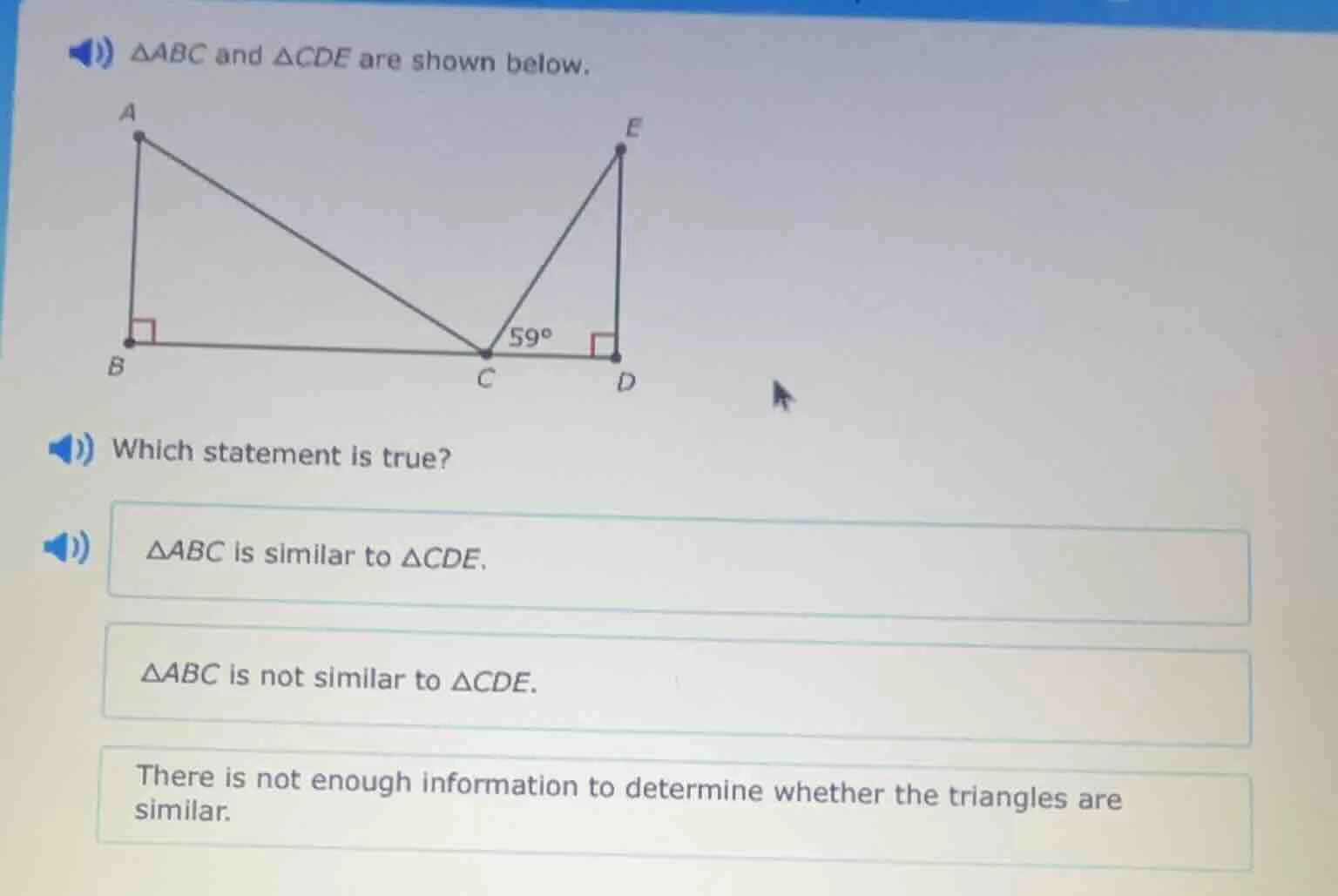
△abc and △cde are shown below.
which statement is true?
△abc is similar to △cde.
△abc is not similar to △cde.
there is not enough information to determine whether the triangles are similar.
Step1: Find the third angle of $\triangle ABC$
In $\triangle ABC$, using the angle - sum property of a triangle ($\angle A+\angle B+\angle ACB = 180^{\circ}$). Given $\angle A = 62^{\circ}$ and $\angle B=41^{\circ}$. Then $\angle ACB=180^{\circ}-(62^{\circ}+41^{\circ})=180^{\circ}-103^{\circ} = 77^{\circ}$. So, $\angle BCA = 77^{\circ}$, and $\angle ACD = 180^{\circ}$ (a straight - line angle). Then $\angle ECD=180^{\circ}-\angle BCA-\angle BCE$. But since we are comparing for similarity, we can also note that the sum of angles in $\triangle CDE$: $\angle D=180^{\circ}-(\angle E+\angle ECD)$.
Another way:
In $\triangle ABC$, $\angle A = 62^{\circ}$, $\angle B = 41^{\circ}$, so $\angle ACB=180-(62 + 41)=77^{\circ}$.
In $\triangle CDE$, $\angle E = 84^{\circ}$.
Since the sides with the red arrows are marked (assuming they are corresponding in a proportion sense for similarity, but more importantly for AA (angle - angle) similarity):
We know that if two angles of one triangle are equal to two angles of another triangle, the triangles are similar.
Let's check the angles:
For $\triangle ABC$: $\angle A = 62^{\circ}$, $\angle B = 41^{\circ}$, $\angle ACB=77^{\circ}$
For $\triangle CDE$: Let's assume the side - marking (the red arrow) implies a correspondence.
We know that $\angle D=180-(84+\angle ECD)$. But if we consider the AA similarity criterion.
Since the two triangles have two pairs of corresponding angles equal (the angles opposite the sides with the red arrows and we can calculate the third angles.
In $\triangle ABC$, $\angle A = 62^{\circ}$, and in $\triangle CDE$, if we assume the correspondence based on the side - marking (the red arrow which usually implies proportional sides in the context of similarity, and also for angle - angle similarity (since the sum of angles in a triangle is $180^{\circ}$).
Let's calculate the third angle of $\triangle ABC$: $\angle ACB=180-(62 + 41)=77^{\circ}$
The third angle of $\triangle CDE$: $\angle D=180-(84 + \angle ECD)$. But since the sides with the red arrows are marked (assuming a correspondence in the order of the triangle names $\triangle ABC$ and $\triangle CDE$ where $\angle A$ corresponds to $\angle D$ (incorrect), but actually, using the AA (angle - angle) similarity:
We know that $\angle BCA$ and $\angle CED$ are not equal. But wait, no, we should use the fact that the sum of angles in a triangle is $180^{\circ}$.
In $\triangle ABC$: $\angle A = 62^{\circ}$, $\angle B = 41^{\circ}$, so $\angle ACB=77^{\circ}$
In $\triangle CDE$: $\angle E = 84^{\circ}$. If we assume the sides with the red arrows (let's say $AB$ corresponds to $CE$ and $AC$ corresponds to $CD$ (by the arrow - marking which is a common notation for similarity in some textbooks, meaning the sides are in proportion).
The sum of angles in $\triangle ABC$: $\angle A+\angle B+\angle ACB = 180^{\circ}$
The sum of angles in $\triangle CDE$: $\angle D+\angle E+\angle ECD = 180^{\circ}$
Since the sides with the red arrows are marked (a visual cue for proportionality which is related to similarity).
Let's use the AA (angle - angle) similarity:
We know that the non - included angles (if we consider the sides with the red arrows as a pair of corresponding sides).
The angles:
In $\triangle ABC$, $\angle A = 62^{\circ}$, $\angle B = 41^{\circ}$
In $\triangle CDE$, if we assume the correspondence based on the side - marking (the red arrow). Let's calculate the third angle of $\triangle CDE$:
Let $\angle D=x$, then $x + 84+\angle ECD=180$. But since the sum of angles in $\triangle ABC$ is $180$ and in $\triangle CDE$ is $180$.
We…
Snap & solve any problem in the app
Get step-by-step solutions on Sovi AI
Photo-based solutions with guided steps
Explore more problems and detailed explanations
$\triangle ABC$ is not similar to $\triangle CDE$.