QUESTION IMAGE
Question
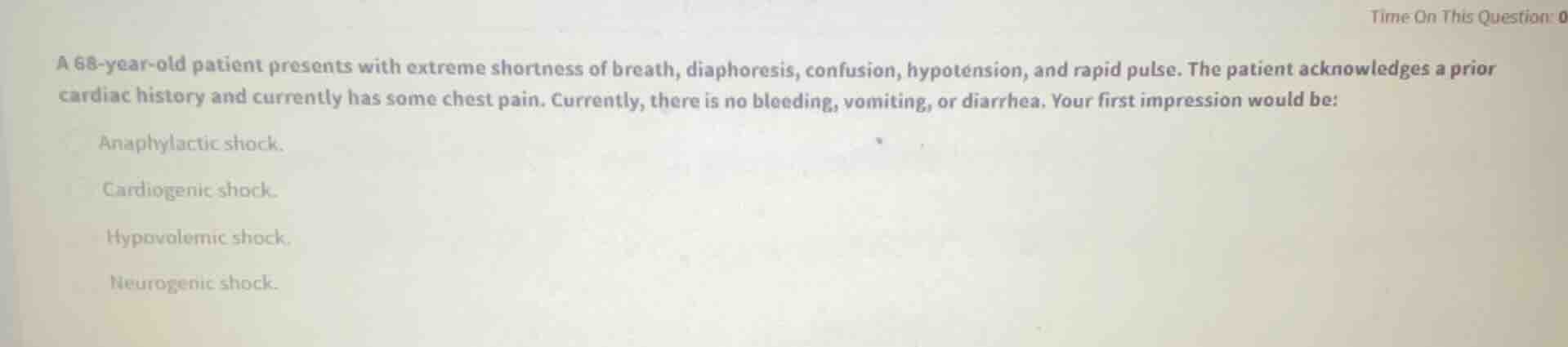
a 68-year-old patient presents with extreme shortness of breath, diaphoresis, confusion, hypotension, and rapid pulse. the patient acknowledges a prior cardiac history and currently has some chest pain. currently, there is no bleeding, vomiting, or diarrhea. your first impression would be:
anaphylactic shock.
cardiogenic shock.
hypovolemic shock.
neurogenic shock.
<pre_analysis>
{
"quality": "clear",
"question_count": 1,
"skills_matched": [
"direct_cot",
"multiple_choice_formatter",
"explain_then_answer",
"tutor",
"mastery_adaptive_brevity"
],
"needs_drawing": false,
"concepts_used": [
"Diaphoresis in Respiratory Distress",
"Hemorrhagic Shock"
],
"new_concepts": [
"Cardiogenic Shock Pathophysiology",
"Shock Classification"
],
"current_concepts": [
"Diaphoresis in Respiratory Distress",
"Hemorrhagic Shock",
"Cardiogenic Shock Pathophysiology",
"Shock Classification"
]
}
</pre_analysis>
<reasoning>
Analyze patient presentation and clinical signs
The patient is a 68-year-old presenting with extreme shortness of breath, confusion, hypotension, rapid pulse, and chest pain. Using the Diaphoresis in Respiratory Distress knowledge point, we recognize that diaphoresis combined with severe dyspnea indicates high sympathetic nervous system activation and critical physiological stress.
Evaluate cardiac history and symptoms
The patient has a prior cardiac history and is currently experiencing chest pain. These findings strongly point to an acute cardiac event, such as a myocardial infarction, leading to pump failure.
Rule out alternative shock etiologies
Using the Hemorrhagic Shock knowledge point, we can rule out hypovolemic shock because there is no history or evidence of active bleeding, vomiting, or diarrhea to cause fluid loss. There are also no signs of anaphylaxis (such as hives or airway swelling) or neurogenic shock (which typically presents with bradycardia and warm, dry skin rather than rapid pulse and diaphoresis).
Formulate the clinical impression
The combination of hypotension, rapid pulse, chest pain, prior cardiac history, and respiratory distress indicates that the heart is failing to pump blood effectively to meet the body's metabolic demands. This presentation is classic for cardiogenic shock.
</reasoning>
<answer>
<mcq-option>Anaphylactic shock.</mcq-option>
<mcq-correct>Cardiogenic shock.</mcq-correct>
<mcq-option>Hypovolemic shock.</mcq-option>
<mcq-option>Neurogenic shock.</mcq-option>
</answer>
<post_analysis>
{
"subject": "Natural Science",
"question_type": "Multiple Choice",
"knowledge_point": [
"Natural Science",
"Medicine",
"Cardiogenic Shock Pathophysiology"
]
}
</post_analysis>
Snap & solve any problem in the app
Get step-by-step solutions on Sovi AI
Photo-based solutions with guided steps
Explore more problems and detailed explanations
<pre_analysis>
{
"quality": "clear",
"question_count": 1,
"skills_matched": [
"direct_cot",
"multiple_choice_formatter",
"explain_then_answer",
"tutor",
"mastery_adaptive_brevity"
],
"needs_drawing": false,
"concepts_used": [
"Diaphoresis in Respiratory Distress",
"Hemorrhagic Shock"
],
"new_concepts": [
"Cardiogenic Shock Pathophysiology",
"Shock Classification"
],
"current_concepts": [
"Diaphoresis in Respiratory Distress",
"Hemorrhagic Shock",
"Cardiogenic Shock Pathophysiology",
"Shock Classification"
]
}
</pre_analysis>
<reasoning>
Analyze patient presentation and clinical signs
The patient is a 68-year-old presenting with extreme shortness of breath, confusion, hypotension, rapid pulse, and chest pain. Using the Diaphoresis in Respiratory Distress knowledge point, we recognize that diaphoresis combined with severe dyspnea indicates high sympathetic nervous system activation and critical physiological stress.
Evaluate cardiac history and symptoms
The patient has a prior cardiac history and is currently experiencing chest pain. These findings strongly point to an acute cardiac event, such as a myocardial infarction, leading to pump failure.
Rule out alternative shock etiologies
Using the Hemorrhagic Shock knowledge point, we can rule out hypovolemic shock because there is no history or evidence of active bleeding, vomiting, or diarrhea to cause fluid loss. There are also no signs of anaphylaxis (such as hives or airway swelling) or neurogenic shock (which typically presents with bradycardia and warm, dry skin rather than rapid pulse and diaphoresis).
Formulate the clinical impression
The combination of hypotension, rapid pulse, chest pain, prior cardiac history, and respiratory distress indicates that the heart is failing to pump blood effectively to meet the body's metabolic demands. This presentation is classic for cardiogenic shock.
</reasoning>
<answer>
<mcq-option>Anaphylactic shock.</mcq-option>
<mcq-correct>Cardiogenic shock.</mcq-correct>
<mcq-option>Hypovolemic shock.</mcq-option>
<mcq-option>Neurogenic shock.</mcq-option>
</answer>
<post_analysis>
{
"subject": "Natural Science",
"question_type": "Multiple Choice",
"knowledge_point": [
"Natural Science",
"Medicine",
"Cardiogenic Shock Pathophysiology"
]
}
</post_analysis>