QUESTION IMAGE
Question
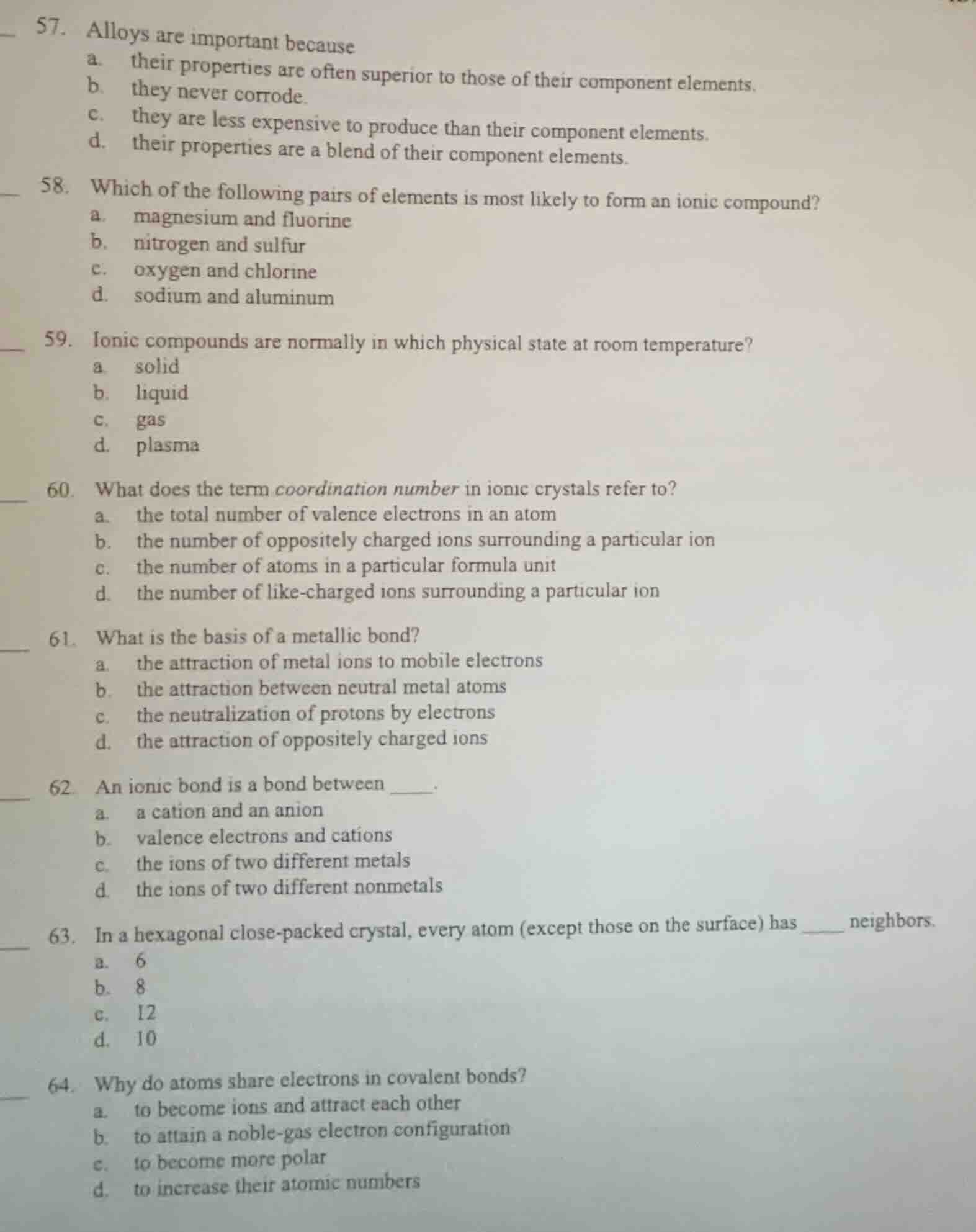
- alloys are important because
a. their properties are often superior to those of their component elements.
b. they never corrode.
c. they are less expensive to produce than their component elements.
d. their properties are a blend of their component elements.
- which of the following pairs of elements is most likely to form an ionic compound?
a. magnesium and fluorine
b. nitrogen and sulfur
c. oxygen and chlorine
d. sodium and aluminum
- ionic compounds are normally in which physical state at room temperature?
a. solid
b. liquid
c. gas
d. plasma
- what does the term coordination number in ionic crystals refer to?
a. the total number of valence electrons in an atom
b. the number of oppositely charged ions surrounding a particular ion
c. the number of atoms in a particular formula unit
d. the number of like-charged ions surrounding a particular ion
- what is the basis of a metallic bond?
a. the attraction of metal ions to mobile electrons
b. the attraction between neutral metal atoms
c. the neutralization of protons by electrons
d. the attraction of oppositely charged ions
- an ionic bond is a bond between ______.
a. a cation and an anion
b. valence electrons and cations
c. the ions of two different metals
d. the ions of two different nonmetals
- in a hexagonal close-packed crystal, every atom (except those on the surface) has ______ neighbors.
a. 6
b. 8
c. 12
d. 10
- why do atoms share electrons in covalent bonds?
a. to become ions and attract each other
b. to attain a noble-gas electron configuration
c. to become more polar
d. to increase their atomic numbers
Analyze questions 57 to 59
Using the Chemical Bonding knowledge point, we evaluate the properties of alloys and ionic compounds:
- Question 57: Alloys are mixtures of metals (or a metal and another element). They are important because their properties (such as strength, hardness, and durability) are often superior to those of their individual component elements. This corresponds to option (a).
- Question 58: Ionic compounds typically form between a metal (which loses electrons to form a cation) and a nonmetal (which gains electrons to form an anion). Magnesium is a metal and fluorine is a nonmetal, making them highly likely to form an ionic compound (\(\text{MgF}_2\)). This corresponds to option (a).
- Question 59: Ionic compounds are held together by strong electrostatic forces in a rigid three-dimensional crystal lattice. Because of these strong attractions, they have high melting points and are normally solids at room temperature. This corresponds to option (a).
Analyze questions 60 to 62
We examine the definitions of coordination number, metallic bonding, and ionic bonding:
- Question 60: In ionic crystals, the coordination number refers to the number of ions of opposite charge that surround a given ion in the crystal lattice. This corresponds to option (b).
- Question 61: A metallic bond is defined as the electrostatic attraction between positively charged metal cations and the surrounding sea of mobile valence electrons. This corresponds to option (a).
- Question 62: An ionic bond is formed by the electrostatic attraction between oppositely charged ions, specifically a positively charged cation and a negatively charged anion. This corresponds to option (a).
Analyze questions 63 and 64
We examine crystal packing and covalent bonding motivations:
- Question 63: In a hexagonal close-packed (hcp) crystal structure, each atom in the interior of the lattice is in direct contact with 12 neighboring atoms (6 in its own plane, 3 in the plane above, and 3 in the plane below). This corresponds to option (c).
- Question 64: Atoms share electrons in covalent bonds to achieve a stable valence electron shell, which typically means attaining a stable noble-gas electron configuration (the octet rule). This corresponds to option (b).

Snap & solve any problem in the app
Get step-by-step solutions on Sovi AI
Photo-based solutions with guided steps
Explore more problems and detailed explanations
Question 57
- a. their properties are often superior to those of their component elements. (Correct answer)
- b. they never corrode.
- c. they are less expensive to produce than their component elements.
- d. their properties are a blend of their component elements.
Question 58
- a. magnesium and fluorine (Correct answer)
- b. nitrogen and sulfur
- c. oxygen and chlorine
- d. sodium and aluminum
Question 59
- a. solid (Correct answer)
- b. liquid
- c. gas
- d. plasma
Question 60
- a. the total number of valence electrons in an atom
- b. the number of oppositely charged ions surrounding a particular ion (Correct answer)
- c. the number of atoms in a particular formula unit
- d. the number of like-charged ions surrounding a particular ion
Question 61
- a. the attraction of metal ions to mobile electrons (Correct answer)
- b. the attraction between neutral metal atoms
- c. the neutralization of protons by electrons
- d. the attraction of oppositely charged ions
Question 62
- a. a cation and an anion (Correct answer)
- b. valence electrons and cations
- c. the ions of two different metals
- d. the ions of two different nonmetals
Question 63
- a. 6
- b. 8
- c. 12 (Correct answer)
- d. 10
Question 64
- a. to become ions and attract each other
- b. to attain a noble-gas electron configuration (Correct answer)
- c. to become more polar
- d. to increase their atomic numbers