Sovi.AI - AI Math Tutor

Scan to solve math questions

QUESTION IMAGE

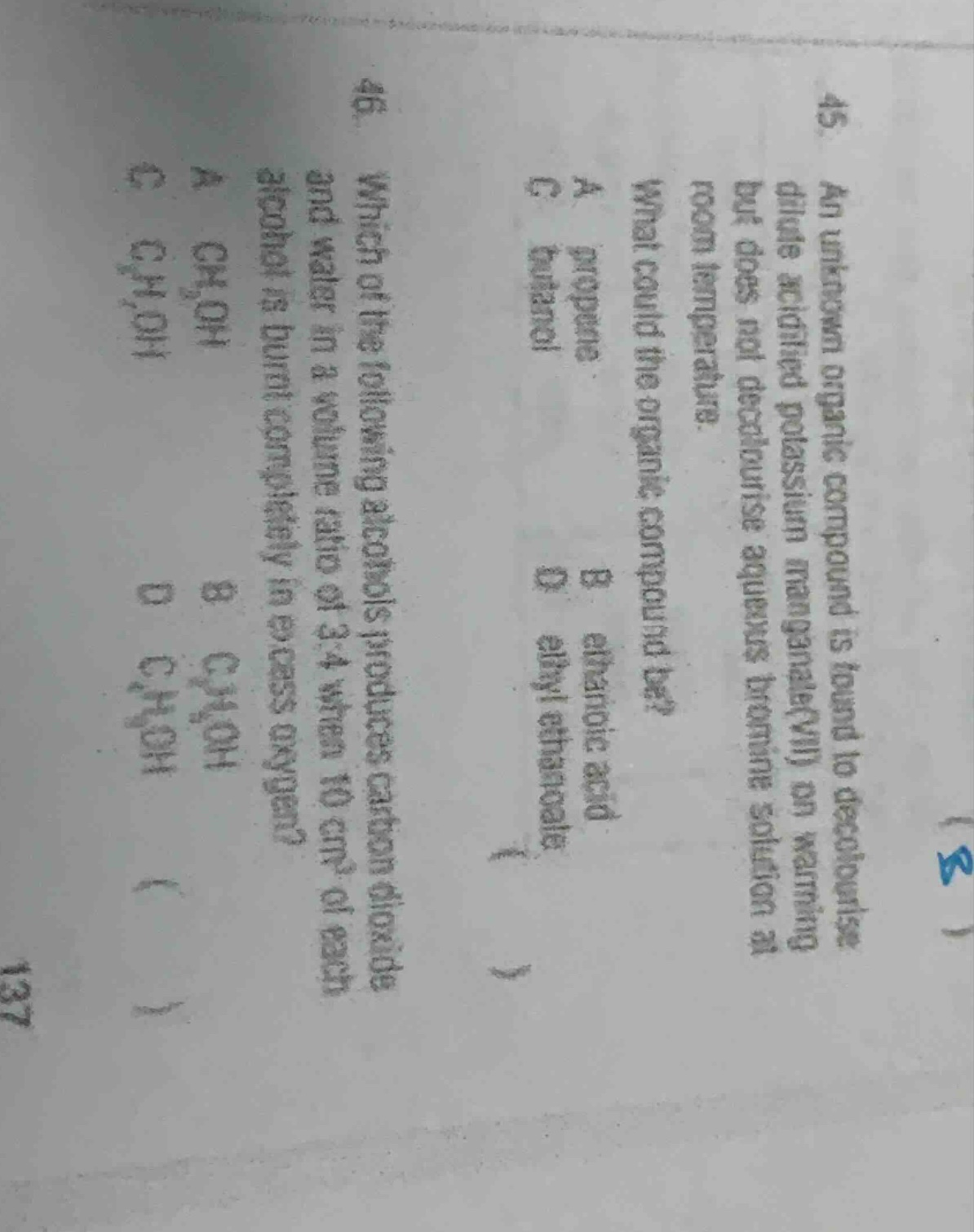
45. an unknown organic compound is found to decolourise dilute acidifie…

Question

  1. an unknown organic compound is found to decolourise dilute acidified potassium manganate(vii) on warming but does not decolourise aqueous bromine solution at room temperature.

what could the organic compound be?
a propene
b ethanoic acid
c butanol
d ethyl ethanoate

  1. which of the following alcohols produces carbon dioxide and water in a volume ratio of 3:4 when 10 cm³ of each alcohol is burnt completely in excess oxygen?

a ch₃oh
b c₂h₅oh
c c₃h₇oh
d c₄h₉oh

Explanation:

Response

<pre_analysis>
{
"quality": "clear",
"question_count": 2,
"skills_matched": [
"step_cot",
"multiple_choice_formatter",
"explain_then_answer",
"tutor"
],
"needs_drawing": false,
"concepts_used": [
"Alcohol Oxidation",
"Properties of Alcohols"
],
"new_concepts": [
"Combustion of Alcohols",
"Organic Qualitative Analysis"
],
"current_concepts": [
"Alcohol Oxidation",
"Properties of Alcohols",
"Combustion of Alcohols",
"Organic Qualitative Analysis"
]
}
</pre_analysis>

<reasoning>

Analyze Question 45

Using the Alcohol Oxidation and Properties of Alcohols knowledge points:

  • The unknown compound decolourises dilute acidified potassium manganate(VII) on warming. This indicates the compound can be oxidized. Primary and secondary alcohols (like butanol) can be oxidized, whereas alkanes (like propane), carboxylic acids (like ethanoic acid), and esters (like ethyl ethanoate) are resistant to oxidation under these conditions.
  • The compound does not decolourise aqueous bromine solution at room temperature. This indicates the absence of carbon-carbon double bonds (\(\text{C}=\text{C}\)), meaning it is saturated.
  • Among the options:
  • A (propane): Alkane, does not decolourise acidified \(\text{KMnO}_4\).
  • B (ethanoic acid): Carboxylic acid, resistant to oxidation.
  • C (butanol): Alcohol, oxidized by acidified \(\text{KMnO}_4\) on warming, saturated (no reaction with aqueous bromine).
  • D (ethyl ethanoate): Ester, resistant to oxidation.
  • Therefore, the compound is butanol (C).

Write combustion equation for Question 46

Using the Properties of Alcohols knowledge point:

  • The general formula for a saturated monohydric alcohol is \(\text{C}_n\text{H}_{2n+1}\text{OH}\).
  • The complete combustion equation is:

\[
\text{C}_n\text{H}_{2n+1}\text{OH} + \frac{3n}{2}\text{O}_2
ightarrow n\text{CO}_2 + (n+1)\text{H}_2\text{O}
\]

  • According to Avogadro's Law, the volume ratio of gases at the same temperature and pressure is equal to their mole ratio.
  • The volume ratio of \(\text{CO}_2\) to \(\text{H}_2\text{O}\) produced is given as \(3:4\).

Solve for the carbon number \(n\)

Using the Properties of Alcohols knowledge point:

  • Set up the ratio of the coefficients of \(\text{CO}_2\) and \(\text{H}_2\text{O}\):

\[
\frac{n}{n+1} = \frac{3}{4}
\]

  • Cross-multiplying gives:

\[
4n = 3(n+1) \implies 4n = 3n + 3 \implies n = 3
\]

  • The alcohol has 3 carbon atoms, which corresponds to propanol, \(\text{C}_3\text{H}_7\text{OH}\).

Match with the options for Question 46

Using the Properties of Alcohols knowledge point:

  • Let's check the options:
  • A: \(\text{CH}_3\text{OH}\) (\(n=1\))
  • B: \(\text{C}_3\text{H}_7\text{OH}\) (\(n=3\))
  • C: \(\text{C}_2\text{H}_5\text{OH}\) (\(n=2\))
  • D: \(\text{C}_4\text{H}_9\text{OH}\) (\(n=4\))
  • The matching formula is \(\text{C}_3\text{H}_7\text{OH}\) (B).

</reasoning>

<answer>

Question 45

<mcq-option>(A) propane</mcq-option>
<mcq-option>(B) ethanoic acid</mcq-option>
<mcq-correct>(C) butanol</mcq-correct>
<mcq-option>(D) ethyl ethanoate</mcq-option>

Question 46

<mcq-option>(A) \(\text{CH}_3\text{OH}\)</mcq-option>
<mcq-correct>(B) \(\text{C}_3\text{H}_7\text{OH}\)</mcq-correct>
<mcq-option>(C) \(\text{C}_2\text{H}_5\text{OH}\)</mcq-option>
<mcq-option>(D) \(\text{C}_4\text{H}_9\text{OH}\)</mcq-option>
</answer>

<post_analysis>
{
"subject": "Natural Science",
"question_type": "Multiple Choice",
"knowledge_point": [
"Natural Science",
"Chemistry",
"Organic Chemistry"…

Answer:

<pre_analysis>
{
"quality": "clear",
"question_count": 2,
"skills_matched": [
"step_cot",
"multiple_choice_formatter",
"explain_then_answer",
"tutor"
],
"needs_drawing": false,
"concepts_used": [
"Alcohol Oxidation",
"Properties of Alcohols"
],
"new_concepts": [
"Combustion of Alcohols",
"Organic Qualitative Analysis"
],
"current_concepts": [
"Alcohol Oxidation",
"Properties of Alcohols",
"Combustion of Alcohols",
"Organic Qualitative Analysis"
]
}
</pre_analysis>

<reasoning>

Analyze Question 45

Using the Alcohol Oxidation and Properties of Alcohols knowledge points:

  • The unknown compound decolourises dilute acidified potassium manganate(VII) on warming. This indicates the compound can be oxidized. Primary and secondary alcohols (like butanol) can be oxidized, whereas alkanes (like propane), carboxylic acids (like ethanoic acid), and esters (like ethyl ethanoate) are resistant to oxidation under these conditions.
  • The compound does not decolourise aqueous bromine solution at room temperature. This indicates the absence of carbon-carbon double bonds (\(\text{C}=\text{C}\)), meaning it is saturated.
  • Among the options:
  • A (propane): Alkane, does not decolourise acidified \(\text{KMnO}_4\).
  • B (ethanoic acid): Carboxylic acid, resistant to oxidation.
  • C (butanol): Alcohol, oxidized by acidified \(\text{KMnO}_4\) on warming, saturated (no reaction with aqueous bromine).
  • D (ethyl ethanoate): Ester, resistant to oxidation.
  • Therefore, the compound is butanol (C).

Write combustion equation for Question 46

Using the Properties of Alcohols knowledge point:

  • The general formula for a saturated monohydric alcohol is \(\text{C}_n\text{H}_{2n+1}\text{OH}\).
  • The complete combustion equation is:

\[
\text{C}_n\text{H}_{2n+1}\text{OH} + \frac{3n}{2}\text{O}_2
ightarrow n\text{CO}_2 + (n+1)\text{H}_2\text{O}
\]

  • According to Avogadro's Law, the volume ratio of gases at the same temperature and pressure is equal to their mole ratio.
  • The volume ratio of \(\text{CO}_2\) to \(\text{H}_2\text{O}\) produced is given as \(3:4\).

Solve for the carbon number \(n\)

Using the Properties of Alcohols knowledge point:

  • Set up the ratio of the coefficients of \(\text{CO}_2\) and \(\text{H}_2\text{O}\):

\[
\frac{n}{n+1} = \frac{3}{4}
\]

  • Cross-multiplying gives:

\[
4n = 3(n+1) \implies 4n = 3n + 3 \implies n = 3
\]

  • The alcohol has 3 carbon atoms, which corresponds to propanol, \(\text{C}_3\text{H}_7\text{OH}\).

Match with the options for Question 46

Using the Properties of Alcohols knowledge point:

  • Let's check the options:
  • A: \(\text{CH}_3\text{OH}\) (\(n=1\))
  • B: \(\text{C}_3\text{H}_7\text{OH}\) (\(n=3\))
  • C: \(\text{C}_2\text{H}_5\text{OH}\) (\(n=2\))
  • D: \(\text{C}_4\text{H}_9\text{OH}\) (\(n=4\))
  • The matching formula is \(\text{C}_3\text{H}_7\text{OH}\) (B).

</reasoning>

<answer>

Question 45

<mcq-option>(A) propane</mcq-option>
<mcq-option>(B) ethanoic acid</mcq-option>
<mcq-correct>(C) butanol</mcq-correct>
<mcq-option>(D) ethyl ethanoate</mcq-option>

Question 46

<mcq-option>(A) \(\text{CH}_3\text{OH}\)</mcq-option>
<mcq-correct>(B) \(\text{C}_3\text{H}_7\text{OH}\)</mcq-correct>
<mcq-option>(C) \(\text{C}_2\text{H}_5\text{OH}\)</mcq-option>
<mcq-option>(D) \(\text{C}_4\text{H}_9\text{OH}\)</mcq-option>
</answer>

<post_analysis>
{
"subject": "Natural Science",
"question_type": "Multiple Choice",
"knowledge_point": [
"Natural Science",
"Chemistry",
"Organic Chemistry"
]
}
</post_analysis>