QUESTION IMAGE
Question
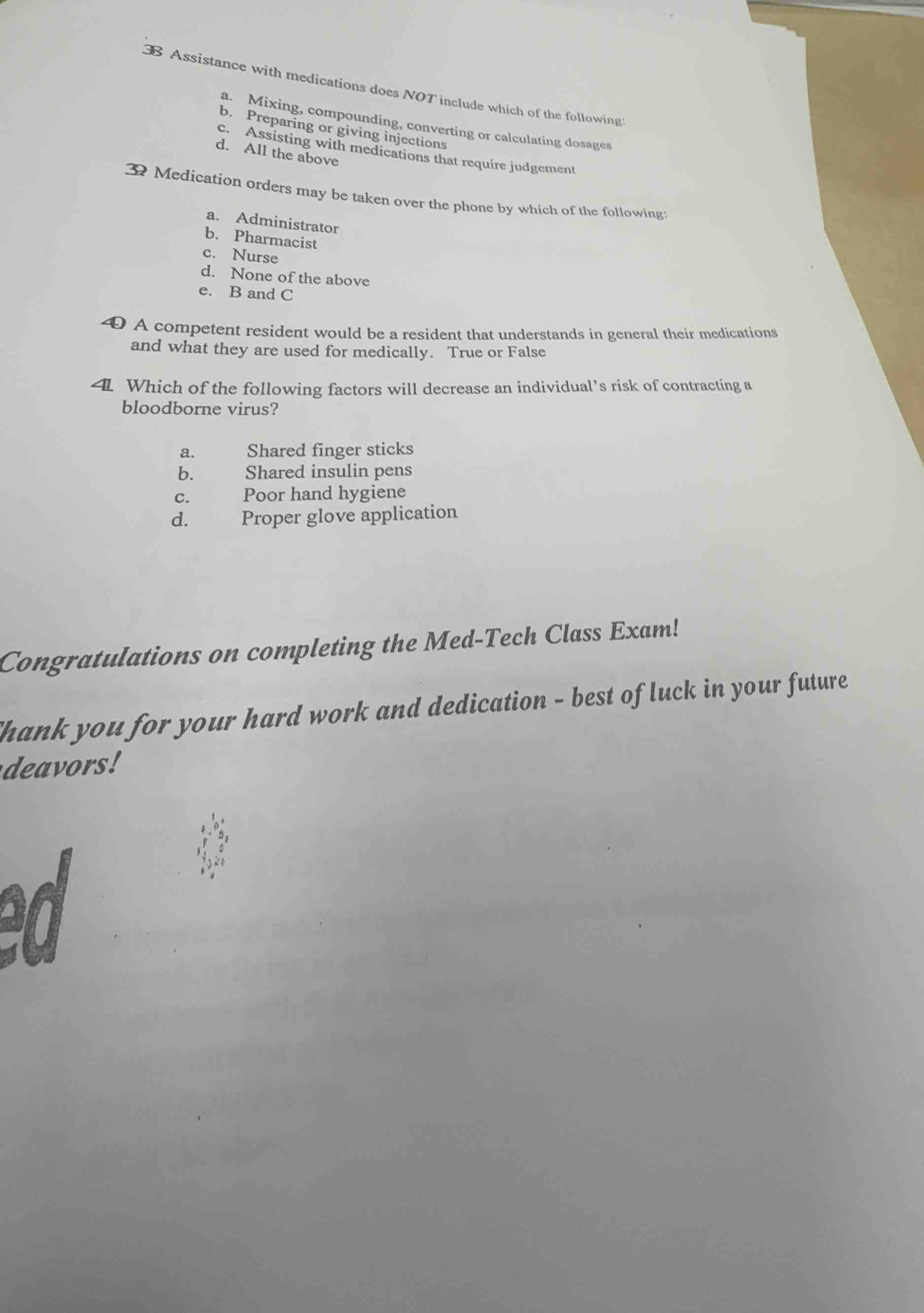
38 assistance with medications does not include which of the following:
a. mixing, compounding, converting or calculating dosages
b. preparing or giving injections
c. assisting with medications that require judgement
d. all the above
39 medication orders may be taken over the phone by which of the following:
a. administrator
b. pharmacist
c. nurse
d. none of the above
e. b and c
40 a competent resident would be a resident that understands in general their medications and what they are used for medically. true or false
41 which of the following factors will decrease an individuals risk of contracting a bloodborne virus?
a. shared finger sticks
b. shared insulin pens
c. poor hand hygiene
d. proper glove application
Analyze assistance with medications scope
Using the Medication Assistance Scope knowledge point, assistance with medications is strictly limited to non-discretionary, supportive tasks. It does not include tasks requiring professional clinical judgment, calculation, or invasive administration.
- Option (a) "Mixing, compounding, converting or calculating dosages" requires clinical calculation.
- Option (b) "Preparing or giving injections" involves invasive administration.
- Option (c) "Assisting with medications that require judgement" requires clinical judgment.
Therefore, none of these are included in assistance, making "All the above" the correct choice.
Analyze telephone medication orders
Using the Medication Administration knowledge point, taking medication orders over the phone requires professional licensure to ensure accuracy and safety.
- Administrators without clinical licenses cannot take medical orders.
- Licensed pharmacists and licensed nurses are authorized to receive verbal or telephone orders.
Therefore, both pharmacists and nurses can take these orders, making "B and C" the correct choice.
Analyze resident competency definition
A competent resident in this context is defined as one who understands their medications, including what they are and their medical purpose. This aligns with standard care protocols, making the statement true.
Analyze bloodborne virus risk reduction
Using the Medication Safety Protocols knowledge point, preventing the transmission of bloodborne pathogens requires strict infection control.
- Sharing finger sticks or insulin pens directly transmits blood.
- Poor hand hygiene increases contamination risks.
- Proper glove application acts as a protective barrier, decreasing risk.

Snap & solve any problem in the app
Get step-by-step solutions on Sovi AI
Photo-based solutions with guided steps
Explore more problems and detailed explanations
Question 38
- a. Mixing, compounding, converting or calculating dosages
- b. Preparing or giving injections
- c. Assisting with medications that require judgement
- d. All the above (Correct answer)
Question 39
- a. Administrator
- b. Pharmacist
- c. Nurse
- d. None of the above
- e. B and C (Correct answer)
Question 40
- True (Correct answer)
- False
Question 41
- a. Shared finger sticks
- b. Shared insulin pens
- c. Poor hand hygiene
- d. Proper glove application (Correct answer)