QUESTION IMAGE
Question
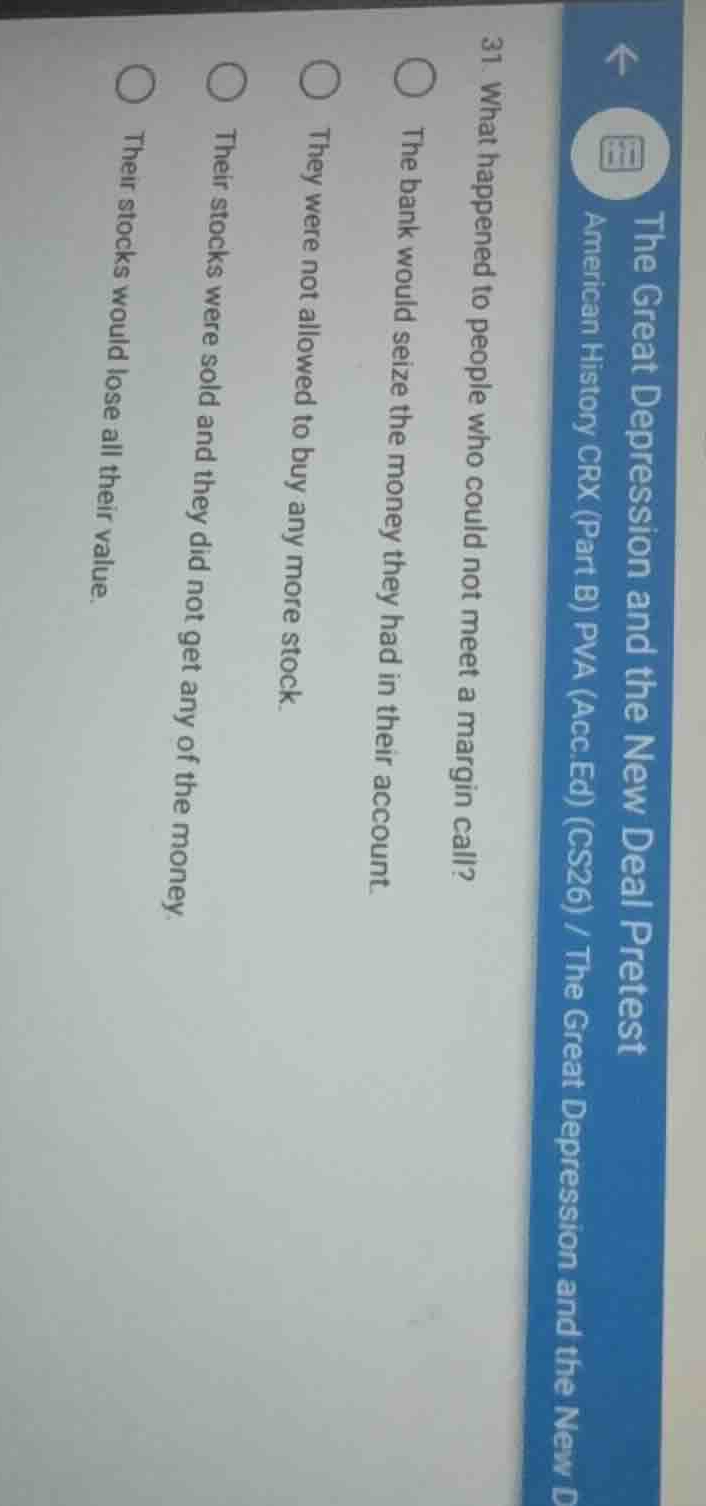
- what happened to people who could not meet a margin call?
the bank would seize the money they had in their account.
they were not allowed to buy any more stock.
their stocks were sold and they did not get any of the money.
their stocks would lose all their value.
<pre_analysis>
{
"quality": "clear",
"question_count": 1,
"skills_matched": [
"direct_cot",
"multiple_choice_formatter",
"explain_then_answer",
"tutor",
"mastery_adaptive_brevity"
],
"needs_drawing": false,
"concepts_used": [
"Buying on Margin"
],
"new_concepts": [
"Margin Call Consequences"
],
"current_concepts": [
"Buying on Margin",
"Margin Call Consequences",
"Stock Market Speculation"
]
}
</pre_analysis>
<reasoning>
Understand the concept of buying on margin
Using the Buying on Margin knowledge point
Buying on margin means purchasing stocks with borrowed money from a broker. The investor puts down a small percentage of the stock's value and borrows the rest, using the purchased stock as collateral for the loan.
Analyze the mechanism of a margin call
If the stock price falls below a certain level, the broker issues a "margin call." This requires the investor to immediately deposit more cash or securities into the account to cover the potential loss and bring the account back to the minimum maintenance margin.
Determine the consequences of failing to meet a margin call
If the investor cannot meet the margin call (i.e., they do not have the cash to deposit), the broker has the legal right to sell the investor's stocks immediately to recoup the borrowed funds. Because the stock is sold to pay off the debt owed to the broker, the investor does not receive any of the proceeds from this forced sale.
</reasoning>
<answer>
<mcq-option>The bank would seize the money they had in their account.</mcq-option>
<mcq-option>They were not allowed to buy any more stock.</mcq-option>
<mcq-correct>Their stocks were sold and they did not get any of the money.</mcq-correct>
<mcq-option>Their stocks would lose all their value.</mcq-option>
</answer>
<post_analysis>
{
"subject": "Social Science",
"question_type": "Multiple Choice",
"knowledge_point": [
"Social Science",
"US History",
"Great Depression Economics"
]
}
</post_analysis>
Snap & solve any problem in the app
Get step-by-step solutions on Sovi AI
Photo-based solutions with guided steps
Explore more problems and detailed explanations
<pre_analysis>
{
"quality": "clear",
"question_count": 1,
"skills_matched": [
"direct_cot",
"multiple_choice_formatter",
"explain_then_answer",
"tutor",
"mastery_adaptive_brevity"
],
"needs_drawing": false,
"concepts_used": [
"Buying on Margin"
],
"new_concepts": [
"Margin Call Consequences"
],
"current_concepts": [
"Buying on Margin",
"Margin Call Consequences",
"Stock Market Speculation"
]
}
</pre_analysis>
<reasoning>
Understand the concept of buying on margin
Using the Buying on Margin knowledge point
Buying on margin means purchasing stocks with borrowed money from a broker. The investor puts down a small percentage of the stock's value and borrows the rest, using the purchased stock as collateral for the loan.
Analyze the mechanism of a margin call
If the stock price falls below a certain level, the broker issues a "margin call." This requires the investor to immediately deposit more cash or securities into the account to cover the potential loss and bring the account back to the minimum maintenance margin.
Determine the consequences of failing to meet a margin call
If the investor cannot meet the margin call (i.e., they do not have the cash to deposit), the broker has the legal right to sell the investor's stocks immediately to recoup the borrowed funds. Because the stock is sold to pay off the debt owed to the broker, the investor does not receive any of the proceeds from this forced sale.
</reasoning>
<answer>
<mcq-option>The bank would seize the money they had in their account.</mcq-option>
<mcq-option>They were not allowed to buy any more stock.</mcq-option>
<mcq-correct>Their stocks were sold and they did not get any of the money.</mcq-correct>
<mcq-option>Their stocks would lose all their value.</mcq-option>
</answer>
<post_analysis>
{
"subject": "Social Science",
"question_type": "Multiple Choice",
"knowledge_point": [
"Social Science",
"US History",
"Great Depression Economics"
]
}
</post_analysis>