QUESTION IMAGE
Question
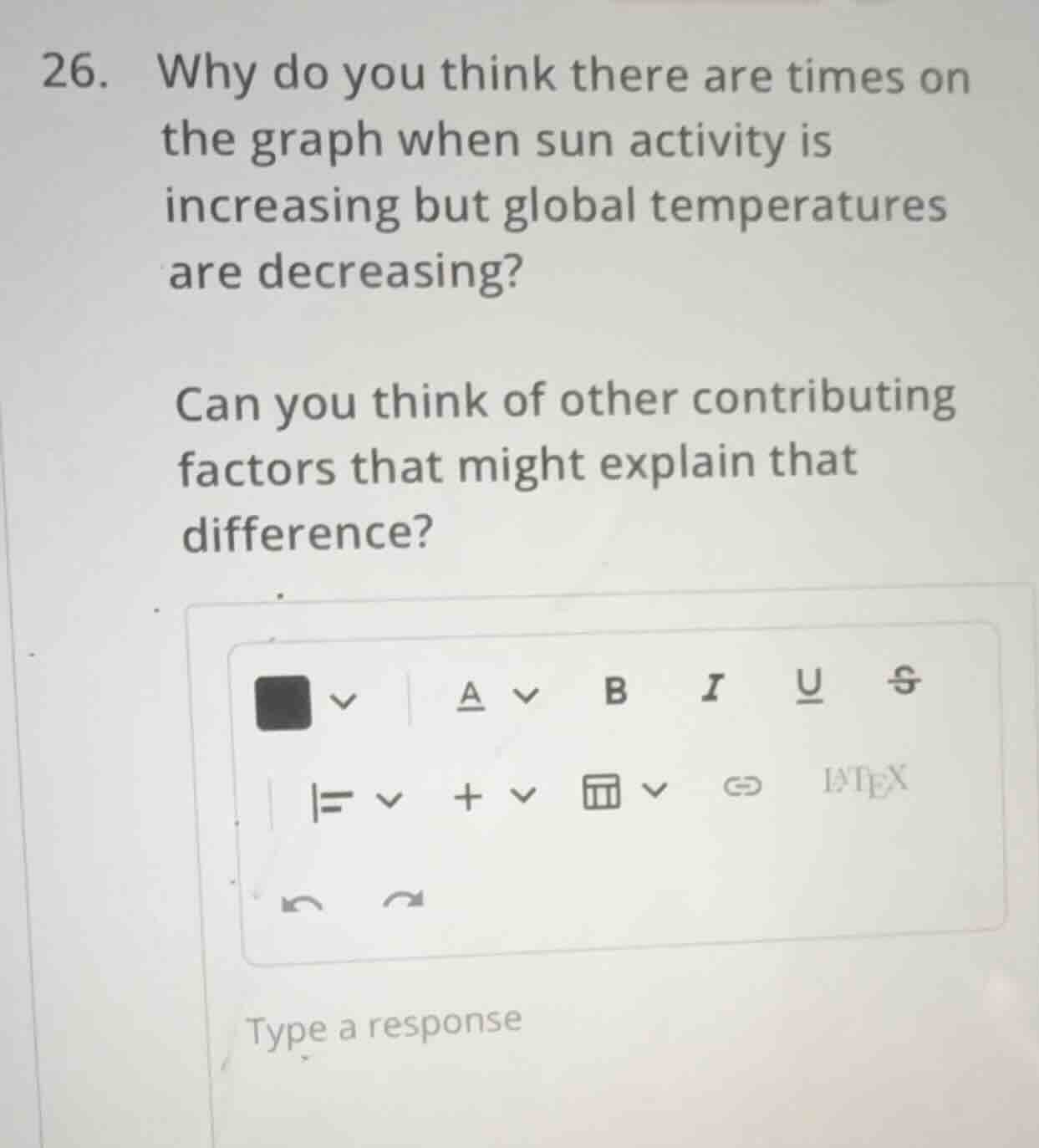
- why do you think there are times on the graph when sun activity is increasing but global temperatures are decreasing?
can you think of other contributing factors that might explain that difference?
Analyze the divergence
The question asks why global temperatures might decrease even when sun activity (solar irradiance) is increasing. This indicates that Solar Forcing is not the sole driver of Earth's climate system.
Identify other factors
Other natural and anthropogenic factors can override solar influence:
- Volcanic eruptions: Large eruptions release aerosols that reflect sunlight, causing short-term cooling.
- Greenhouse gases: Rising greenhouse gas concentrations trap heat, but complex climate feedbacks can cause regional or temporary cooling trends.
- Aerosols and pollution: Industrial sulfate aerosols reflect incoming solar radiation, leading to a cooling effect that can temporarily mask solar warming.
- Internal climate variability: Decadal oscillations in ocean currents (like El Niño/La Niña or the Pacific Decadal Oscillation) redistribute heat and alter global surface temperatures independently of solar output.

Snap & solve any problem in the app
Get step-by-step solutions on Sovi AI
Photo-based solutions with guided steps
Explore more problems and detailed explanations
Times when solar activity increases but global temperatures decrease occur because solar activity is only one of several factors influencing Earth's climate. Other contributing factors that can override solar forcing to cause cooling include:
- Volcanic Activity: Major volcanic eruptions inject sulfur dioxide aerosols into the stratosphere, which reflect incoming sunlight back into space and cause temporary global cooling.
- Atmospheric Aerosols: Industrial pollution and natural aerosols (like dust and sea spray) reflect solar radiation, creating a cooling effect that can temporarily offset solar warming.
- Oceanic Circulation: Internal climate cycles, such as El Niño-Southern Oscillation (ENSO) phases or the Pacific Decadal Oscillation (PDO), redistribute heat between the deep ocean and the atmosphere, temporarily lowering global surface temperatures.
- Greenhouse Gas Dynamics and Feedbacks: Complex feedback loops, such as changes in cloud cover or ice-albedo feedbacks, can alter how much heat is retained or reflected by the planet.