QUESTION IMAGE
Question
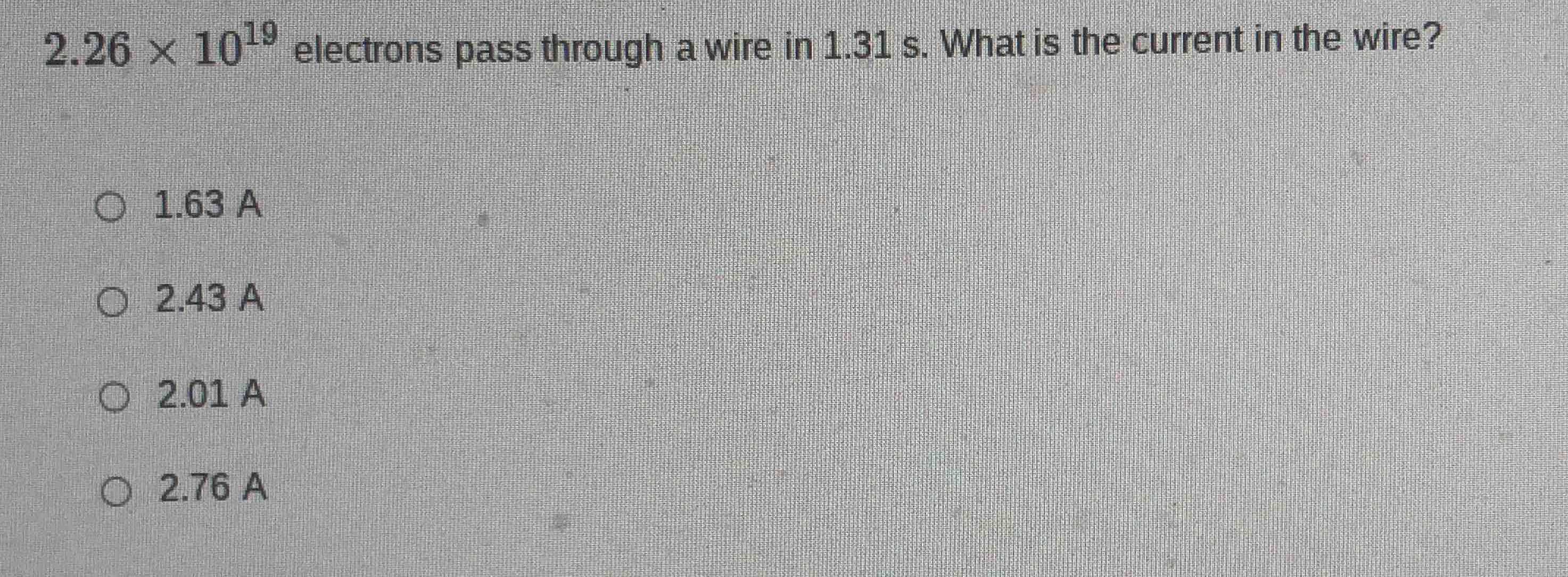
2.26 \times 10^{19} electrons pass through a wire in 1.31 s. what is the current in the wire?
1.63 a
2.43 a
2.01 a
2.76 a
Identify the given values and target variable
We are given the following values from the problem statement:
- Number of electrons, \(N = 2.26 \times 10^{19}\)
- Time interval, \(\Delta t = 1.31\text{ s}\)
We need to find the electric current, \(I\), in the wire.
Relate electric current to charge and time
Electric current is defined as the rate at which electric charge flows past a point in a circuit:
where \(\Delta Q\) is the total charge that passes through the cross-section of the wire in time \(\Delta t\).
Calculate the total charge
The total charge \(\Delta Q\) is quantized and is equal to the number of electrons \(N\) multiplied by the elementary charge \(e\), which is the charge of a single electron:
Using this constant, we calculate the total charge:
Calculate the electric current
Now, we substitute the total charge \(\Delta Q\) and the time interval \(\Delta t\) into our current formula:
Rounding to three significant figures, we get:
Match with the given options
Comparing our calculated value of \(2.76\text{ A}\) with the multiple-choice options:
- \(1.63\text{ A}\)
- \(2.43\text{ A}\)
- \(2.01\text{ A}\)
- \(2.76\text{ A}\)
The correct option is \(2.76\text{ A}\).

Snap & solve any problem in the app
Get step-by-step solutions on Sovi AI
Photo-based solutions with guided steps
Explore more problems and detailed explanations
- (A) 1.63 A
- (B) 2.43 A
- (C) 2.01 A
- (D) 2.76 A (Correct answer)