QUESTION IMAGE
Question
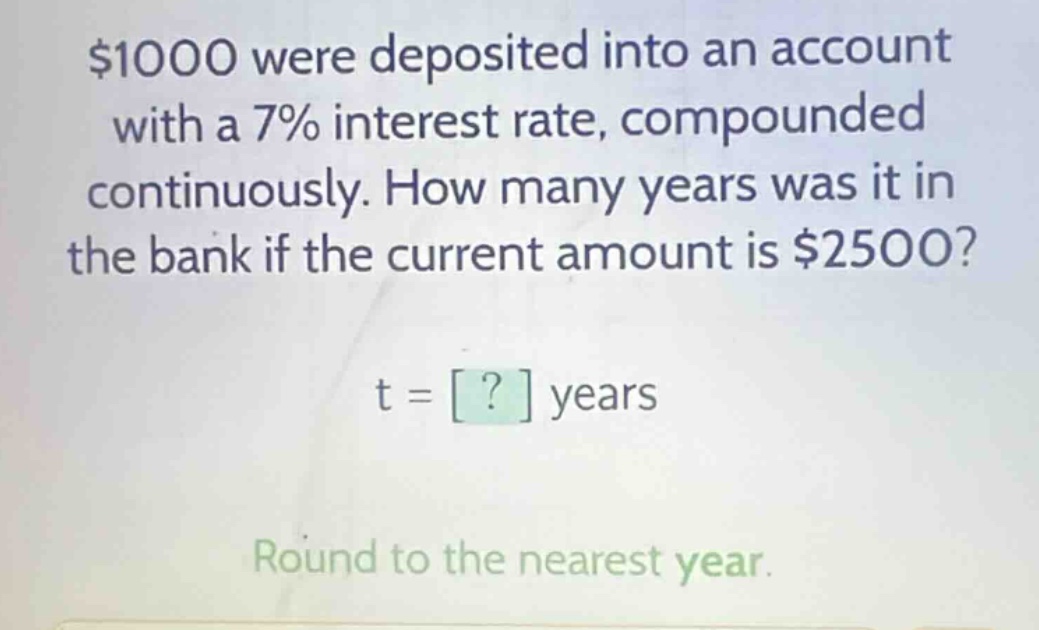
$1000 were deposited into an account with a 7% interest rate, compounded continuously. how many years was it in the bank if the current amount is $2500? t = ? years round to the nearest year.
Step1: Recall the formula for continuous compounding
The formula for continuous compounding is $A = Pe^{rt}$, where $A$ is the final amount, $P$ is the principal amount, $r$ is the annual interest rate (in decimal), and $t$ is the time in years.
We know $P = 1000$, $A = 2500$, and $r = 0.07$ (since 7% = 0.07). We need to solve for $t$.
Step2: Substitute the known values into the formula
Substitute $A = 2500$, $P = 1000$, and $r = 0.07$ into the formula $A = Pe^{rt}$:
$$2500 = 1000e^{0.07t}$$
Step3: Divide both sides by 1000
Divide both sides of the equation by 1000 to simplify:
$$\frac{2500}{1000}=e^{0.07t}$$
$$2.5 = e^{0.07t}$$
Step4: Take the natural logarithm of both sides
Take the natural logarithm (ln) of both sides to solve for the exponent. Recall that $\ln(e^x)=x$.
$$\ln(2.5)=\ln(e^{0.07t})$$
$$\ln(2.5) = 0.07t$$
Step5: Solve for t
Divide both sides by 0.07 to solve for $t$:
$$t=\frac{\ln(2.5)}{0.07}$$
Calculate $\ln(2.5)\approx0.9163$, then:
$$t=\frac{0.9163}{0.07}\approx13.09$$
Round to the nearest year, so $t\approx13$.

Snap & solve any problem in the app
Get step-by-step solutions on Sovi AI
Photo-based solutions with guided steps
Explore more problems and detailed explanations
13