QUESTION IMAGE
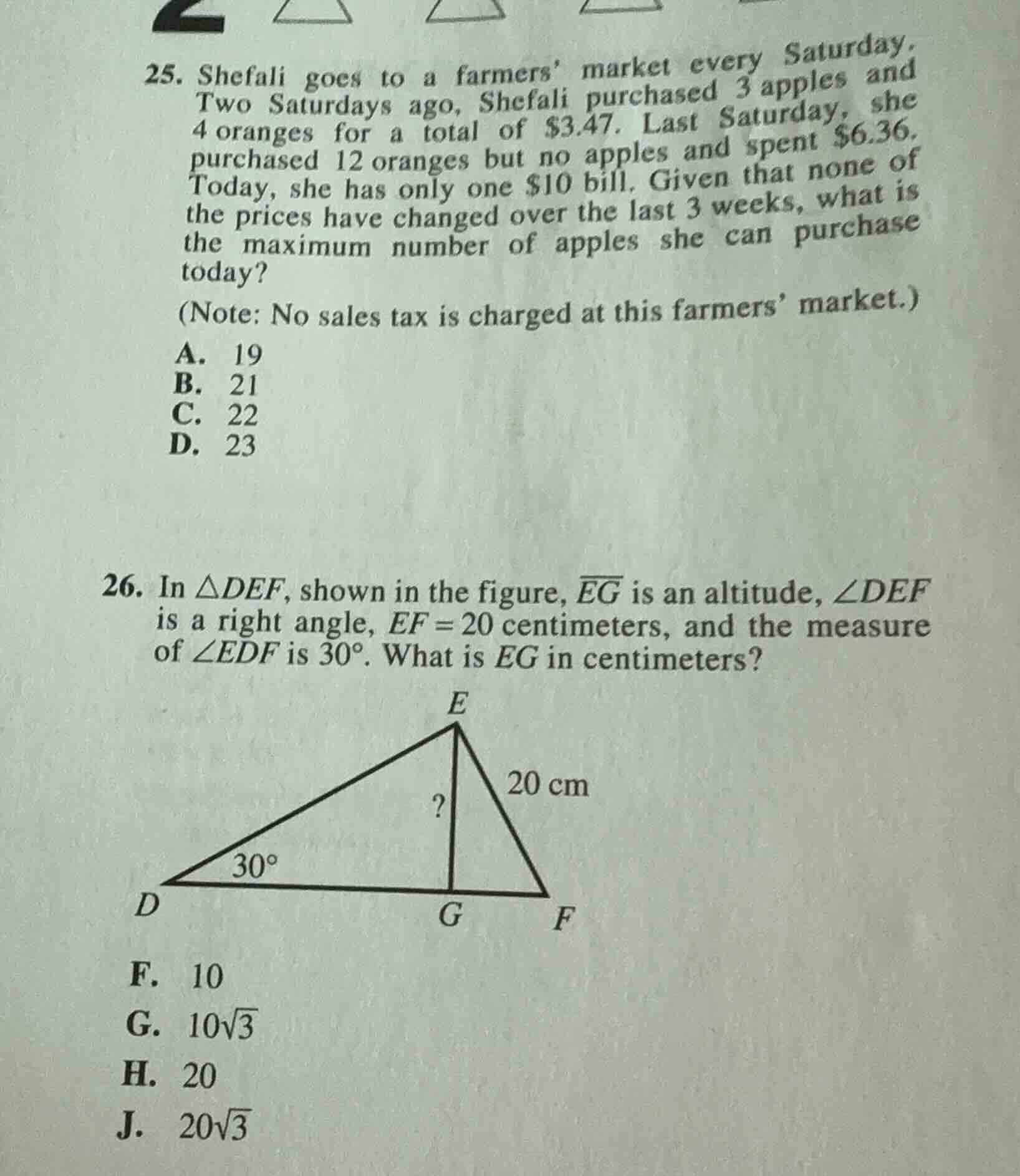
Question
- shefali goes to a farmers market every saturday. two saturdays ago, shefali purchased 3 apples and 4 oranges for a total of \\$3.47. last saturday, she purchased 12 oranges but no apples and spent \\$6.36. today, she has only one \\$10 bill. given that none of the prices have changed over the last 3 weeks, what is the maximum number of apples she can purchase today?
(note: no sales tax is charged at this farmers market.)
a. 19
b. 21
c. 22
d. 23
- in \\(\triangle def\\), shown in the figure, \\(\overline{eg}\\) is an altitude, \\(\angle def\\) is a right angle, \\(ef = 20\\) centimeters, and the measure of \\(\angle edf\\) is \\(30^\circ\\). what is \\(eg\\) in centimeters?
f. 10
g. \\(10\sqrt{3}\\)
h. 20
j. \\(20\sqrt{3}\\)
Solve the system of equations for Question 25
Using the Algebraic Modeling knowledge point, let \(a\) be the price of an apple and \(o\) be the price of an orange in dollars.
From the given information:
- Last Saturday, she purchased 12 oranges for \$6.36:
- Two Saturdays ago, she purchased 3 apples and 4 oranges for \$3.47:
Substitute \(o = 0.53\) into the equation:
Thus, the price of an apple is \$0.45.
Calculate the maximum number of apples for Question 25
Today, Shefali has a \$10 bill. We want to find the maximum number of apples, \(n\), she can purchase:
Since the number of apples must be an integer, the maximum number of apples she can purchase is 22. This corresponds to option C.
Analyze the geometry of Question 26
Using the Right Triangle Geometry knowledge point, we analyze \(\triangle DEF\).
We are given:
- \(\angle DEF = 90^\circ\)
- \(\angle EDF = 30^\circ\)
- \(EF = 20\text{ cm}\)
- \(\overline{EG}\) is an altitude to hypotenuse \(\overline{DF}\), so \(\angle EGF = 90^\circ\).
In right triangle \(\triangle DEF\), since \(\angle EDF = 30^\circ\) and \(\angle DEF = 90^\circ\), the remaining angle is:
Calculate the altitude EG for Question 26
Now consider the right triangle \(\triangle EGF\), where \(\angle EGF = 90^\circ\).
We know:
- The hypotenuse of this smaller triangle is \(EF = 20\text{ cm}\).
- The angle \(\angle EFG = \angle EFD = 60^\circ\).
Using basic trigonometry in \(\triangle EGF\):
Since \(\sin(60^\circ) = \frac{\sqrt{3}}{2}\):
This corresponds to option G.

Snap & solve any problem in the app
Get step-by-step solutions on Sovi AI
Photo-based solutions with guided steps
Explore more problems and detailed explanations
Question 25
- A. 19
- B. 21
- C. 22 (Correct answer)
- D. 23
Question 26
- F. 10
- G. 10\sqrt{3} (Correct answer)
- H. 20
- J. 20\sqrt{3}