QUESTION IMAGE
Question
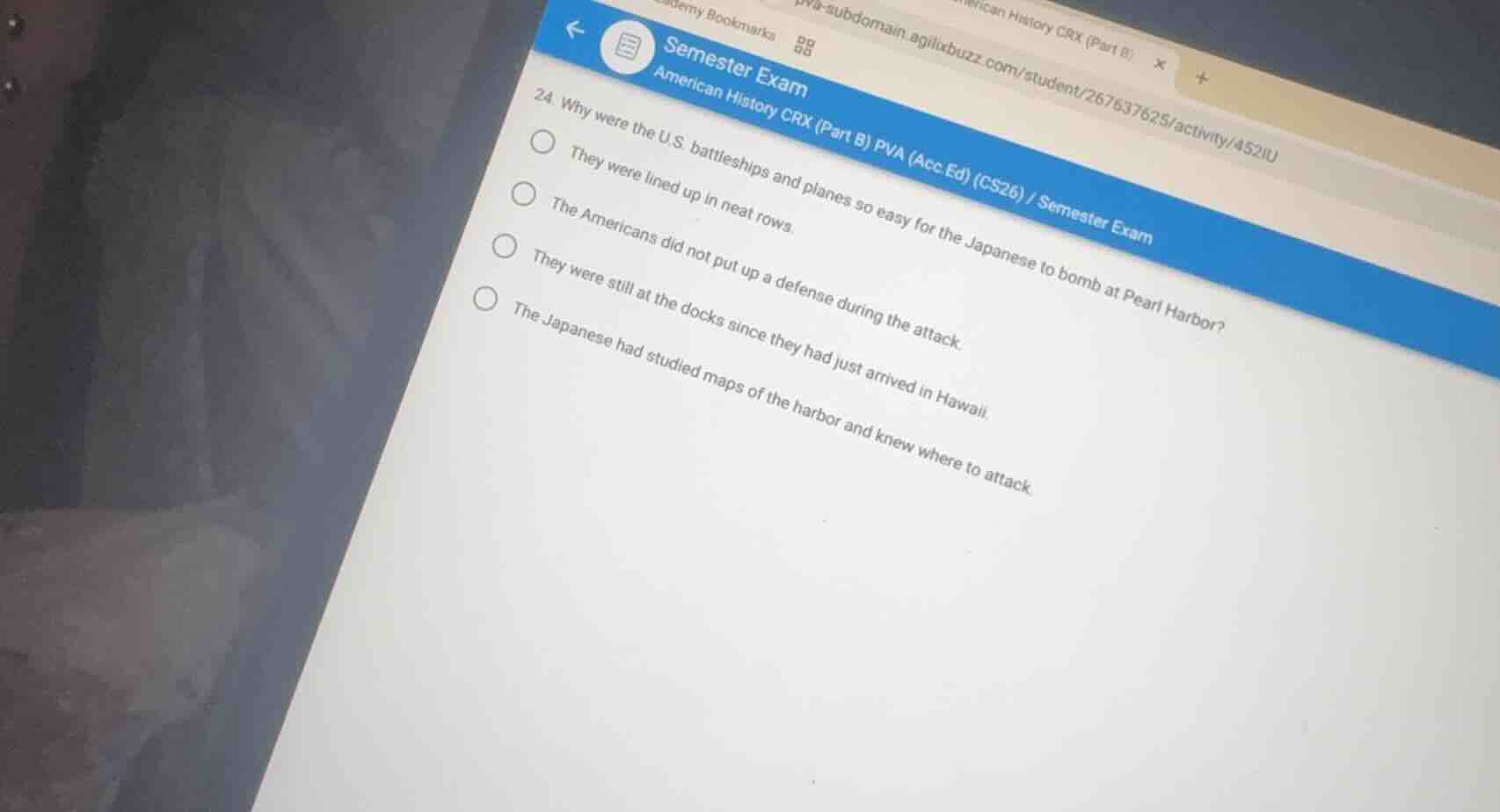
- why were the u.s. battleships and planes so easy for the japanese to bomb at pearl harbor?
they were lined up in neat rows.
the americans did not put up a defense during the attack.
they were still at the docks since they had just arrived in hawaii.
the japanese had studied maps of the harbor and knew where to attack.
<pre_analysis>
{
"quality": "clear",
"question_count": 1,
"skills_matched": [
"direct_cot",
"multiple_choice_formatter",
"explain_then_answer",
"tutor"
],
"needs_drawing": false,
"concepts_used": [],
"new_concepts": [
"Pearl Harbor Attack",
"World War II Tactics"
],
"current_concepts": [
"Pearl Harbor Attack",
"World War II Tactics"
]
}
</pre_analysis>
<reasoning>
Analyze the historical context of Pearl Harbor
On December 7, 1941, the Japanese military launched a surprise air strike on the U.S. naval base at Pearl Harbor in Hawaii. To prevent sabotage by local residents of Japanese descent, U.S. military commanders had ordered aircraft to be parked tightly together, wingtip to wingtip, in the middle of the airfields rather than dispersed. Similarly, the battleships were moored closely together in "Battleship Row."
Evaluate the vulnerability of the layout
Parking the planes in neat, concentrated rows and mooring the battleships side-by-side made them highly vulnerable targets. This arrangement allowed Japanese bombers to easily target and destroy multiple assets in single passes, as they were not dispersed or protected in bunkers.
Assess the provided multiple-choice options
- Option 1 ("They were lined up in neat rows."): This directly matches the historical tactical vulnerability where planes and ships were lined up closely, making them easy targets.
- Option 2 ("The Americans did not put up a defense during the attack."): This is incorrect; despite the surprise, American servicemen fought back courageously with anti-aircraft guns and managed to shoot down several Japanese planes.
- Option 3 ("They were still at the docks since they had just arrived in Hawaii."): This is incorrect; the Pacific Fleet had been stationed at Pearl Harbor since early 1940.
- Option 4 ("The Japanese had studied maps of the harbor and knew where to attack."): While true that they studied maps, the specific reason they were easy to bomb (highly concentrated targets) was due to the defensive grouping of the U.S. assets in neat rows.
</reasoning>
<answer>
<mcq-correct>(A) They were lined up in neat rows.</mcq-correct>
<mcq-option>(B) The Americans did not put up a defense during the attack.</mcq-option>
<mcq-option>(C) They were still at the docks since they had just arrived in Hawaii.</mcq-option>
<mcq-option>(D) The Japanese had studied maps of the harbor and knew where to attack.</mcq-option>
</answer>
<post_analysis>
{
"subject": "Social Science",
"question_type": "Multiple Choice",
"knowledge_point": [
"Social Science",
"History",
"Pearl Harbor Attack"
]
}
</post_analysis>
Snap & solve any problem in the app
Get step-by-step solutions on Sovi AI
Photo-based solutions with guided steps
Explore more problems and detailed explanations
<pre_analysis>
{
"quality": "clear",
"question_count": 1,
"skills_matched": [
"direct_cot",
"multiple_choice_formatter",
"explain_then_answer",
"tutor"
],
"needs_drawing": false,
"concepts_used": [],
"new_concepts": [
"Pearl Harbor Attack",
"World War II Tactics"
],
"current_concepts": [
"Pearl Harbor Attack",
"World War II Tactics"
]
}
</pre_analysis>
<reasoning>
Analyze the historical context of Pearl Harbor
On December 7, 1941, the Japanese military launched a surprise air strike on the U.S. naval base at Pearl Harbor in Hawaii. To prevent sabotage by local residents of Japanese descent, U.S. military commanders had ordered aircraft to be parked tightly together, wingtip to wingtip, in the middle of the airfields rather than dispersed. Similarly, the battleships were moored closely together in "Battleship Row."
Evaluate the vulnerability of the layout
Parking the planes in neat, concentrated rows and mooring the battleships side-by-side made them highly vulnerable targets. This arrangement allowed Japanese bombers to easily target and destroy multiple assets in single passes, as they were not dispersed or protected in bunkers.
Assess the provided multiple-choice options
- Option 1 ("They were lined up in neat rows."): This directly matches the historical tactical vulnerability where planes and ships were lined up closely, making them easy targets.
- Option 2 ("The Americans did not put up a defense during the attack."): This is incorrect; despite the surprise, American servicemen fought back courageously with anti-aircraft guns and managed to shoot down several Japanese planes.
- Option 3 ("They were still at the docks since they had just arrived in Hawaii."): This is incorrect; the Pacific Fleet had been stationed at Pearl Harbor since early 1940.
- Option 4 ("The Japanese had studied maps of the harbor and knew where to attack."): While true that they studied maps, the specific reason they were easy to bomb (highly concentrated targets) was due to the defensive grouping of the U.S. assets in neat rows.
</reasoning>
<answer>
<mcq-correct>(A) They were lined up in neat rows.</mcq-correct>
<mcq-option>(B) The Americans did not put up a defense during the attack.</mcq-option>
<mcq-option>(C) They were still at the docks since they had just arrived in Hawaii.</mcq-option>
<mcq-option>(D) The Japanese had studied maps of the harbor and knew where to attack.</mcq-option>
</answer>
<post_analysis>
{
"subject": "Social Science",
"question_type": "Multiple Choice",
"knowledge_point": [
"Social Science",
"History",
"Pearl Harbor Attack"
]
}
</post_analysis>