QUESTION IMAGE
Question
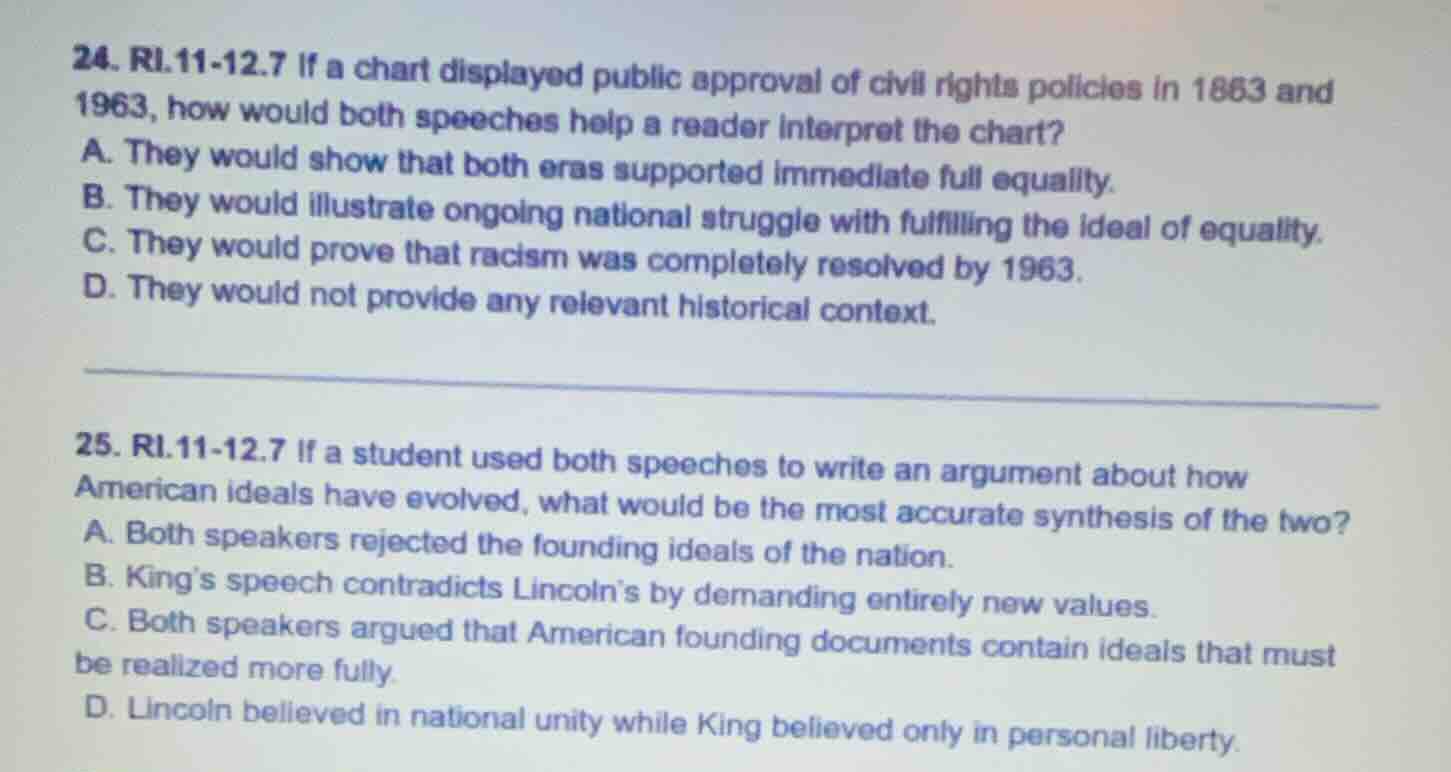
- ri.11-12.7 if a chart displayed public approval of civil rights policies in 1863 and 1963, how would both speeches help a reader interpret the chart?
a. they would show that both eras supported immediate full equality.
b. they would illustrate ongoing national struggle with fulfilling the ideal of equality.
c. they would prove that racism was completely resolved by 1963.
d. they would not provide any relevant historical context.
- ri.11-12.7 if a student used both speeches to write an argument about how american ideals have evolved, what would be the most accurate synthesis of the two?
a. both speakers rejected the founding ideals of the nation.
b. king’s speech contradicts lincoln’s by demanding entirely new values.
c. both speakers argued that american founding documents contain ideals that must be realized more fully.
d. lincoln believed in national unity while king believed only in personal liberty.
For question 24: The two referenced speeches are Lincoln's 1863 Gettysburg Address (centered on ending slavery and upholding equality amid the Civil War) and King's 1963 "I Have a Dream" speech (calling for the fulfillment of equal rights promises unmet a century later). A chart showing 1863 and 1963 approval of civil rights policies would reflect that equality was still an unfulfilled ideal in both eras, as the nation continued grappling with this goal over 100 years. Options A is wrong because 1863 did not have widespread support for immediate full equality; D is wrong because the speeches provide critical historical context; C is wrong because racism was not resolved by 1963.
For question 25: Lincoln's speech invoked the founding ideal of equality to push for ending slavery and uniting the nation around that promise. King's speech referenced the Declaration of Independence and Constitution's ideals of equality, arguing the nation had failed to fully deliver on those promises for Black Americans. Both centered on realizing the nation's existing founding ideals more fully. Option A is wrong because both embraced founding ideals; B is wrong because King's speech built on, not contradicted, Lincoln's push for equality; D is wrong because King also focused on national unity and collective equality, not just personal liberty.

Snap & solve any problem in the app
Get step-by-step solutions on Sovi AI
Photo-based solutions with guided steps
Explore more problems and detailed explanations
- C. They would illustrate ongoing national struggle with fulfilling the ideal of equality.
- C. Both speakers argued that American founding documents contain ideals that must be realized more fully.