QUESTION IMAGE
Question
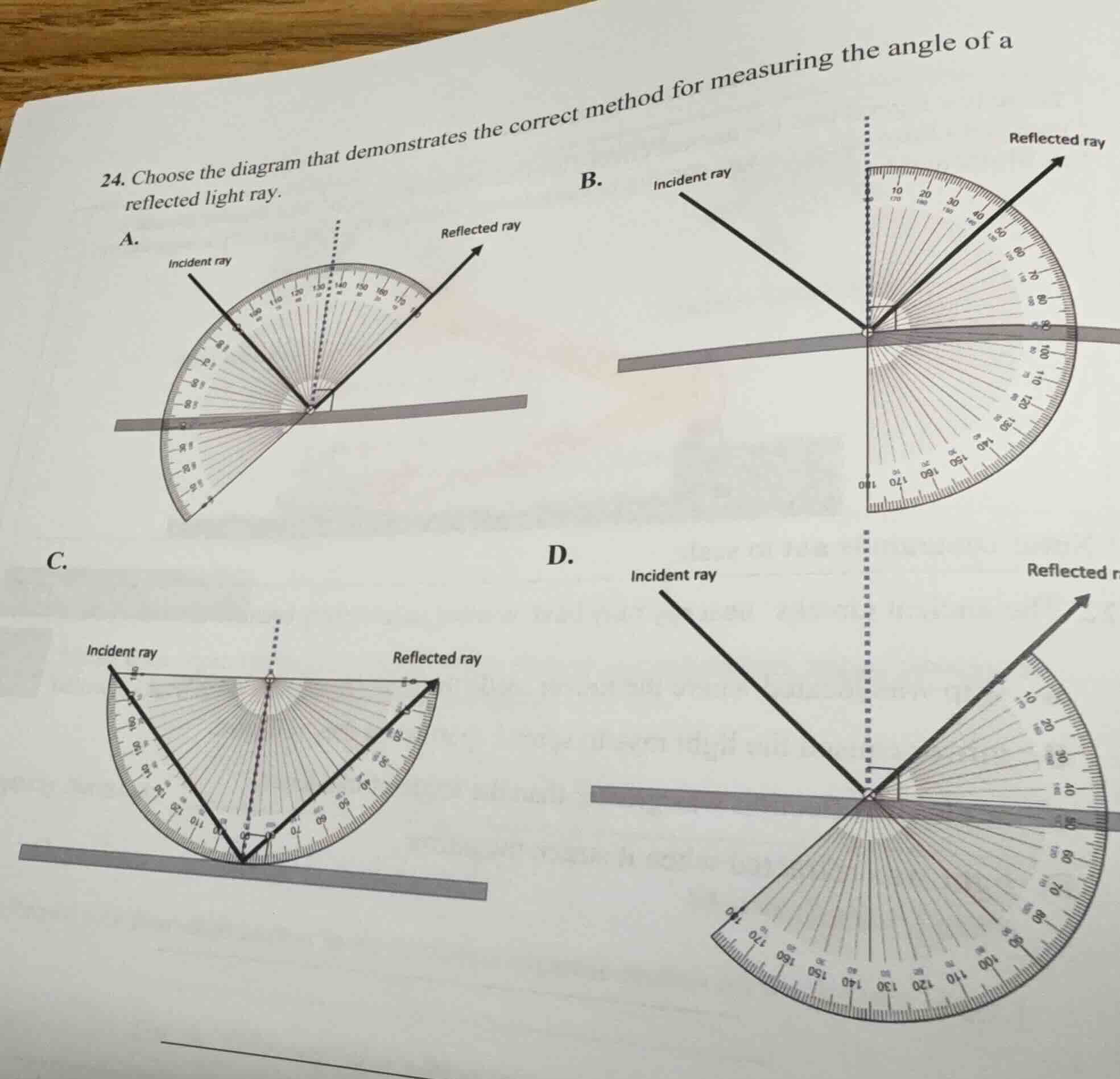
- choose the diagram that demonstrates the correct method for measuring the angle of a reflected light ray.
a.
b.
c.
d.
<pre_analysis>
{
"quality": "clear",
"question_count": 1,
"skills_matched": [
"direct_cot",
"multiple_choice_formatter",
"explain_then_answer",
"tutor"
],
"needs_drawing": false,
"concepts_used": [
"Law of Reflection"
],
"new_concepts": [
"Angle of Reflection Measurement"
],
"current_concepts": [
"Law of Reflection",
"Angle of Reflection Measurement"
]
}
</pre_analysis>
<reasoning>
Identify the target angle
The question asks for the correct method to measure the angle of a reflected light ray. By the Law of Reflection, the angle of reflection is defined as the angle between the reflected ray and the normal line (the perpendicular line to the reflecting surface at the point of incidence).
Analyze the protractor alignment
To measure the angle between the reflected ray and the normal line using a protractor:
- The baseline (flat edge) of the protractor must lie along the normal line, or the \(0^\circ\) mark must align with the normal line so that we measure the angular deviation from the normal.
- Alternatively, if the baseline of the protractor lies along the reflecting surface, the \(90^\circ\) mark aligns with the normal line, and the angle of reflection is measured from the \(90^\circ\) mark to the reflected ray.
- Looking at the diagrams, the protractor's straight baseline is aligned along the normal line (the vertical dashed line) in some options, allowing direct measurement from the normal.
- In Diagram A, the flat baseline of the protractor is aligned along the normal line (vertical dashed line), and its center is at the point of incidence. This allows direct measurement of the angle between the normal line and the reflected ray along the curved scale starting from \(0^\circ\) at the normal.
Evaluate each option
- A: The flat baseline of the protractor is aligned perfectly with the vertical normal line, with the center origin at the point of reflection. This directly measures the angle of the reflected ray relative to the normal line.
- B: The protractor is aligned with its flat baseline along the reflecting surface, but it is shifted to the right rather than centered at the point of incidence.
- C: The protractor is placed on the surface but the normal line is not aligned with the \(90^\circ\) mark correctly, and the baseline is not on the normal.
- D: The protractor is placed upside down below the reflecting surface, which does not measure the reflected ray in the medium above.
</reasoning>
<answer>
<mcq-correct>(A) Protractor baseline aligned with the normal line</mcq-correct>
<mcq-option>(B) Protractor shifted along the reflecting surface</mcq-option>
<mcq-option>(C) Protractor baseline on the reflecting surface but misaligned</mcq-option>
<mcq-option>(D) Protractor placed below the reflecting surface</mcq-option>
</answer>
<post_analysis>
{
"subject": "Natural Science",
"question_type": "Multiple Choice",
"knowledge_point": [
"Natural Science",
"Physics",
"Law of Reflection"
]
}
</post_analysis>
Snap & solve any problem in the app
Get step-by-step solutions on Sovi AI
Photo-based solutions with guided steps
Explore more problems and detailed explanations
<pre_analysis>
{
"quality": "clear",
"question_count": 1,
"skills_matched": [
"direct_cot",
"multiple_choice_formatter",
"explain_then_answer",
"tutor"
],
"needs_drawing": false,
"concepts_used": [
"Law of Reflection"
],
"new_concepts": [
"Angle of Reflection Measurement"
],
"current_concepts": [
"Law of Reflection",
"Angle of Reflection Measurement"
]
}
</pre_analysis>
<reasoning>
Identify the target angle
The question asks for the correct method to measure the angle of a reflected light ray. By the Law of Reflection, the angle of reflection is defined as the angle between the reflected ray and the normal line (the perpendicular line to the reflecting surface at the point of incidence).
Analyze the protractor alignment
To measure the angle between the reflected ray and the normal line using a protractor:
- The baseline (flat edge) of the protractor must lie along the normal line, or the \(0^\circ\) mark must align with the normal line so that we measure the angular deviation from the normal.
- Alternatively, if the baseline of the protractor lies along the reflecting surface, the \(90^\circ\) mark aligns with the normal line, and the angle of reflection is measured from the \(90^\circ\) mark to the reflected ray.
- Looking at the diagrams, the protractor's straight baseline is aligned along the normal line (the vertical dashed line) in some options, allowing direct measurement from the normal.
- In Diagram A, the flat baseline of the protractor is aligned along the normal line (vertical dashed line), and its center is at the point of incidence. This allows direct measurement of the angle between the normal line and the reflected ray along the curved scale starting from \(0^\circ\) at the normal.
Evaluate each option
- A: The flat baseline of the protractor is aligned perfectly with the vertical normal line, with the center origin at the point of reflection. This directly measures the angle of the reflected ray relative to the normal line.
- B: The protractor is aligned with its flat baseline along the reflecting surface, but it is shifted to the right rather than centered at the point of incidence.
- C: The protractor is placed on the surface but the normal line is not aligned with the \(90^\circ\) mark correctly, and the baseline is not on the normal.
- D: The protractor is placed upside down below the reflecting surface, which does not measure the reflected ray in the medium above.
</reasoning>
<answer>
<mcq-correct>(A) Protractor baseline aligned with the normal line</mcq-correct>
<mcq-option>(B) Protractor shifted along the reflecting surface</mcq-option>
<mcq-option>(C) Protractor baseline on the reflecting surface but misaligned</mcq-option>
<mcq-option>(D) Protractor placed below the reflecting surface</mcq-option>
</answer>
<post_analysis>
{
"subject": "Natural Science",
"question_type": "Multiple Choice",
"knowledge_point": [
"Natural Science",
"Physics",
"Law of Reflection"
]
}
</post_analysis>