QUESTION IMAGE
Question
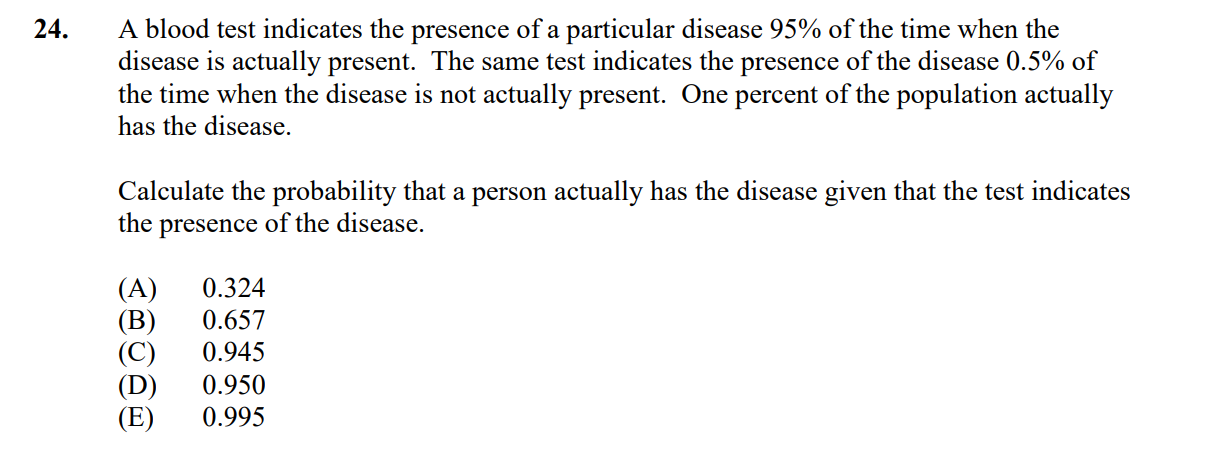
- a blood test indicates the presence of a particular disease (95\\%) of the time when the disease is actually present. the same test indicates the presence of the disease (0.5\\%) of the time when the disease is not actually present. one percent of the population actually has the disease.
calculate the probability that a person actually has the disease given that the test indicates the presence of the disease.
(a) 0.324
(b) 0.657
(c) 0.945
(d) 0.950
(e) 0.995
⚡ Using what you learned: Conditional Probability · 🆕 New: Bayes' Theorem
Updating beliefs with new evidence
Step 1: Define events and probabilities
Let \( D \) be the event that a person has the disease, and \( T \) be the event that the test is positive (indicates the presence of the disease).
From the problem statement:
- \( P(D) = 0.01 \) (one percent of the population has the disease)
- \( P(D^c) = 1 - 0.01 = 0.99 \) (the rest of the population does not have the disease)
- \( P(T \mid D) = 0.95 \) (true positive rate)
- \( P(T \mid D^c) = 0.005 \) (false positive rate of \( 0.5\% \))
We want to find the conditional probability \( P(D \mid T) \).
Step 2: Calculate the total probability of a positive test
To find the overall probability of testing positive, \( P(T) \), we combine the cases of testing positive with the disease and testing positive without the disease:
Step 3: Apply Bayes' Theorem
Now, we calculate the probability that a person actually has the disease given a positive test result:
Comparing this with the given options, \( 0.657 \) corresponds to option (B).

Snap & solve any problem in the app
Get step-by-step solutions on Sovi AI
Photo-based solutions with guided steps
Explore more problems and detailed explanations
(B) 0.657