QUESTION IMAGE
Question
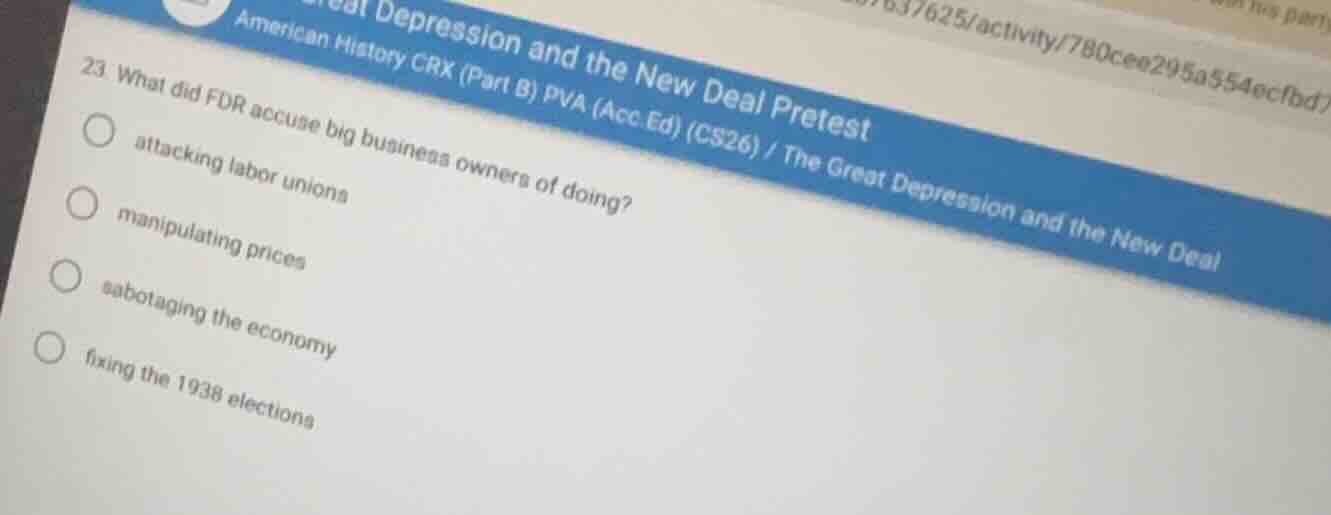
- what did fdr accuse big business owners of doing?
attacking labor unions
manipulating prices
sabotaging the economy
fixing the 1938 elections
<pre_analysis>
{
"quality": "clear",
"question_count": 1,
"skills_matched": [
"direct_cot",
"multiple_choice_formatter",
"explain_then_answer",
"tutor",
"mastery_adaptive_brevity"
],
"needs_drawing": false,
"concepts_used": [
"Sixty Families",
"New Deal Politics"
],
"new_concepts": [
"Roosevelt Recession",
"Capital Strike"
],
"current_concepts": [
"Sixty Families",
"New Deal Politics",
"Roosevelt Recession",
"Capital Strike"
]
}
</pre_analysis>
<reasoning>
Identify the historical context of FDR's accusations
Using the New Deal Politics knowledge point, we focus on the late 1930s, specifically during the economic downturn of 1937–1938 (often called the "Roosevelt Recession"). During this period, Franklin D. Roosevelt and his administration faced criticism for the sudden economic decline and sought to explain its causes.
Analyze FDR's rhetoric against big business
Using the Sixty Families knowledge point, FDR and key administration figures (like Harold Ickes and Robert Jackson) blamed a "capital strike" by major corporations. They accused big business owners and monopolists of intentionally withholding investment and sabotaging the economy to force the administration to roll back New Deal regulations and tax policies.
Evaluate the given multiple-choice options
- attacking labor unions: While big businesses did oppose unions, this was not the primary accusation FDR leveled at them to explain the economic downturn.
- manipulating prices: Although antitrust rhetoric was common, the specific accusation regarding the recession was broader economic obstruction.
- sabotaging the economy: This matches the administration's narrative of a "capital strike" where industrial leaders deliberately halted production and investment to undermine the New Deal.
- fixing the 1938 elections: FDR did not accuse them of direct election tampering, though he campaigned heavily against conservative Democrats and Republicans.
</reasoning>
<answer>
<mcq-option>attacking labor unions</mcq-option>
<mcq-option>manipulating prices</mcq-option>
<mcq-correct>sabotaging the economy</mcq-correct>
<mcq-option>fixing the 1938 elections</mcq-option>
</answer>
<post_analysis>
{
"subject": "Social Science",
"question_type": "Multiple Choice",
"knowledge_point": [
"Social Science",
"U.S. History",
"New Deal Politics"
]
}
</post_analysis>
Snap & solve any problem in the app
Get step-by-step solutions on Sovi AI
Photo-based solutions with guided steps
Explore more problems and detailed explanations
<pre_analysis>
{
"quality": "clear",
"question_count": 1,
"skills_matched": [
"direct_cot",
"multiple_choice_formatter",
"explain_then_answer",
"tutor",
"mastery_adaptive_brevity"
],
"needs_drawing": false,
"concepts_used": [
"Sixty Families",
"New Deal Politics"
],
"new_concepts": [
"Roosevelt Recession",
"Capital Strike"
],
"current_concepts": [
"Sixty Families",
"New Deal Politics",
"Roosevelt Recession",
"Capital Strike"
]
}
</pre_analysis>
<reasoning>
Identify the historical context of FDR's accusations
Using the New Deal Politics knowledge point, we focus on the late 1930s, specifically during the economic downturn of 1937–1938 (often called the "Roosevelt Recession"). During this period, Franklin D. Roosevelt and his administration faced criticism for the sudden economic decline and sought to explain its causes.
Analyze FDR's rhetoric against big business
Using the Sixty Families knowledge point, FDR and key administration figures (like Harold Ickes and Robert Jackson) blamed a "capital strike" by major corporations. They accused big business owners and monopolists of intentionally withholding investment and sabotaging the economy to force the administration to roll back New Deal regulations and tax policies.
Evaluate the given multiple-choice options
- attacking labor unions: While big businesses did oppose unions, this was not the primary accusation FDR leveled at them to explain the economic downturn.
- manipulating prices: Although antitrust rhetoric was common, the specific accusation regarding the recession was broader economic obstruction.
- sabotaging the economy: This matches the administration's narrative of a "capital strike" where industrial leaders deliberately halted production and investment to undermine the New Deal.
- fixing the 1938 elections: FDR did not accuse them of direct election tampering, though he campaigned heavily against conservative Democrats and Republicans.
</reasoning>
<answer>
<mcq-option>attacking labor unions</mcq-option>
<mcq-option>manipulating prices</mcq-option>
<mcq-correct>sabotaging the economy</mcq-correct>
<mcq-option>fixing the 1938 elections</mcq-option>
</answer>
<post_analysis>
{
"subject": "Social Science",
"question_type": "Multiple Choice",
"knowledge_point": [
"Social Science",
"U.S. History",
"New Deal Politics"
]
}
</post_analysis>