QUESTION IMAGE
Question
23 multiple choice 2 points
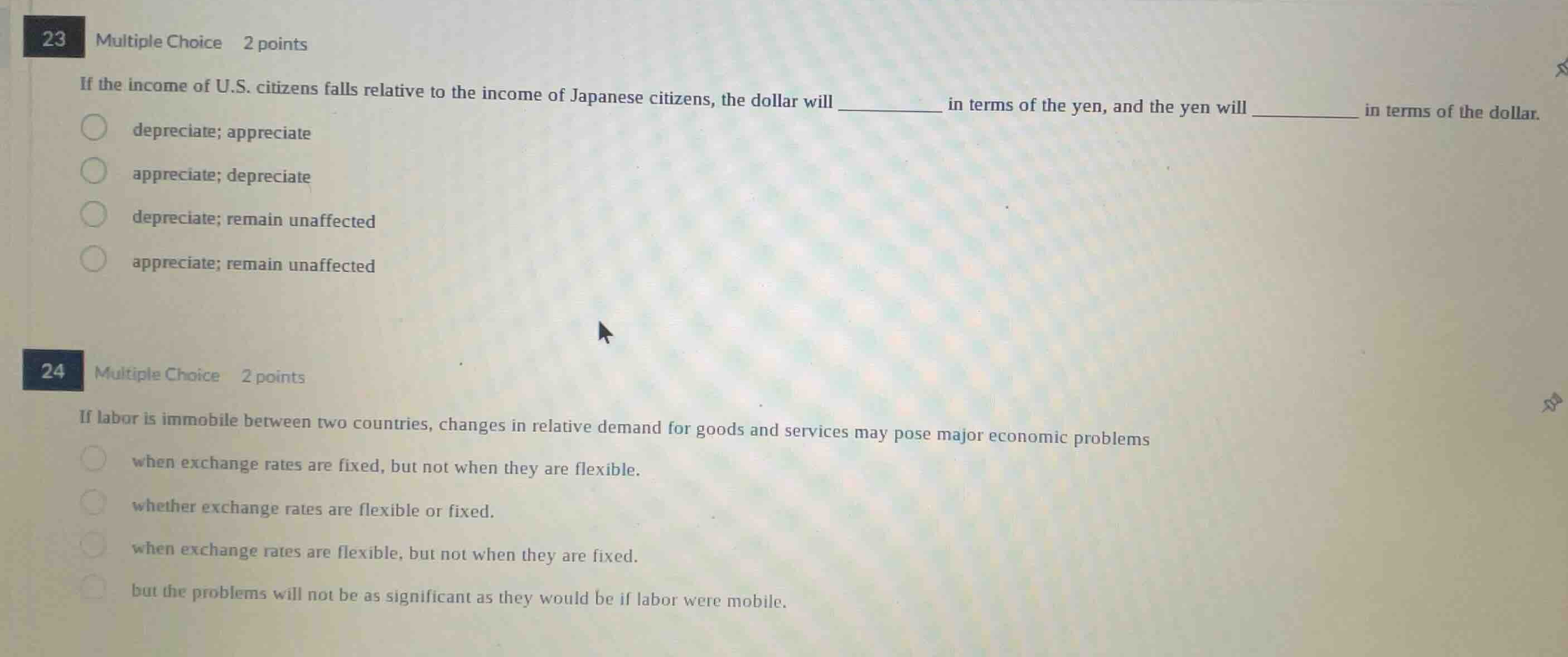
if the income of u.s. citizens falls relative to the income of japanese citizens, the dollar will ____ in terms of the yen, and the yen will ____ in terms of the dollar.
depreciate; appreciate
appreciate; depreciate
depreciate; remain unaffected
appreciate; remain unaffected
24 multiple choice 2 points
if labor is immobile between two countries, changes in relative demand for goods and services may pose major economic problems
when exchange rates are fixed, but not when they are flexible.
whether exchange rates are flexible or fixed.
when exchange rates are flexible, but not when they are fixed.
but the problems will not be as significant as they would be if labor were mobile.
Analyze Question 23
When U.S. citizen income falls relative to Japanese citizen income, U.S. demand for Japanese imports decreases, reducing the supply of dollars in the foreign exchange market. Simultaneously, Japanese citizens, with relatively higher incomes, increase their demand for U.S. exports, increasing the demand for dollars. This combination of decreased supply of dollars and increased demand for dollars causes the dollar to appreciate. Consequently, the yen must depreciate in terms of the dollar.
Analyze Question 24
If labor is immobile between two countries, they cannot rely on labor migration to adjust to asymmetric demand shocks. Under a flexible exchange rate system, the exchange rate can adjust to restore competitiveness and balance trade. However, under a fixed exchange rate system, neither labor mobility nor exchange rate adjustments are available to absorb the shock, leading to major economic problems such as persistent unemployment or recession in the country facing decreased demand. Thus, these changes pose major economic problems when exchange rates are fixed, but not when they are flexible.

Snap & solve any problem in the app
Get step-by-step solutions on Sovi AI
Photo-based solutions with guided steps
Explore more problems and detailed explanations
Question 23
- depreciate; appreciate
- appreciate; depreciate (Correct answer)
- depreciate; remain unaffected
- appreciate; remain unaffected
Question 24
- when exchange rates are fixed, but not when they are flexible. (Correct answer)
- whether exchange rates are flexible or fixed.
- when exchange rates are flexible, but not when they are fixed.
- but the problems will not be as significant as they would be if labor were mobile.