QUESTION IMAGE
Question
23 multiple choice 1 point
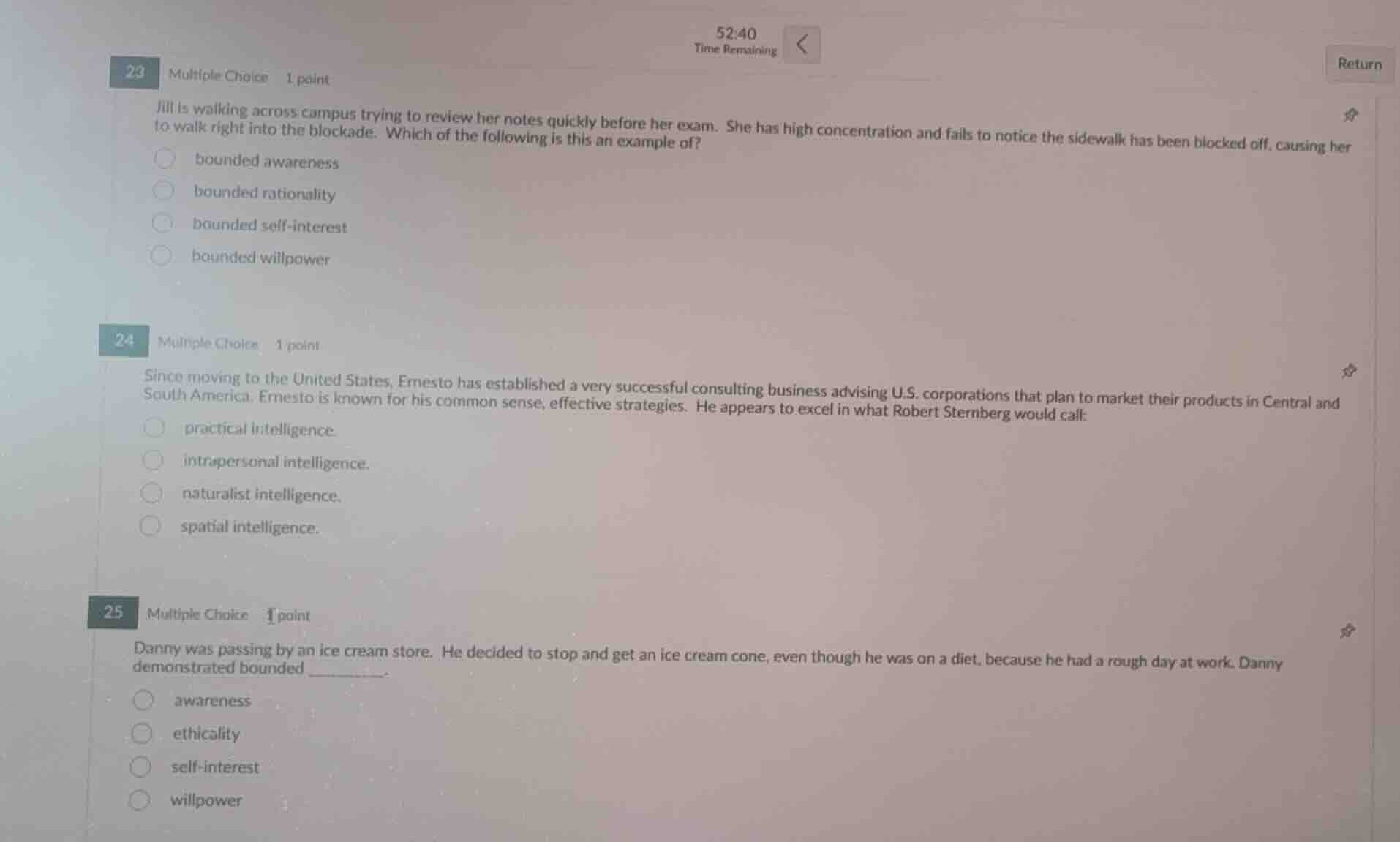
jill is walking across campus trying to review her notes quickly before her exam. she has high concentration and fails to notice the sidewalk has been blocked off, causing her to walk right into the blockade. which of the following is this an example of?
bounded awareness
bounded rationality
bounded self-interest
bounded willpower
24 multiple choice 1 point
since moving to the united states, ernesto has established a very successful consulting business advising u.s. corporations that plan to market their products in central and south america. ernesto is known for his common sense, effective strategies. he appears to excel in what robert sternberg would call:
practical intelligence
intrapersonal intelligence
naturalist intelligence
spatial intelligence
25 multiple choice 1 point
danny was passing by an ice cream store. he decided to stop and get an ice cream cone, even though he was on a diet, because he had a rough day at work. danny demonstrated bounded ______.
awareness
ethicality
self-interest
willpower
Analyze Question 23
The scenario describes Jill focusing intensely on reviewing her notes while walking, which prevents her from noticing a highly visible physical obstacle (the sidewalk blockade). This is a classic example of how intense focus on one task filters out other relevant information in the environment. In cognitive psychology, this systematic failure to notice obvious and important information because attention is directed elsewhere is known as bounded awareness (specifically, inattentional blindness).
Let's evaluate the options:
- bounded awareness: Correct. It refers to the cognitive limits that prevent people from noticing useful, observable information.
- bounded rationality: This concept, which is part of your mastered knowledge in Bounded Rationality, refers to decision-making limits due to cognitive, information, and time constraints, rather than perceptual filtering.
- bounded self-interest: This describes limits on how selfishly people act.
- bounded willpower: This describes limits on self-control.
Analyze Question 24
The scenario describes Ernesto's success in consulting based on "common sense" and "effective strategies" in real-world business environments. We are asked to identify this using Robert Sternberg's framework.
According to Sternberg's Triarchic Theory of Intelligence, intelligence is divided into three parts:
- Analytical intelligence (academic problem-solving)
- Creative intelligence (dealing with novel situations)
- Practical intelligence ("street smarts" or common sense used to adapt to, shape, or select everyday environments)
Ernesto's ability to apply common sense and practical strategies to run a successful business directly represents practical intelligence. The other options (intrapersonal, naturalist, spatial) belong to Howard Gardner's Multiple Intelligences theory, not Sternberg's triarchic model.
Analyze Question 25
The scenario describes Danny choosing to eat an ice cream cone despite being on a diet because he had a rough day. This represents a failure of self-control in favor of immediate gratification.
In behavioral economics and psychology, the tendency to give in to short-term temptations that conflict with our long-term goals (like staying on a diet) is known as Bounded Willpower. Therefore, Danny demonstrated bounded willpower.

Snap & solve any problem in the app
Get step-by-step solutions on Sovi AI
Photo-based solutions with guided steps
Explore more problems and detailed explanations
Question 23
- bounded awareness (Correct answer)
- bounded rationality
- bounded self-interest
- bounded willpower
Question 24
- practical intelligence. (Correct answer)
- intrapersonal intelligence.
- naturalist intelligence.
- spatial intelligence.
Question 25
- awareness
- ethicality
- self-interest
- willpower (Correct answer)