QUESTION IMAGE
Question
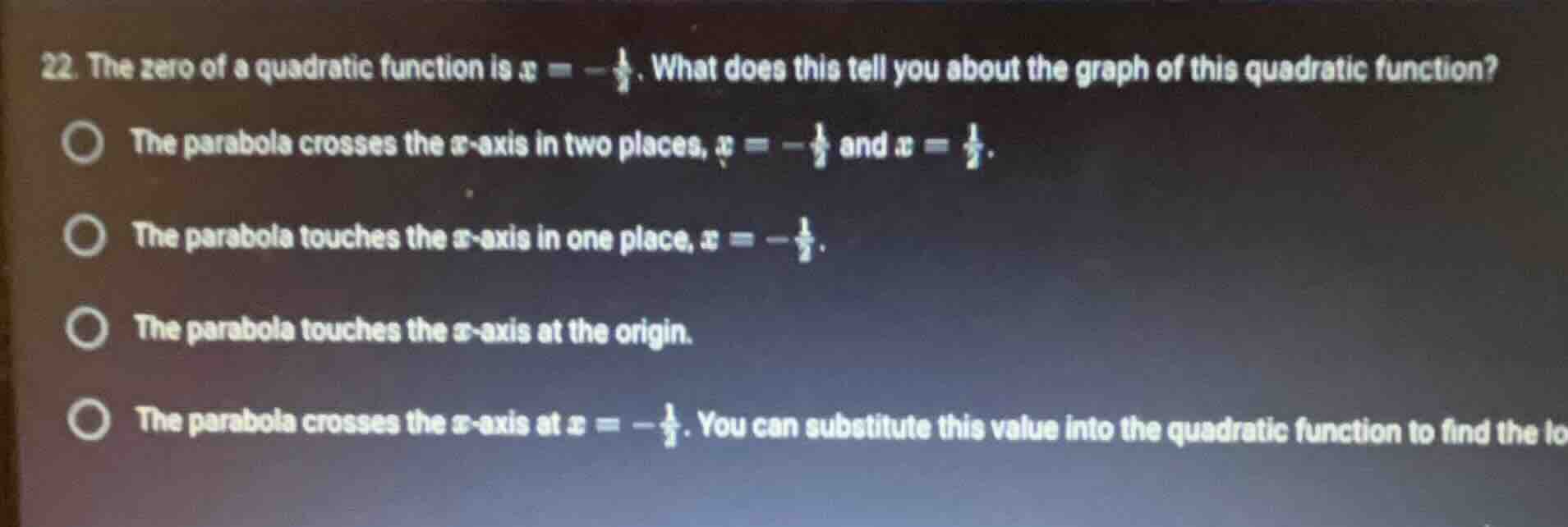
- the zero of a quadratic function is \\(x = -\frac{1}{7}\\). what does this tell you about the graph of this quadratic function?
- the parabola crosses the \\(x\\)-axis in two places, \\(x = -\frac{1}{7}\\) and \\(x = \frac{1}{7}\\).
- the parabola touches the \\(x\\)-axis in one place, \\(x = -\frac{1}{7}\\).
- the parabola touches the \\(x\\)-axis at the origin.
- the parabola crosses the \\(x\\)-axis at \\(x = -\frac{1}{7}\\). you can substitute this value into the quadratic function to find the lo
🆕 New Concept Discovered: Graphical Meaning of Quadratic Zeros
Where the function equals zero on the graph
Step 1: Understand the term "the zero"
The phrasing "the zero of a quadratic function is \( x = -\frac{1}{3} \)" uses the singular form "the zero." This indicates that the quadratic function has exactly one real zero (a double root).
Step 2: Relate zeros to graphical intercepts
A zero of a function \( f(x) \) is an \( x \)-value where the output is zero, meaning \( f(x) = 0 \). On a graph, these correspond to the points where the curve meets the \( x \)-axis.
- If a quadratic function has two distinct real zeros, its parabola crosses the \( x \)-axis at two distinct points.
- If a quadratic function has exactly one real zero, its vertex lies directly on the \( x \)-axis. This means the parabola touches the \( x \)-axis at exactly one point and turns around, rather than crossing through it.
Step 3: Evaluate the given options
- Option 1: "The parabola crosses the \( x \)-axis in two places, \( x = -\frac{1}{3} \) and \( x = \frac{1}{3} \)."
- Incorrect. There is no information suggesting \( x = \frac{1}{3} \) is also a zero.
- Option 2: "The parabola touches the \( x \)-axis in one place, \( x = -\frac{1}{3} \)."
- Correct. Since there is only one unique real zero, the parabola's vertex lies on the \( x \)-axis at this value, meaning it touches the axis at exactly this one point.
- Option 3: "The parabola touches the \( x \)-axis at the origin."
- Incorrect. The origin is \( (0,0) \), but the zero is at \( x = -\frac{1}{3} \).
- Option 4: "The parabola crosses the \( x \)-axis at \( x = -\frac{1}{3} \). You can substitute this value into the quadratic function to find the lo..."
- Incorrect. A parabola cannot cross the \( x \)-axis at only one point; if it crosses through to the other side, it must cross back at a second point due to its U-shape. Therefore, with only one zero, it must touch (be tangent to) the axis rather than cross it.

Snap & solve any problem in the app
Get step-by-step solutions on Sovi AI
Photo-based solutions with guided steps
Explore more problems and detailed explanations
The parabola touches the \( x \)-axis in one place, \( x = -\frac{1}{3} \).