QUESTION IMAGE
Question
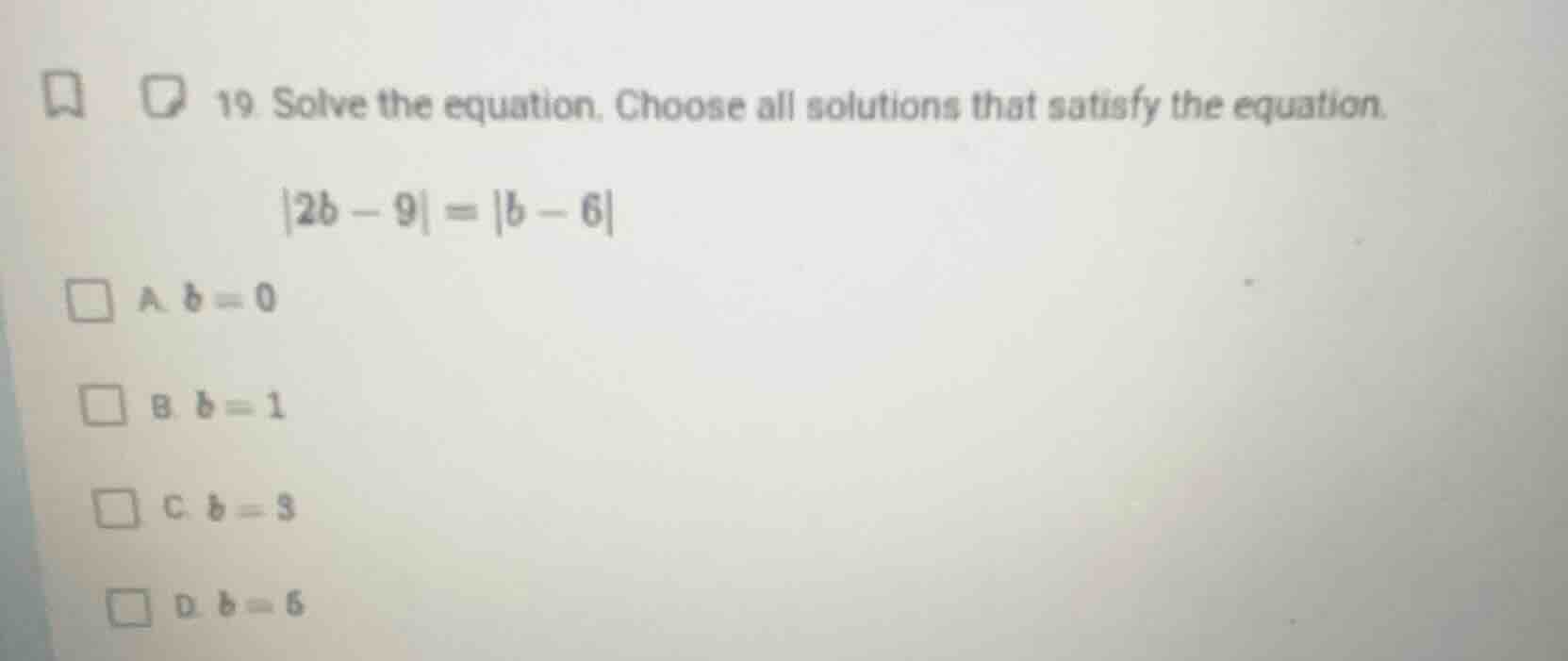
- solve the equation. choose all solutions that satisfy the equation.
| 2b - 9 | = | b - 6 |
a. b = 0
b. b = 1
c. b = 3
d. b = 6
Step1: Use the property of absolute value
If \(|x| = |y|\), then \(x = y\) or \(x = -y\). So for \(|2b - 9| = |b - 6|\), we have two cases:
Case 1: \(2b - 9 = b - 6\)
Step2: Solve Case 1
Subtract \(b\) from both sides: \(2b - b - 9 = -6\)
Simplify: \(b - 9 = -6\)
Add 9 to both sides: \(b = -6 + 9 = 3\)
Case 2: \(2b - 9 = -(b - 6)\)
Step3: Solve Case 2
Expand the right side: \(2b - 9 = -b + 6\)
Add \(b\) to both sides: \(2b + b - 9 = 6\)
Simplify: \(3b - 9 = 6\)
Add 9 to both sides: \(3b = 6 + 9 = 15\)
Divide by 3: \(b = \frac{15}{3} = 5\) Wait, but 5 is not in the options. Wait, maybe I made a mistake? Wait, no, the options are A. \(b = 0\), B. \(b = 1\), C. \(b = 3\), D. \(b = 6\). Wait, let's check the solutions by plugging into the original equation.
Wait, when \(b = 3\): \(|2*3 - 9| = |6 - 9| = |-3| = 3\); \(|3 - 6| = |-3| = 3\). So \(b = 3\) works.
When \(b = 5\) (which we got from Case 2), but 5 is not an option. Wait, maybe I made a mistake in Case 2. Let's recheck Case 2:
\(2b - 9 = - (b - 6)\) => \(2b - 9 = -b + 6\) => \(2b + b = 6 + 9\) => \(3b = 15\) => \(b = 5\). But 5 is not in the options. Wait, maybe the problem has a typo, or maybe I misread the options. Wait, the options are A. \(b = 0\), B. \(b = 1\), C. \(b = 3\), D. \(b = 6\). Let's check each option:
Check \(b = 0\): \(|2*0 - 9| = |-9| = 9\); \(|0 - 6| = |-6| = 6\). 9 ≠ 6, so not a solution.
Check \(b = 1\): \(|2*1 - 9| = |-7| = 7\); \(|1 - 6| = |-5| = 5\). 7 ≠ 5, not a solution.
Check \(b = 3\): As before, \(|6 - 9| = 3\), \(|3 - 6| = 3\). So \(b = 3\) works.
Check \(b = 6\): \(|2*6 - 9| = |12 - 9| = 3\); \(|6 - 6| = 0\). 3 ≠ 0, so not a solution.
Wait, so only \(b = 3\) (option C) works. But earlier, when we solved Case 2, we got \(b = 5\), which is not an option. But among the given options, only \(b = 3\) satisfies the equation.
Wait, let's check \(b = 6\): \(|2*6 - 9| = |12 - 9| = 3\); \(|6 - 6| = 0\). 3 ≠ 0, so no. \(b = 0\): \(| -9 | = 9\), \(| -6 | = 6\), 9 ≠ 6. \(b = 1\): \(| -7 | = 7\), \(| -5 | = 5\), 7 ≠ 5. \(b = 3\): \(| -3 | = 3\), \(| -3 | = 3\), so yes.
So the correct solution from the options is \(b = 3\).

Snap & solve any problem in the app
Get step-by-step solutions on Sovi AI
Photo-based solutions with guided steps
Explore more problems and detailed explanations
C. \(b = 3\)