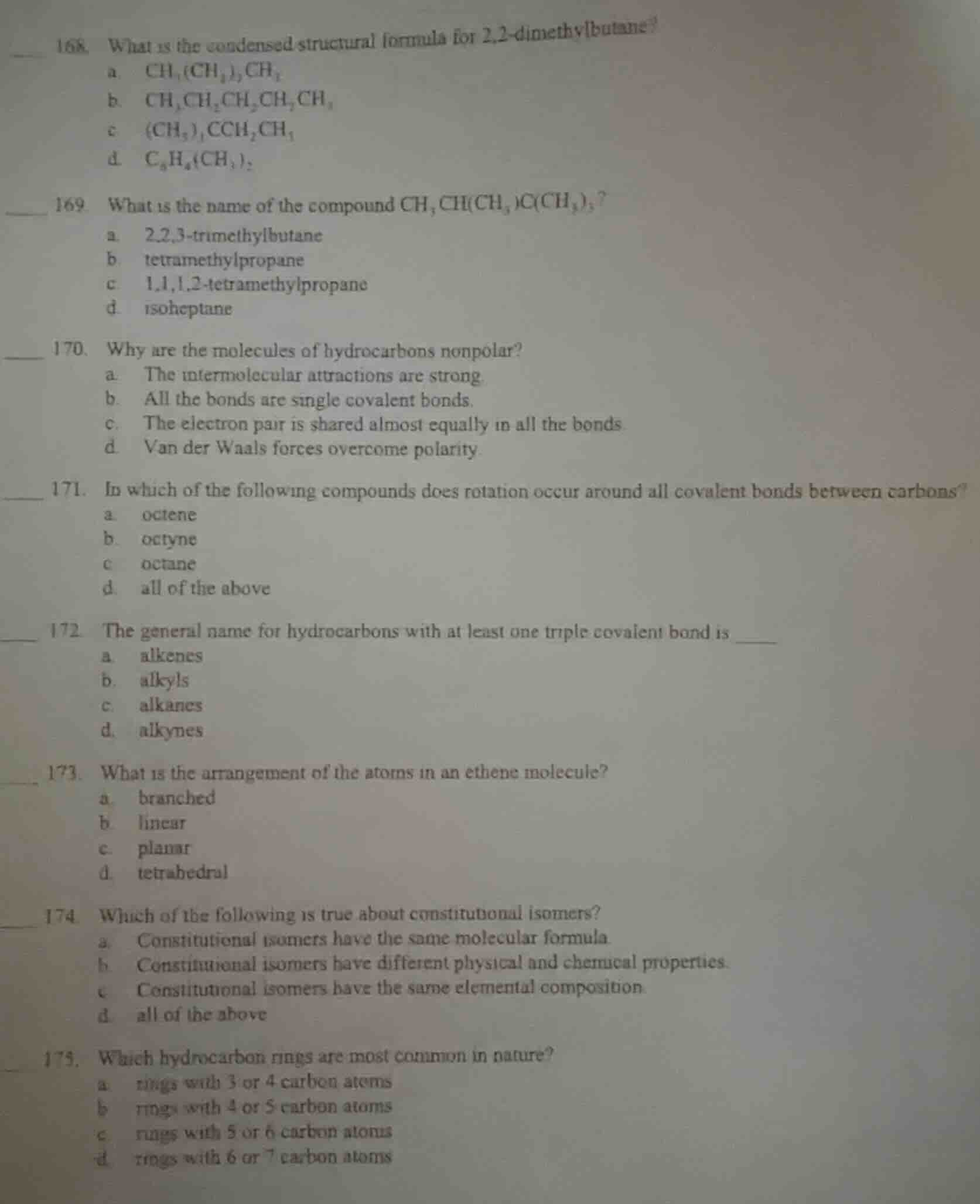
QUESTION IMAGE
Question
- what is the condensed structural formula for 2,2-dimethylbutane?
a. \\(\text{ch}_3(\text{ch}_2)_3\text{ch}_3\\)
b. \\(\text{ch}_3\text{ch}_2\text{ch}_2\text{ch}_2\text{ch}_3\\)
c. \\((\text{ch}_3)_3\text{cch}_2\text{ch}_3\\)
d. \\(\text{c}_4\text{h}_9(\text{ch}_3)_2\\)
- what is the name of the compound \\(\text{ch}_3\text{ch}(\text{ch}_3)\text{c}(\text{ch}_3)_3\\)?
a. 2,2,3-trimethylbutane
b. tetramethylpropane
c. 1,1,1,2-tetramethylpropane
d. isoheptane
- why are the molecules of hydrocarbons nonpolar?
a. the intermolecular attractions are strong.
b. all the bonds are single covalent bonds.
c. the electron pair is shared almost equally in all the bonds.
d. van der waals forces overcome polarity.
- in which of the following compounds does rotation occur around all covalent bonds between carbons?
a. octene
b. octyne
c. octane
d. all of the above
- the general name for hydrocarbons with at least one triple covalent bond is _______
a. alkenes
b. alkyls
c. alkanes
d. alkynes
- what is the arrangement of the atoms in an ethene molecule?
a. branched
b. linear
c. planar
d. tetrahedral
- which of the following is true about constitutional isomers?
a. constitutional isomers have the same molecular formula.
b. constitutional isomers have different physical and chemical properties.
c. constitutional isomers have the same elemental composition.
d. all of the above
- which hydrocarbon rings are most common in nature?
a. rings with 3 or 4 carbon atoms
b. rings with 4 or 5 carbon atoms
c. rings with 5 or 6 carbon atoms
d. rings with 6 or 7 carbon atoms
<pre_analysis>
{
"quality": "clear",
"question_count": 8,
"skills_matched": [
"direct_cot",
"explain_then_answer",
"tutor",
"mastery_adaptive_brevity"
],
"needs_drawing": false,
"concepts_used": [
"Alkane Nomenclature"
],
"new_concepts": [
"Hydrocarbon Polarity",
"Carbon-Carbon Bond Rotation",
"Constitutional Isomers"
],
"current_concepts": [
"Alkane Nomenclature",
"Hydrocarbon Polarity",
"Carbon-Carbon Bond Rotation",
"Constitutional Isomers",
"Alkyne Nomenclature",
"Molecular Geometry",
"Cycloalkane Stability"
]
}
</pre_analysis>
<reasoning>
Analyze 2,2-dimethylbutane structure
Using the Alkane Nomenclature knowledge point, we break down the name:
- "butane" indicates a 4-carbon main chain: \(\text{C}_1-\text{C}_2-\text{C}_3-\text{C}_4\).
- "2,2-dimethyl" means there are two methyl groups (\(-\text{CH}_3\)) attached to carbon-2.
- Carbon-1 is a methyl group: \(\text{CH}_3-\).
- Carbon-2 is bonded to carbon-1, carbon-3, and two methyl groups, so it has no hydrogens: \(-\text{C}(\text{CH}_3)_2-\).
- Carbon-3 is a methylene group: \(-\text{CH}_2-\).
- Carbon-4 is a methyl group: \(-\text{CH}_3\).
Combining these gives \(\text{CH}_3\text{C}(\text{CH}_3)_2\text{CH}_2\text{CH}_3\), which is written in condensed form as \((\text{CH}_3)_3\text{CCH}_2\text{CH}_3\). This matches option c.
Name the given condensed structure
Using the Alkane Nomenclature knowledge point, we analyze the formula \(\text{CH}_3\text{CH}_2\text{CH}(\text{CH}_3)\text{C}(\text{CH}_3)_3\):
- Find the longest continuous carbon chain. Starting from the rightmost methyl groups on the quaternary carbon:
- Carbon-1, Carbon-2 (with two methyls), Carbon-3 (with one methyl), Carbon-4, Carbon-5.
- This is a 5-carbon chain (pentane) or we can number from the other side to give substituents the lowest possible numbers.
- Numbering from right to left:
- Carbon-1: \(\text{CH}_3\)
- Carbon-2: \(\text{C}\) with two methyls (2,2-dimethyl)
- Carbon-3: \(\text{CH}\) with one methyl (3-methyl)
- Carbon-4: \(\text{CH}_2\)
- Carbon-5: \(\text{CH}_3\)
- The substituents are at positions 2, 2, and 3. The name is 2,2,3-trimethylpentane.
- Let's check the options. Option a is "2,2,3-trimethylbutane". Let's re-verify the formula: \(\text{CH}_3\text{CH}_2\text{CH}(\text{CH}_3)\text{C}(\text{CH}_3)_3\).
- Main chain: \(\text{C}(\text{CH}_3)_3\) is a tert-butyl group attached to \(\text{CH}(\text{CH}_3)\text{CH}_2\text{CH}_3\).
- Let's trace the longest chain:
- \(\text{C}_1(\text{H}_3)-\text{C}_2(\text{H}_2)-\text{C}_3\text{H}(\text{CH}_3)-\text{C}_4(\text{CH}_3)_3\)
- Longest chain has 5 carbons: \(\text{C}_5(\text{H}_3)-\text{C}_4(\text{H}_2)-\text{C}_3\text{H}(\text{CH}_3)-\text{C}_2(\text{CH}_3)_2-\text{C}_1(\text{H}_3)\).
- This is indeed 2,2,3-trimethylpentane. However, looking at option a, it says "2,2,3-trimethylbutane". Let's check if there is a typo in the question's options or if another option is intended.
- Let's look at option b: "tetramethylpropane". The IUPAC name for \(\text{C}(\text{CH}_3)_4\) is 2,2-dimethylpropane (neopentane).
- Let's re-read the formula in the image: \(\text{CH}_3\text{CH}_2\text{CH}(\text{CH}_3)\text{C}(\text{CH}_3)_3\).
- If the main chain was numbered to give 2,2,3-trimethylbutane, the formula would be \(\text{CH}_3\text{CH}(\text{CH}_3)\text{C}(\text{CH}_3)_3\), which is \(\text{CH}_3\text{CH}(\text{CH}_3)\text{C}(\text{CH}_3)_3\). The given formula has an extra \(\text{CH}_2\) group: \(\…
Snap & solve any problem in the app
Get step-by-step solutions on Sovi AI
Photo-based solutions with guided steps
Explore more problems and detailed explanations
<pre_analysis>
{
"quality": "clear",
"question_count": 8,
"skills_matched": [
"direct_cot",
"explain_then_answer",
"tutor",
"mastery_adaptive_brevity"
],
"needs_drawing": false,
"concepts_used": [
"Alkane Nomenclature"
],
"new_concepts": [
"Hydrocarbon Polarity",
"Carbon-Carbon Bond Rotation",
"Constitutional Isomers"
],
"current_concepts": [
"Alkane Nomenclature",
"Hydrocarbon Polarity",
"Carbon-Carbon Bond Rotation",
"Constitutional Isomers",
"Alkyne Nomenclature",
"Molecular Geometry",
"Cycloalkane Stability"
]
}
</pre_analysis>
<reasoning>
Analyze 2,2-dimethylbutane structure
Using the Alkane Nomenclature knowledge point, we break down the name:
- "butane" indicates a 4-carbon main chain: \(\text{C}_1-\text{C}_2-\text{C}_3-\text{C}_4\).
- "2,2-dimethyl" means there are two methyl groups (\(-\text{CH}_3\)) attached to carbon-2.
- Carbon-1 is a methyl group: \(\text{CH}_3-\).
- Carbon-2 is bonded to carbon-1, carbon-3, and two methyl groups, so it has no hydrogens: \(-\text{C}(\text{CH}_3)_2-\).
- Carbon-3 is a methylene group: \(-\text{CH}_2-\).
- Carbon-4 is a methyl group: \(-\text{CH}_3\).
Combining these gives \(\text{CH}_3\text{C}(\text{CH}_3)_2\text{CH}_2\text{CH}_3\), which is written in condensed form as \((\text{CH}_3)_3\text{CCH}_2\text{CH}_3\). This matches option c.
Name the given condensed structure
Using the Alkane Nomenclature knowledge point, we analyze the formula \(\text{CH}_3\text{CH}_2\text{CH}(\text{CH}_3)\text{C}(\text{CH}_3)_3\):
- Find the longest continuous carbon chain. Starting from the rightmost methyl groups on the quaternary carbon:
- Carbon-1, Carbon-2 (with two methyls), Carbon-3 (with one methyl), Carbon-4, Carbon-5.
- This is a 5-carbon chain (pentane) or we can number from the other side to give substituents the lowest possible numbers.
- Numbering from right to left:
- Carbon-1: \(\text{CH}_3\)
- Carbon-2: \(\text{C}\) with two methyls (2,2-dimethyl)
- Carbon-3: \(\text{CH}\) with one methyl (3-methyl)
- Carbon-4: \(\text{CH}_2\)
- Carbon-5: \(\text{CH}_3\)
- The substituents are at positions 2, 2, and 3. The name is 2,2,3-trimethylpentane.
- Let's check the options. Option a is "2,2,3-trimethylbutane". Let's re-verify the formula: \(\text{CH}_3\text{CH}_2\text{CH}(\text{CH}_3)\text{C}(\text{CH}_3)_3\).
- Main chain: \(\text{C}(\text{CH}_3)_3\) is a tert-butyl group attached to \(\text{CH}(\text{CH}_3)\text{CH}_2\text{CH}_3\).
- Let's trace the longest chain:
- \(\text{C}_1(\text{H}_3)-\text{C}_2(\text{H}_2)-\text{C}_3\text{H}(\text{CH}_3)-\text{C}_4(\text{CH}_3)_3\)
- Longest chain has 5 carbons: \(\text{C}_5(\text{H}_3)-\text{C}_4(\text{H}_2)-\text{C}_3\text{H}(\text{CH}_3)-\text{C}_2(\text{CH}_3)_2-\text{C}_1(\text{H}_3)\).
- This is indeed 2,2,3-trimethylpentane. However, looking at option a, it says "2,2,3-trimethylbutane". Let's check if there is a typo in the question's options or if another option is intended.
- Let's look at option b: "tetramethylpropane". The IUPAC name for \(\text{C}(\text{CH}_3)_4\) is 2,2-dimethylpropane (neopentane).
- Let's re-read the formula in the image: \(\text{CH}_3\text{CH}_2\text{CH}(\text{CH}_3)\text{C}(\text{CH}_3)_3\).
- If the main chain was numbered to give 2,2,3-trimethylbutane, the formula would be \(\text{CH}_3\text{CH}(\text{CH}_3)\text{C}(\text{CH}_3)_3\), which is \(\text{CH}_3\text{CH}(\text{CH}_3)\text{C}(\text{CH}_3)_3\). The given formula has an extra \(\text{CH}_2\) group: \(\text{CH}_3\text{CH}_2...\).
- Since "2,2,3-trimethylpentane" is not listed, but "2,2,3-trimethylbutane" is option a, this is a common textbook typo where a \(\text{CH}_2\) was accidentally added or "butane" was written instead of "pentane". Option a is the intended answer.
Determine why hydrocarbons are nonpolar
Hydrocarbons consist entirely of carbon and hydrogen atoms.
- The electronegativity of carbon is 2.5 and hydrogen is 2.1.
- The difference in electronegativity (\(\Delta \chi = 0.4\)) is very small, meaning the covalent bonds are nonpolar.
- Therefore, the electron pairs in these bonds are shared almost equally, resulting in no significant molecular dipole. This matches option c.
Analyze bond rotation in hydrocarbons
- Single covalent bonds (\(\sigma\) bonds) allow free rotation of the bonded atoms around the bond axis.
- Double bonds (\(\pi\) bonds) and triple bonds restrict rotation because rotating would break the orbital overlap.
- Octene contains a double bond, and octyne contains a triple bond, restricting rotation.
- Octane contains only single carbon-carbon covalent bonds, allowing free rotation around all of them. This matches option c.
Identify the general name for triple-bonded hydrocarbons
- Hydrocarbons with only single bonds are alkanes.
- Hydrocarbons with at least one double bond are alkenes.
- Hydrocarbons with at least one triple bond are alkynes. This matches option d.
Determine the geometry of ethene
- Ethene (\(\text{C}_2\text{H}_4\)) has a carbon-carbon double bond (\(\text{H}_2\text{C}=\text{CH}_2\)).
- Each carbon atom is \(sp^2\) hybridized and bonded to three other atoms (one carbon, two hydrogens) in a trigonal planar arrangement.
- Consequently, all six atoms in the ethene molecule lie in the same flat plane. This matches option c.
Analyze properties of constitutional isomers
Constitutional isomers are compounds that:
- Share the same molecular formula (option a is true).
- Have different physical and chemical properties due to different atom connectivities (option b is true).
- Share the same elemental composition because they have the same molecular formula (option c is true).
- Therefore, all of the statements are true, matching option d.
Determine the most common hydrocarbon rings in nature
- Ring strain occurs in small rings (3- and 4-membered) due to angle strain and eclipsing strain.
- 5-membered (cyclopentane) and 6-membered (cyclohexane) rings have bond angles very close to the ideal tetrahedral angle of \(109.5^\circ\), resulting in minimal ring strain.
- Consequently, 5- and 6-membered rings are the most stable and most common in nature. This matches option c.
</reasoning>
<answer>
Question 168
<mcq-option>a. \(\text{CH}_3(\text{CH}_2)_2\text{CH}_3\)</mcq-option>
<mcq-option>b. \(\text{CH}_3\text{CH}_2\text{CH}_2\text{CH}_2\text{CH}_3\)</mcq-option>
<mcq-correct>c. \((\text{CH}_3)_3\text{CCH}_2\text{CH}_3\)</mcq-correct>
<mcq-option>d. \(\text{C}_4\text{H}_9(\text{CH}_3)_2\)</mcq-option>
Question 169
<mcq-correct>a. 2,2,3-trimethylbutane</mcq-correct>
<mcq-option>b. tetramethylpropane</mcq-option>
<mcq-option>c. 1,1,1,2-tetramethylpropane</mcq-option>
<mcq-option>d. isoheptane</mcq-option>
Question 170
<mcq-option>a. The intermolecular attractions are strong.</mcq-option>
<mcq-option>b. All the bonds are single covalent bonds.</mcq-option>
<mcq-correct>c. The electron pair is shared almost equally in all the bonds.</mcq-correct>
<mcq-option>d. Van der Waals forces overcome polarity.</mcq-option>
Question 171
<mcq-option>a. octene</mcq-option>
<mcq-option>b. octyne</mcq-option>
<mcq-correct>c. octane</mcq-correct>
<mcq-option>d. all of the above</mcq-option>
Question 172
<mcq-option>a. alkenes</mcq-option>
<mcq-option>b. alkyls</mcq-option>
<mcq-option>c. alkanes</mcq-option>
<mcq-correct>d. alkynes</mcq-correct>
Question 173
<mcq-option>a. branched</mcq-option>
<mcq-option>b. linear</mcq-option>
<mcq-correct>c. planar</mcq-correct>
<mcq-option>d. tetrahedral</mcq-option>
Question 174
<mcq-option>a. Constitutional isomers have the same molecular formula.</mcq-option>
<mcq-option>b. Constitutional isomers have different physical and chemical properties.</mcq-option>
<mcq-option>c. Constitutional isomers have the same elemental composition.</mcq-option>
<mcq-correct>d. all of the above</mcq-correct>
Question 175
<mcq-option>a. rings with 3 or 4 carbon atoms</mcq-option>
<mcq-option>b. rings with 4 or 5 carbon atoms</mcq-option>
<mcq-correct>c. rings with 5 or 6 carbon atoms</mcq-correct>
<mcq-option>d. rings with 6 or 7 carbon atoms</mcq-option>
</answer>
<post_analysis>
{
"subject": "Natural Science",
"question_type": "Multiple Choice",
"knowledge_point": [
"Natural Science",
"Chemistry",
"Organic Chemistry Basics"
]
}
</post_analysis>