QUESTION IMAGE
Question
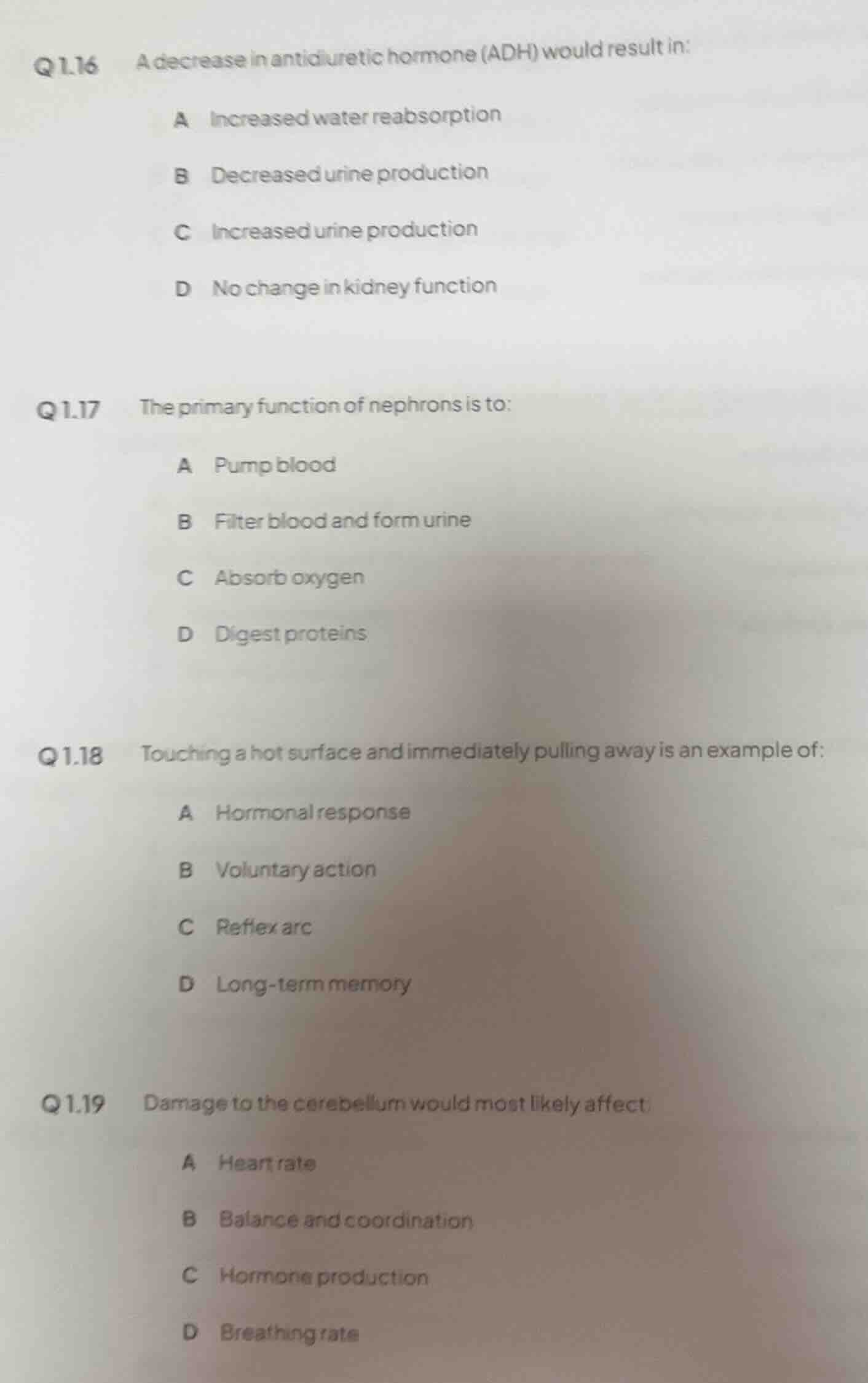
q 1.16 a decrease in antidiuretic hormone (adh) would result in:
a increased water reabsorption
b decreased urine production
c increased urine production
d no change in kidney function
q 1.17 the primary function of nephrons is to:
a pump blood
b filter blood and form urine
c absorb oxygen
d digest proteins
q 1.18 touching a hot surface and immediately pulling away is an example of:
a hormonal response
b voluntary action
c reflex arc
d long-term memory
q 1.19 damage to the cerebellum would most likely affect:
a heart rate
b balance and coordination
c hormone production
d breathing rate
Analyze Q1.16: ADH decrease
Antidiuretic hormone (ADH) promotes water reabsorption in the kidneys. A decrease in ADH reduces water reabsorption, leading to increased urine production (diuresis).
Analyze Q1.17: Nephron function
Nephrons are the functional units of the kidney. Their primary role is to filter blood, reabsorb essential substances, and secrete wastes to form urine.
Analyze Q1.18: Reflex arc
Touching a hot surface and immediately pulling away is an involuntary, rapid response mediated by a neural pathway called a reflex arc.
Analyze Q1.19: Cerebellum damage
The cerebellum is responsible for coordinating voluntary movements, balance, posture, and motor control. Damage to it impairs balance and coordination.

Snap & solve any problem in the app
Get step-by-step solutions on Sovi AI
Photo-based solutions with guided steps
Explore more problems and detailed explanations
Question 1.16
- A Increased water reabsorption
- B Decreased urine production
- C Increased urine production (Correct answer)
- D No change in kidney function
Question 1.17
- A Pump blood
- B Filter blood and form urine (Correct answer)
- C Absorb oxygen
- D Digest proteins
Question 1.18
- A Hormonal response
- B Voluntary action</mcq-correct>
- C Reflex arc (Correct answer)
<mcq-option>D Long-term memory
Question 1.19
- A Heart rate
- B Balance and coordination (Correct answer)
- C Hormone production
- D Breathing rate