QUESTION IMAGE
Question
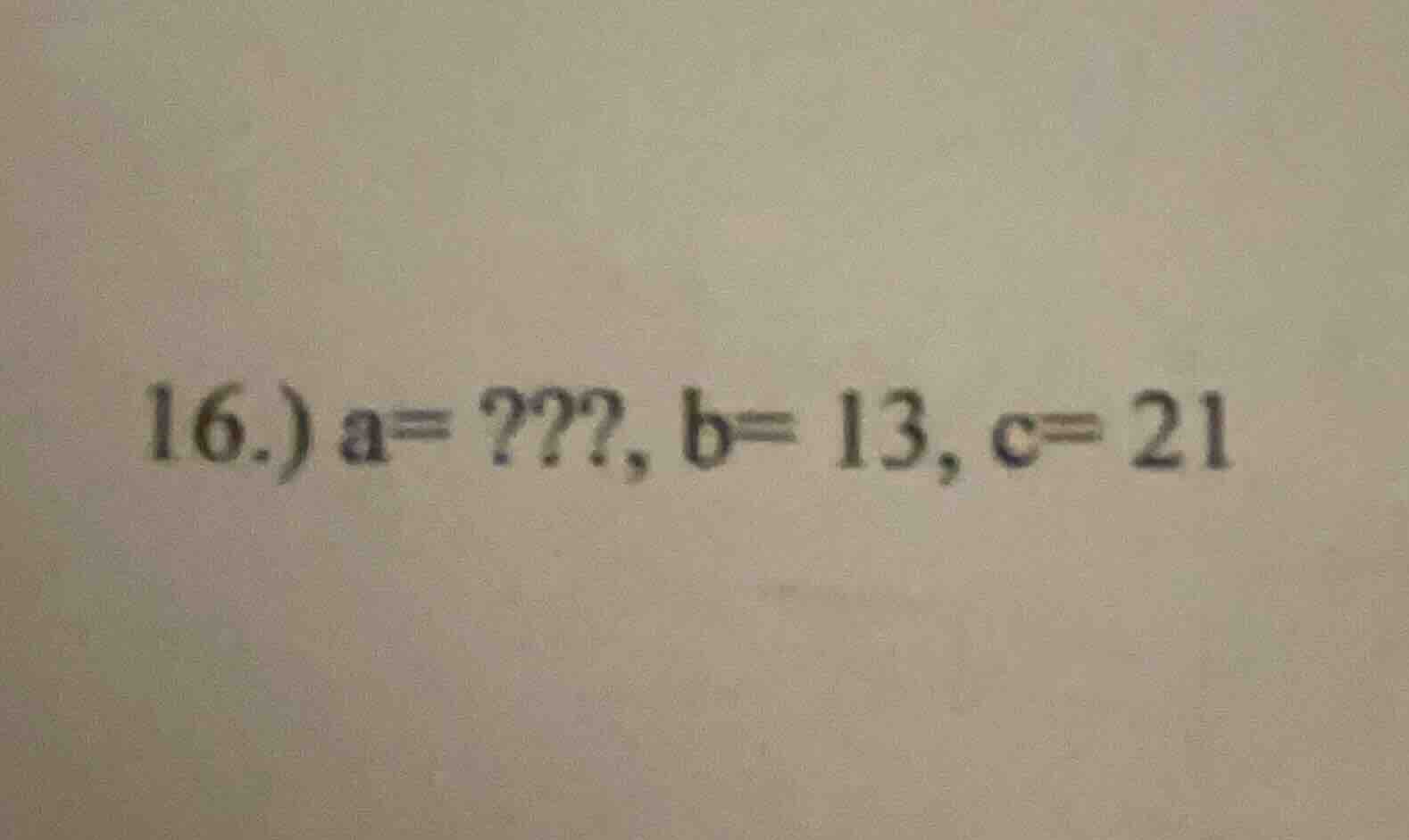
16.) a=???, b= 13, c= 21
Assuming this is a right - triangle problem where \(c\) is the hypotenuse (the longest side) and we use the Pythagorean theorem \(a^{2}+b^{2}=c^{2}\) (if \(a\) and \(b\) are the legs and \(c\) is the hypotenuse).
Step 1: Recall the Pythagorean theorem
The Pythagorean theorem for a right triangle is \(a^{2}+b^{2}=c^{2}\), where \(c\) is the hypotenuse and \(a\), \(b\) are the legs of the right triangle. We want to solve for \(a\), so we can re - arrange the formula to \(a^{2}=c^{2}-b^{2}\)
Step 2: Substitute the given values of \(b\) and \(c\)
We know that \(b = 13\) and \(c=21\). Substitute these values into the formula \(a^{2}=c^{2}-b^{2}\). So \(a^{2}=21^{2}-13^{2}\)
First, calculate \(21^{2}=21\times21 = 441\) and \(13^{2}=13\times13=169\)
Then \(a^{2}=441 - 169=272\)
Step 3: Solve for \(a\)
Take the square root of both sides to find \(a\). \(a=\sqrt{272}\). We can simplify \(\sqrt{272}=\sqrt{16\times17}=4\sqrt{17}\approx16.49\) (if we want a decimal approximation)
If we assume that \(a\) is the hypotenuse (but since \(c = 21>b = 13\), it's more likely that \(c\) is the hypotenuse), and if \(a\) were the hypotenuse, the formula would be \(a^{2}=b^{2}+c^{2}\), then \(a^{2}=13^{2}+21^{2}=169 + 441=610\), and \(a=\sqrt{610}\approx24.7\). But since \(c = 21\) is larger than \(b = 13\), the first case (where \(c\) is the hypotenuse) is more reasonable.

Snap & solve any problem in the app
Get step-by-step solutions on Sovi AI
Photo-based solutions with guided steps
Explore more problems and detailed explanations
If \(c\) is the hypotenuse, \(a=\sqrt{272}=4\sqrt{17}\approx16.49\); if \(a\) is the hypotenuse, \(a=\sqrt{610}\approx24.7\). But based on the fact that \(c = 21\) is longer than \(b = 13\), the more probable value (when \(c\) is the hypotenuse) is \(a = \sqrt{21^{2}-13^{2}}=\sqrt{441 - 169}=\sqrt{272}\approx16.49\) or \(4\sqrt{17}\)