QUESTION IMAGE
Question
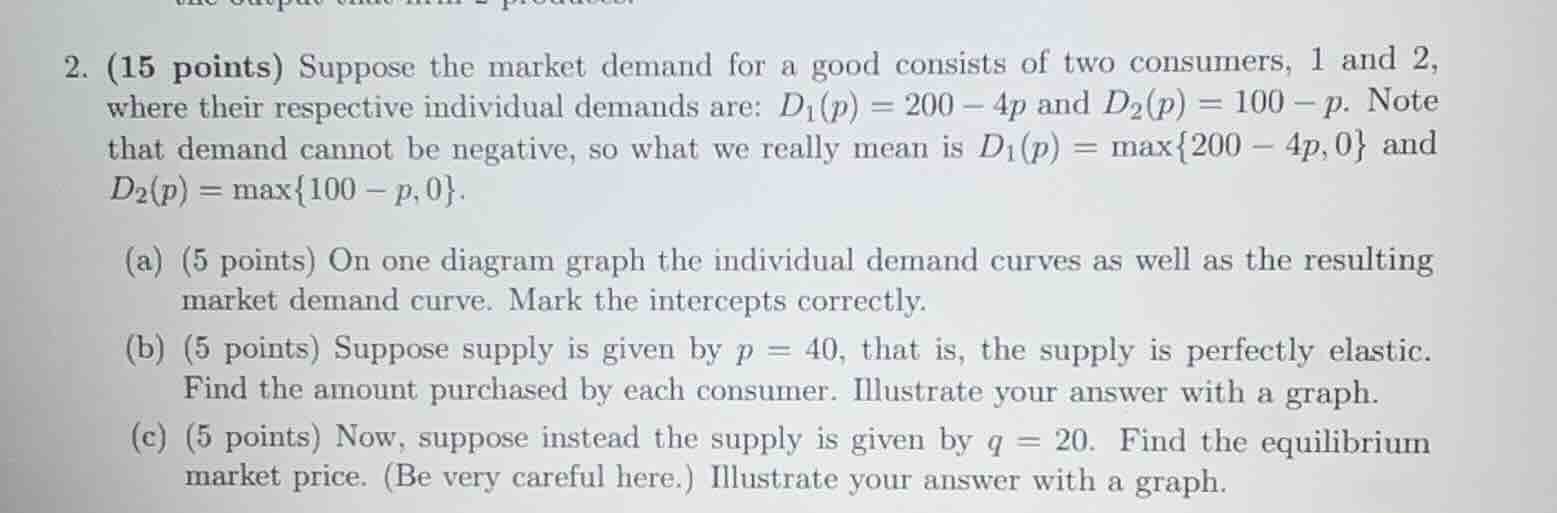
- (15 points) suppose the market demand for a good consists of two consumers, 1 and 2, where their respective individual demands are: \\(d_1(p) = 200 - 4p\\) and \\(d_2(p) = 100 - p\\). note that demand cannot be negative, so what we really mean is \\(d_1(p) = \max\\{200 - 4p, 0\\}\\) and \\(d_2(p) = \max\\{100 - p, 0\\}\\).
(a) (5 points) on one diagram graph the individual demand curves as well as the resulting market demand curve. mark the intercepts correctly.
(b) (5 points) suppose supply is given by \\(p = 40\\), that is, the supply is perfectly elastic. find the amount purchased by each consumer. illustrate your answer with a graph.
(c) (5 points) now, suppose instead the supply is given by \\(q = 20\\). find the equilibrium market price. (be very careful here.) illustrate your answer with a graph.
Aggregate individual demands
Using the Market Equilibrium knowledge point, we sum individual demands horizontally.
Individual demands are:
For \(p \ge 100\):
For \(50 \le p < 100\):
For \(p < 50\):
Find quantities at price \(p = 40\)
Substitute \(p = 40\) into individual demand functions:
Total market quantity purchased:
Find equilibrium price for supply \(q = 20\)
We set the market demand equal to the fixed supply \(Q = 20\).
Since \(20 < 50\) (the quantity at the kink point where \(p = 50\) is \(D(50) = 50\)), the equilibrium must occur on the upper segment of the market demand curve where only consumer 2 purchases the good.
Using the segment for \(50 \le p < 100\):
At \(p = 80\):

Snap & solve any problem in the app
Get step-by-step solutions on Sovi AI
Photo-based solutions with guided steps
Explore more problems and detailed explanations
Question 2
(a) The individual demand curves and the resulting market demand curve are defined as:
- Consumer 1 Demand: \(D_1(p) = 200 - 4p\) for \(p \in [0, 50]\), with intercepts at \((q=200, p=0)\) and \((q=0, p=50)\).
- Consumer 2 Demand: \(D_2(p) = 100 - p\) for \(p \in [0, 100]\), with intercepts at \((q=100, p=0)\) and \((q=0, p=100)\).
- Market Demand:
The market demand curve has a kink at \((q=50, p=50)\), with intercepts at \((q=300, p=0)\) and \((q=0, p=100)\).
(b) When supply is perfectly elastic at \(p = 40\):
- Amount purchased by Consumer 1: \(q_1 = 40\) units.
- Amount purchased by Consumer 2: \(q_2 = 60\) units.
- Total market quantity: \(Q = 100\) units.
(c) When supply is fixed at \(q = 20\):
- The equilibrium market price is \(p = 80\).
- At this price, Consumer 1 purchases \(q_1 = 0\) units, and Consumer 2 purchases \(q_2 = 20\) units.