QUESTION IMAGE
Question
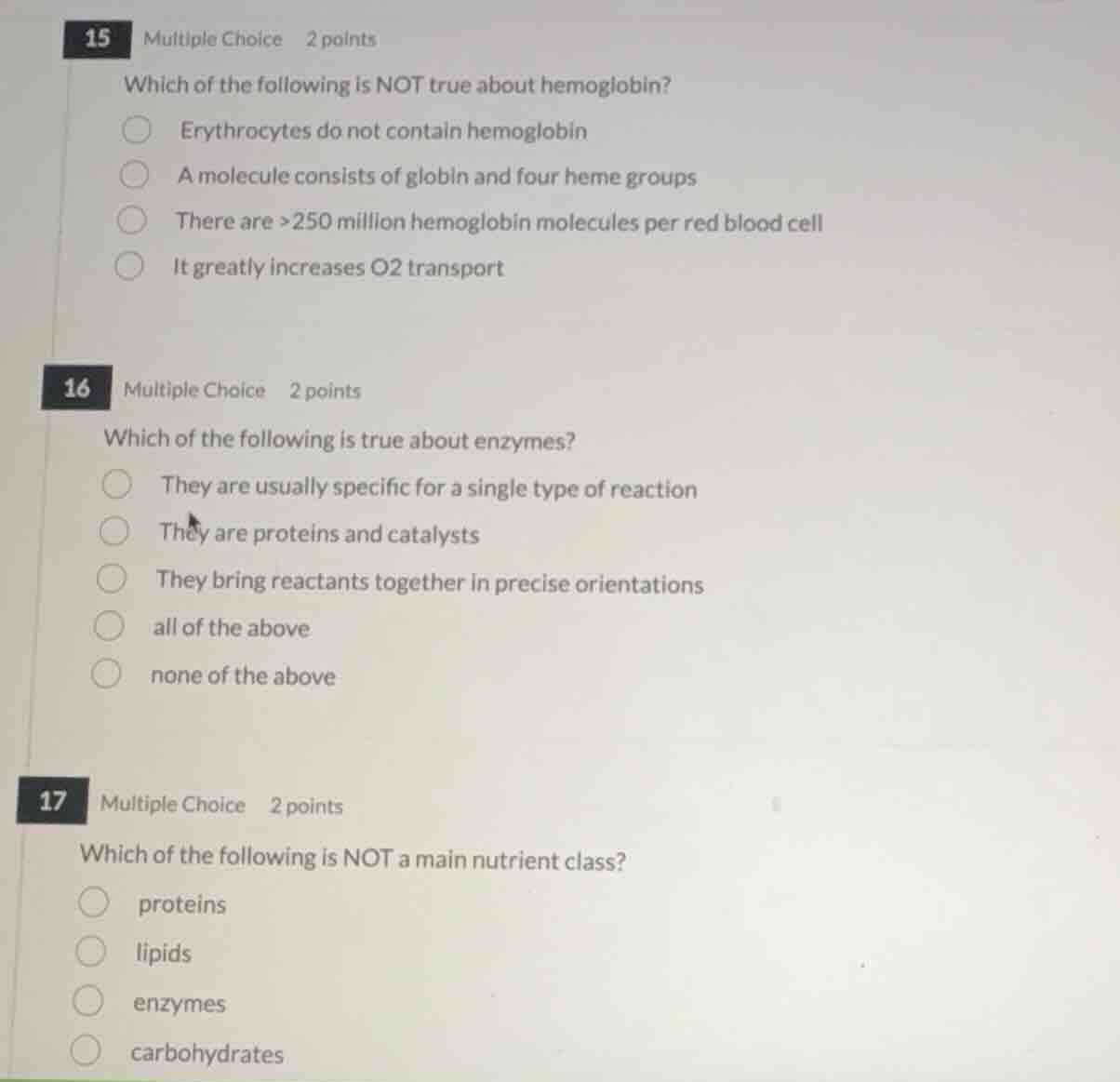
15 multiple choice 2 points
which of the following is not true about hemoglobin?
erythrocytes do not contain hemoglobin
a molecule consists of globin and four heme groups
there are >250 million hemoglobin molecules per red blood cell
it greatly increases o2 transport
16 multiple choice 2 points
which of the following is true about enzymes?
they are usually specific for a single type of reaction
they are proteins and catalysts
they bring reactants together in precise orientations
all of the above
none of the above
17 multiple choice 2 points
which of the following is not a main nutrient class?
proteins
lipids
enzymes
carbohydrates
Analyze hemoglobin characteristics
- Erythrocytes (red blood cells) are packed with hemoglobin, which is essential for oxygen transport. The statement "Erythrocytes do not contain hemoglobin" is false.
- Hemoglobin consists of globin proteins and four iron-containing heme groups.
- Each red blood cell contains approximately 250–280 million hemoglobin molecules.
- Hemoglobin greatly increases the blood's oxygen-carrying capacity.
Analyze enzyme characteristics
- Enzymes are highly specific catalysts, typically accelerating a single type of chemical reaction.
- Most enzymes are proteins that act as biological catalysts.
- Enzymes bind substrates at their active sites, bringing reactants together in precise orientations to facilitate the reaction.
- Since all individual statements are true, "all of the above" is the correct choice.
Identify main nutrient classes
- The six major classes of nutrients required by the body are carbohydrates, lipids, proteins, water, vitamins, and minerals.
- Enzymes are biological catalysts (proteins) produced by the body to speed up chemical reactions, but they are not classified as a dietary nutrient class.

Snap & solve any problem in the app
Get step-by-step solutions on Sovi AI
Photo-based solutions with guided steps
Explore more problems and detailed explanations
Question 15
- (A) Erythrocytes do not contain hemoglobin (Correct answer)
- (B) A molecule consists of globin and four heme groups
- (C) There are >250 million hemoglobin molecules per red blood cell
- (D) It greatly increases O2 transport
Question 16
- (A) They are usually specific for a single type of reaction
- (B) They are proteins and catalysts
- (C) They bring reactants together in precise orientations
- (D) all of the above (Correct answer)
- (E) none of the above
Question 17
- (A) proteins
- (B) lipids
- (C) enzymes (Correct answer)
- (D) carbohydrates