QUESTION IMAGE
Question
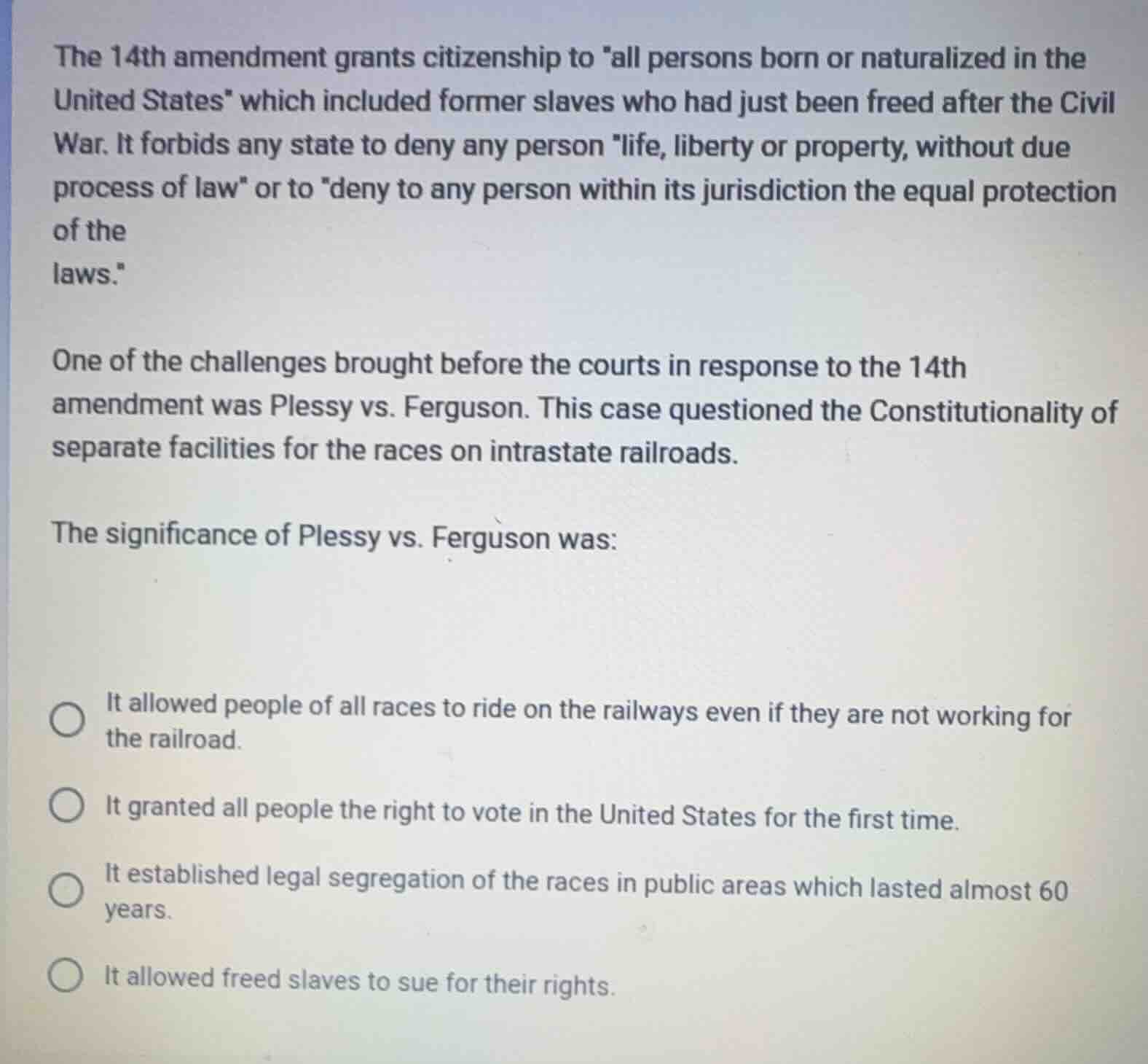
the 14th amendment grants citizenship to \all persons born or naturalized in the united states\ which included former slaves who had just been freed after the civil war. it forbids any state to deny any person \life, liberty or property, without due process of law\ or to \deny to any person within its jurisdiction the equal protection of the laws.\
one of the challenges brought before the courts in response to the 14th amendment was plessy vs. ferguson. this case questioned the constitutionality of separate facilities for the races on intrastate railroads.
the significance of plessy vs. ferguson was:
it allowed people of all races to ride on the railways even if they are not working for the railroad.
it granted all people the right to vote in the united states for the first time.
it established legal segregation of the races in public areas which lasted almost 60 years.
it allowed freed slaves to sue for their rights.
Analyze the historical context
The question discusses the 14th Amendment and its relationship to the landmark Supreme Court case Plessy v. Ferguson (1896). This connects directly to the Reconstruction Era and its legal aftermath.
Evaluate the legal question
Plessy v. Ferguson challenged the constitutionality of Louisiana's Separate Car Act, which mandated segregated railway cars. The plaintiff argued this violated the Equal Protection Clause of the 14th Amendment.
Assess the Supreme Court ruling
The Supreme Court ruled against Plessy, establishing the "separate but equal" doctrine. This decision constitutionally validated state-sponsored racial segregation.
Determine the long-term significance
This ruling legally sanctioned Jim Crow segregation across public facilities. This system remained the law of the land until it was overturned by Brown v. Board of Education in 1954, lasting nearly 60 years.
Match with the correct option
Evaluating the choices:
- Option 1 is incorrect; it does not address the constitutional issue of segregation.
- Option 2 is incorrect; voting rights were addressed by the 15th and 19th Amendments.
- Option 3 is correct; it established legal segregation in public areas for nearly 60 years.
- Option 4 is incorrect; the right of freed slaves to sue was established earlier (e.g., Civil Rights Act of 1866).

Snap & solve any problem in the app
Get step-by-step solutions on Sovi AI
Photo-based solutions with guided steps
Explore more problems and detailed explanations
- It allowed people of all races to ride on the railways even if they are not working for the railroad.
- It granted all people the right to vote in the United States for the first time.
- It established legal segregation of the races in public areas which lasted almost 60 years. (Correct answer)
- It allowed freed slaves to sue for their rights.