QUESTION IMAGE
Question
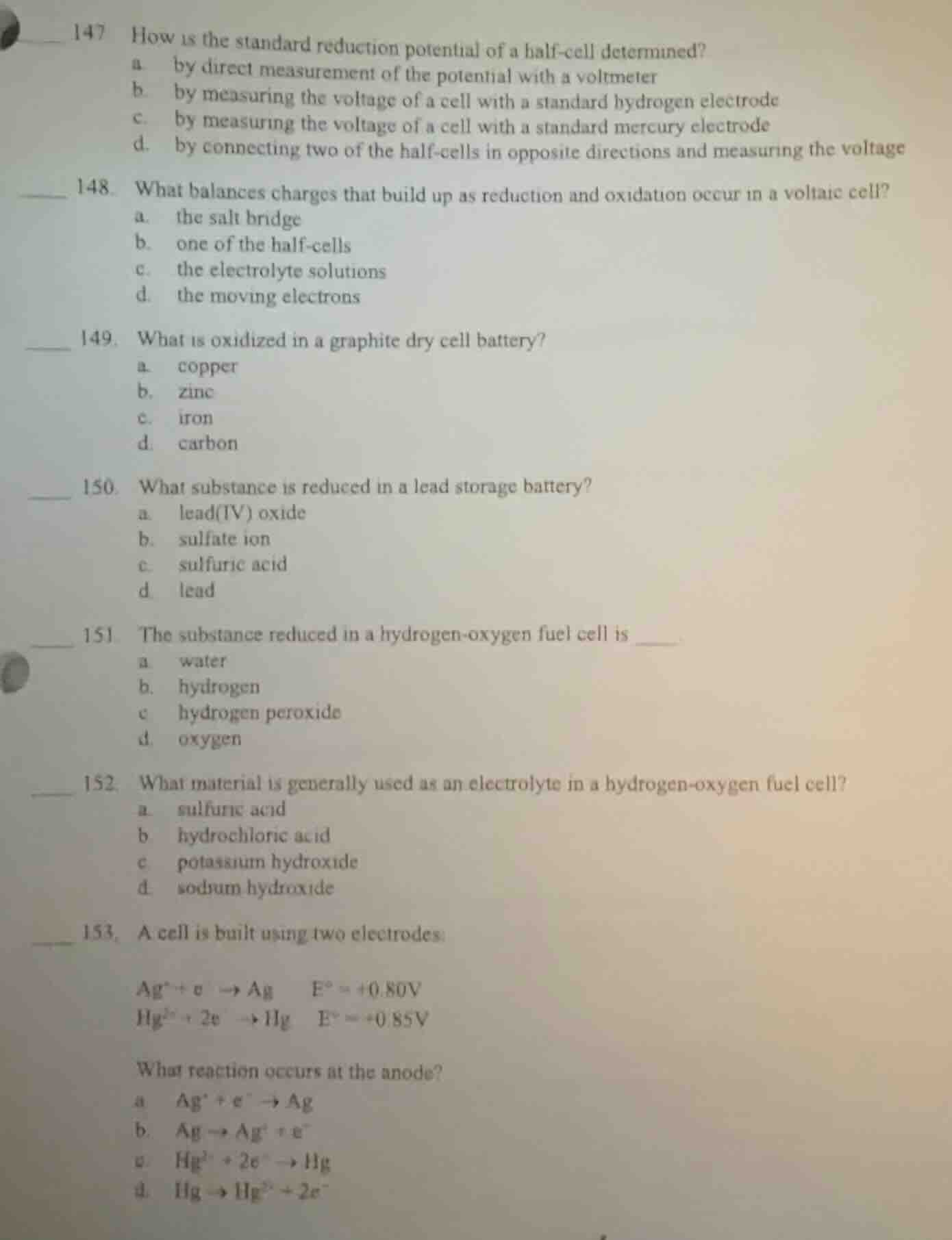
- how is the standard reduction potential of a half-cell determined?
a. by direct measurement of the potential with a voltmeter
b. by measuring the voltage of a cell with a standard hydrogen electrode
c. by measuring the voltage of a cell with a standard mercury electrode
d. by connecting two of the half-cells in opposite directions and measuring the voltage
- what balances charges that build up as reduction and oxidation occur in a voltaic cell?
a. the salt bridge
b. one of the half-cells
c. the electrolyte solutions
d. the moving electrons
- what is oxidized in a graphite dry cell battery?
a. copper
b. zinc
c. iron
d. carbon
- what substance is reduced in a lead storage battery?
a. lead(iv) oxide
b. sulfate ion
c. sulfuric acid
d. lead
- the substance reduced in a hydrogen-oxygen fuel cell is ______.
a. water
b. hydrogen
c. hydrogen peroxide
d. oxygen
- what material is generally used as an electrolyte in a hydrogen-oxygen fuel cell?
a. sulfuric acid
b. hydrochloric acid
c. potassium hydroxide
d. sodium hydroxide
- a cell is built using two electrodes:
\\(\text{ag}^+ + \text{e}^- \
ightarrow \text{ag} \quad e^\circ = +0.80\text{v}\\)
\\(\text{hg}^{2+} + 2\text{e}^- \
ightarrow \text{hg} \quad e^\circ = +0.85\text{v}\\)
what reaction occurs at the anode?
a. \\(\text{ag}^+ + \text{e}^- \
ightarrow \text{ag}\\)
b. \\(\text{ag} \
ightarrow \text{ag}^+ + \text{e}^-\\)
c. \\(\text{hg}^{2+} + 2\text{e}^- \
ightarrow \text{hg}\\)
d. \\(\text{hg} \
ightarrow \text{hg}^{2+} + 2\text{e}^-\\)
Determine standard reduction potential
Using the Voltaic Cell Design knowledge point
The standard reduction potential of any half-cell cannot be measured in isolation. It is determined by measuring the cell potential of a galvanic cell composed of the half-cell of interest connected to a standard reference electrode. By international convention, the reference standard is the standard hydrogen electrode (SHE), which is assigned a potential of exactly \(0.00\text{ V}\). Therefore, the measured cell voltage directly equals the standard reduction potential of the other half-cell. This corresponds to option (b).
Identify charge balance mechanism
Using the Voltaic Cell Design knowledge point
As oxidation and reduction reactions proceed in a voltaic cell, positive ions accumulate at the anode and negative ions accumulate at the cathode. To maintain electrical neutrality and allow current to flow continuously, a salt bridge is used. The salt bridge contains inert ions that migrate into the half-cells to balance these accumulating charges. This corresponds to option (a).
Identify oxidized species in dry cell
In a standard zinc-carbon (graphite) dry cell battery, the anode container is made of zinc metal, and the cathode is a carbon (graphite) rod surrounded by manganese dioxide. Oxidation occurs at the anode, where zinc metal (\(\text{Zn}\)) is oxidized to zinc ions (\(\text{Zn}^{2+}\)). Carbon serves only as an inert conductor. This corresponds to option (b).
Identify reduced species in lead storage battery
In a lead storage battery, the cathode consists of lead(IV) oxide (\(\text{PbO}_2\)) packed on a metal grid. During discharge, lead(IV) oxide is reduced to lead(II) sulfate (\(\text{PbSO}_4\)), where the oxidation state of lead decreases from +4 to +2. This corresponds to option (a).
Identify reduced species in fuel cell
In a hydrogen-oxygen fuel cell, hydrogen gas (\(\text{H}_2\)) is fed to the anode where it undergoes oxidation to form water. Oxygen gas (\(\text{O}_2\)) is fed to the cathode where it undergoes reduction, combining with electrons and protons to form water. Thus, oxygen is the substance reduced. This corresponds to option (d).
Identify electrolyte in fuel cell
A standard alkaline hydrogen-oxygen fuel cell typically uses a concentrated aqueous solution of potassium hydroxide (\(\text{KOH}\)) as its electrolyte because of its high ionic conductivity and compatibility with the alkaline electrodes. This corresponds to option (c).
Determine anode reaction
Using the Voltaic Cell Design knowledge point
The standard reduction potentials are given as:
The half-cell with the higher reduction potential (\(\text{Hg}^{2+}/\text{Hg}\)) will undergo reduction at the cathode:
The half-cell with the lower reduction potential (\(\text{Ag}^+/\text{Ag}\)) must undergo oxidation at the anode…

Snap & solve any problem in the app
Get step-by-step solutions on Sovi AI
Photo-based solutions with guided steps
Explore more problems and detailed explanations
Question 147
- a. by direct measurement of the potential with a voltmeter
- b. by measuring the voltage of a cell with a standard hydrogen electrode (Correct answer)
- c. by measuring the voltage of a cell with a standard mercury electrode
- d. by connecting two of the half-cells in opposite directions and measuring the voltage
Question 148
- a. the salt bridge (Correct answer)
- b. one of the half-cells
- c. the electrolyte solutions
- d. the moving electrons
Question 149
- a. copper
- b. zinc (Correct answer)
- c. iron
- d. carbon
Question 150
- a. lead(IV) oxide (Correct answer)
- b. sulfate ion
- c. sulfuric acid
- d. lead
Question 151
- a. water
- b. hydrogen
- c. hydrogen peroxide
- d. oxygen (Correct answer)
Question 152
- a. sulfuric acid
- b. hydrochloric acid
- c. potassium hydroxide (Correct answer)
- d. sodium hydroxide
Question 153
- a. \(\text{Ag}^+ + e^-
ightarrow \text{Ag}\)
- **b. \(\text{Ag}
ightarrow \text{Ag}^+ + e^-\) (Correct answer)**
- c. \(\text{Hg}^{2+} + 2e^-
ightarrow \text{Hg}\)
- d. \(\text{Hg}
ightarrow \text{Hg}^{2+} + 2e^-\)