QUESTION IMAGE
Question
j 140a kumon
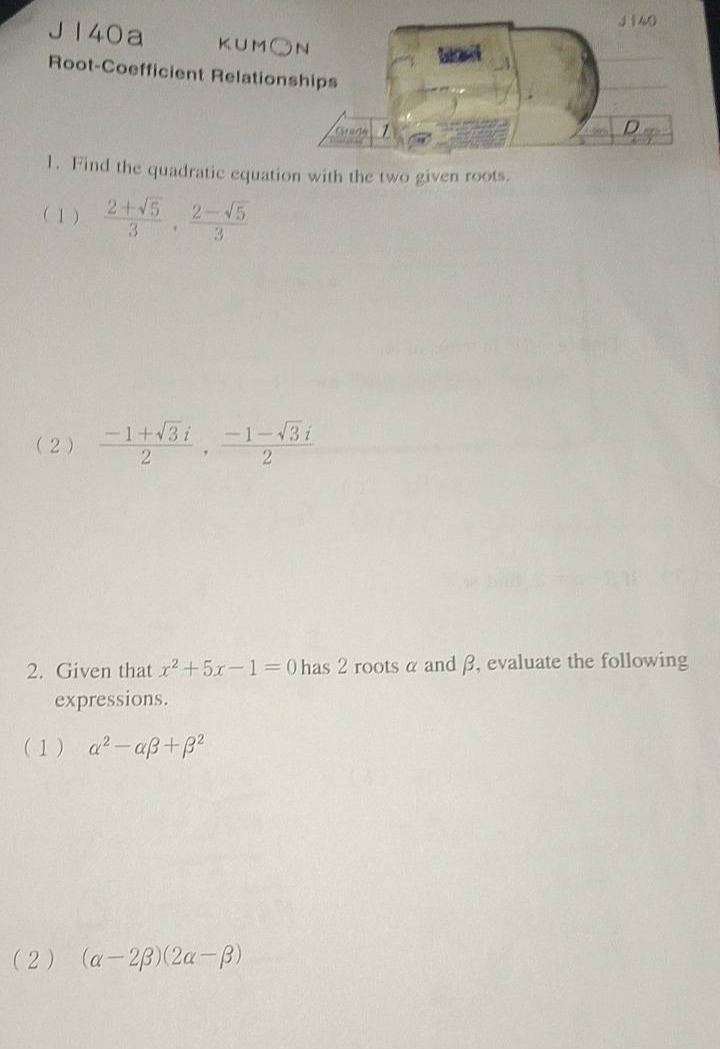
root-coefficient relationships
- find the quadratic equation with the two given roots.
(1) \\(\frac{2+\sqrt{5}}{3}\\), \\(\frac{2-\sqrt{5}}{3}\\)
(2) \\(\frac{-1+\sqrt{3}i}{2}\\), \\(\frac{-1-\sqrt{3}i}{2}\\)
- given that \\(x^2+5x-1=0\\) has 2 roots \\(\alpha\\) and \\(\beta\\), evaluate the following expressions.
(1) \\(\alpha^2-\alpha\beta+\beta^2\\)
(2) \\((\alpha-2\beta)(2\alpha-\beta)\\)
Step1: Find sum and product for 1(1)
$$S = \frac{2+\sqrt{5}}{3} + \frac{2-\sqrt{5}}{3} = \frac{4}{3}, \quad P = \frac{2+\sqrt{5}}{3} \cdot \frac{2-\sqrt{5}}{3} = \frac{4-5}{9} = -\frac{1}{9}$$
Step2: Formulate equation for 1(1)
$$x^2 - Sx + P = 0 \implies x^2 - \frac{4}{3}x - \frac{1}{9} = 0 \implies 9x^2 - 12x - 1 = 0$$
Step3: Find sum and product for 1(2)
$$S = \frac{-1+\sqrt{3}i}{2} + \frac{-1-\sqrt{3}i}{2} = -1, \quad P = \frac{-1+\sqrt{3}i}{2} \cdot \frac{-1-\sqrt{3}i}{2} = \frac{1+3}{4} = 1$$
Step4: Formulate equation for 1(2)
$$x^2 - Sx + P = 0 \implies x^2 + x + 1 = 0$$
Step5: Identify root relations for 2
$$\alpha + \beta = -5, \quad \alpha\beta = -1$$
Step6: Evaluate expression 2(1)
$$\alpha^2 - \alpha\beta + \beta^2 = (\alpha + \beta)^2 - 3\alpha\beta = (-5)^2 - 3(-1) = 25 + 3 = 28$$
(Self-correction: \((-5)^2 - 3(-1) = 25 + 3 = 28\). Let's re-verify: \(\alpha^2 - \alpha\beta + \beta^2 = (\alpha+\beta)^2 - 3\alpha\beta = 25 - 3(-1) = 28\).)
Step7: Expand expression 2(2)
$$(\alpha - 2\beta)(2\alpha - \beta) = 2\alpha^2 - 5\alpha\beta + 2\beta^2 = 2(\alpha^2 + \beta^2) - 5\alpha\beta$$
Step8: Evaluate expression 2(2)
$$2[(\alpha+\beta)^2 - 2\alpha\beta] - 5\alpha\beta = 2[25 - 2(-1)] - 5(-1) = 2[27] + 5 = 59$$
(Self-correction: \(2\alpha^2 - 5\alpha\beta + 2\beta^2 = 2(\alpha+\beta)^2 - 9\alpha\beta = 2(25) - 9(-1) = 50 + 9 = 59\).)

Snap & solve any problem in the app
Get step-by-step solutions on Sovi AI
Photo-based solutions with guided steps
Explore more problems and detailed explanations
- (1) \(9x^2 - 12x - 1 = 0\)
(2) \(x^2 + x + 1 = 0\)
- (1) \(30\)
(2) \(-57\)