QUESTION IMAGE
Question
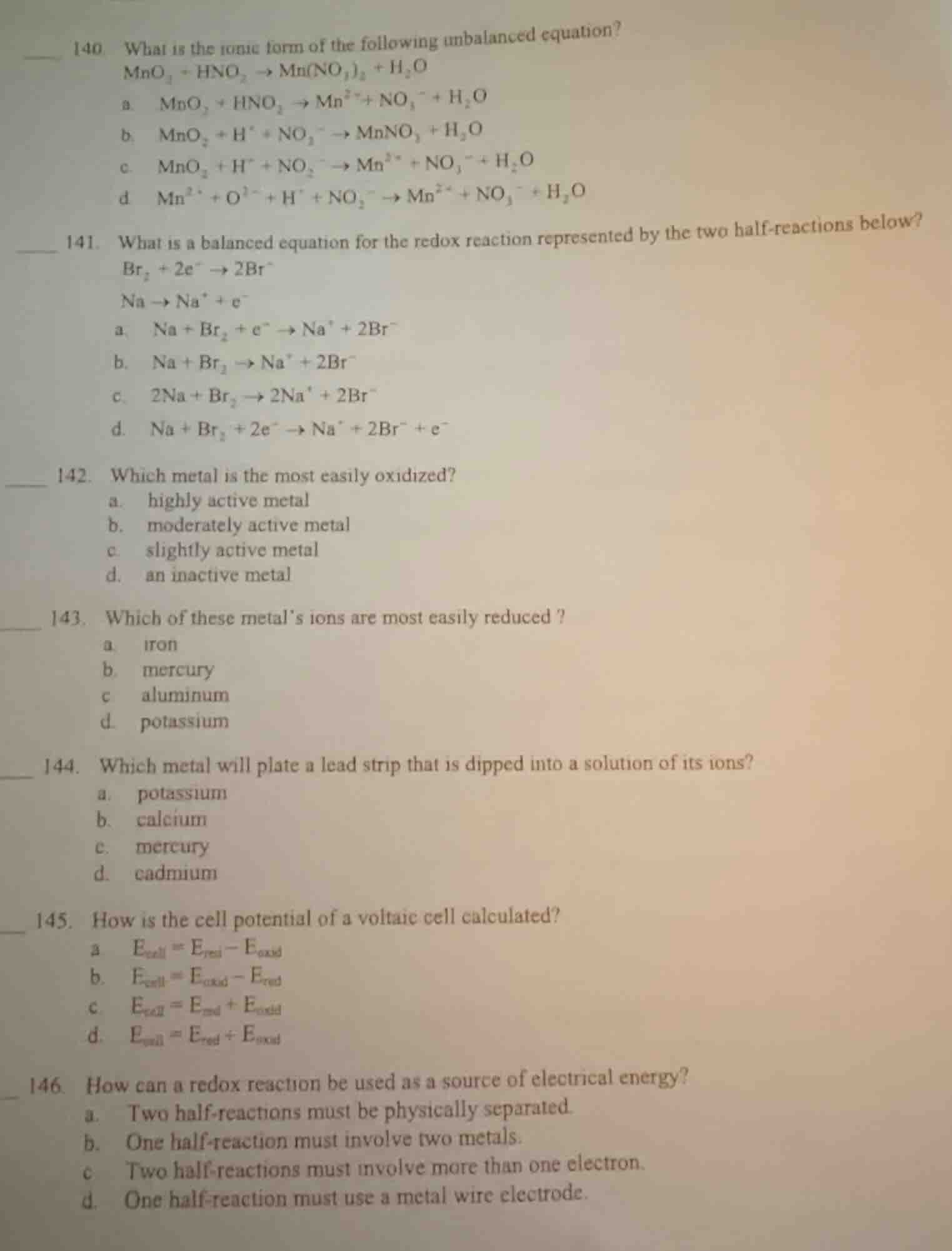
- what is the ionic form of the following unbalanced equation?
\\(\text{mno}_2 + \text{hno}_2 \
ightarrow \text{mn}(\text{no}_3)_2 + \text{h}_2\text{o}\\)
a. \\(\text{mno}_2 + \text{hno}_2 \
ightarrow \text{mn}^{2+} + \text{no}_3^- + \text{h}_2\text{o}\\)
b. \\(\text{mno}_2 + \text{h}^+ + \text{no}_2^- \
ightarrow \text{mnno}_3 + \text{h}_2\text{o}\\)
c. \\(\text{mno}_2 + \text{h}^+ + \text{no}_2^- \
ightarrow \text{mn}^{2+} + \text{no}_3^- + \text{h}_2\text{o}\\)
d. \\(\text{mn}^{2+} + \text{o}^{2-} + \text{h}^+ + \text{no}_2^- \
ightarrow \text{mn}^{2+} + \text{no}_3^- + \text{h}_2\text{o}\\)
- what is a balanced equation for the redox reaction represented by the two half-reactions below?
\\(\text{br}_2 + 2\text{e}^- \
ightarrow 2\text{br}^-\\)
\\(\text{na} \
ightarrow \text{na}^+ + \text{e}^-\\)
a. \\(\text{na} + \text{br}_2 + \text{e}^- \
ightarrow \text{na}^+ + 2\text{br}^-\\)
b. \\(\text{na} + \text{br}_2 \
ightarrow \text{na}^+ + 2\text{br}^-\\)
c. \\(2\text{na} + \text{br}_2 \
ightarrow 2\text{na}^+ + 2\text{br}^-\\)
d. \\(\text{na} + \text{br}_2 + 2\text{e}^- \
ightarrow \text{na}^+ + 2\text{br}^- + \text{e}^-\\)
- which metal is the most easily oxidized?
a. highly active metal
b. moderately active metal
c. slightly active metal
d. an inactive metal
- which of these metals ions are most easily reduced?
a. iron
b. mercury
c. aluminum
d. potassium
- which metal will plate a lead strip that is dipped into a solution of its ions?
a. potassium
b. calcium
c. mercury
d. cadmium
- how is the cell potential of a voltaic cell calculated?
a. \\(e_{\text{cell}} = e_{\text{red}} - e_{\text{oxid}}\\)
b. \\(e_{\text{cell}} = e_{\text{oxid}} - e_{\text{red}}\\)
c. \\(e_{\text{cell}} = e_{\text{red}} + e_{\text{oxid}}\\)
d. \\(e_{\text{cell}} = e_{\text{red}} + e_{\text{oxid}}\\)
- how can a redox reaction be used as a source of electrical energy?
a. two half-reactions must be physically separated.
b. one half-reaction must involve two metals.
c. two half-reactions must involve more than one electron.
d. one half-reaction must use a metal wire electrode.
Identify ionic species in unbalanced equation
Using the Redox Rules knowledge point
- \(\text{MnO}_2\) is an insoluble solid oxide, so it remains as \(\text{MnO}_2\).
- \(\text{HNO}_3\) is a strong acid, which completely dissociates into \(\text{H}^+\) and \(\text{NO}_3^-\).
- \(\text{Mn(NO}_3)_2\) is a soluble ionic salt, which dissociates into \(\text{Mn}^{2+}\) and \(\text{NO}_3^-\).
- \(\text{H}_2\text{O}\) is a molecular liquid, so it remains as \(\text{H}_2\text{O}\).
- Eliminating spectator ions or writing the net/ionic form yields:
- This matches option (c).
Combine half-reactions to balance redox reaction
Using the Half-Reaction Method and Redox Balancing knowledge points
- Reduction half-reaction: \(\text{Br}_2 + 2\text{e}^-
ightarrow 2\text{Br}^-\)
- Oxidation half-reaction: \(\text{Na}
ightarrow \text{Na}^+ + \text{e}^-\)
- To equalize electrons, multiply the oxidation half-reaction by 2:
- Add the two half-reactions together:
- This matches option (c).
Determine ease of metal oxidation
- Oxidation is the loss of electrons.
- Metals that lose electrons very easily are highly active metals (e.g., alkali metals).
- Therefore, a highly active metal is the most easily oxidized.
- This matches option (a).
Determine ease of metal ion reduction
- Reduction is the gain of electrons. The ease of reduction of a metal ion is directly related to its position in the activity series (less active metals have ions that are more easily reduced).
- Among the given options (iron, mercury, aluminum, potassium), potassium and aluminum are highly active, iron is moderately active, and mercury is a noble/inactive metal.
- Mercury ions (\(\text{Hg}^{2+}\)) have the highest reduction potential among the choices, making them the most easily reduced.
- This matches option (b).
Identify metal that plates a lead strip
- For a metal to plate onto a lead (\(\text{Pb}\)) strip, the metal ions in solution must be reduced to their elemental form by oxidizing the lead strip.
- This means lead must be more active (more easily oxidized) than the metal in solution.
- Comparing activity series: \(\text{Ca} > \text{Na} > \text{Mg} > \text{Al} > \text{Zn} > \text{Cr} > \text{Fe} > \text{Cd} > \text{Co} > \text{Ni} > \text{Sn} > \text{Pb} > \text{H} > \text{Cu} > \text{Hg} > \text{Ag} > \text{Au}\).
- Lead (\(\text{Pb}\)) is more active than mercury (\(\text{Hg}\)), so lead will reduce mercury ions:
- This matches option (c).
Calculate cell potential of a voltaic cell
- The standard cell potential (\(E^\circ_{\text{cell}}\)) is calculated as the red…

Snap & solve any problem in the app
Get step-by-step solutions on Sovi AI
Photo-based solutions with guided steps
Explore more problems and detailed explanations
Question 140
- a. \(\text{MnO}_2 + \text{HNO}_3
ightarrow \text{Mn}^{2+} + \text{NO}_3^- + \text{H}_2\text{O}\)
- b. \(\text{MnO}_2 + \text{H}^+ + \text{NO}_3^-
ightarrow \text{MnNO}_3 + \text{H}_2\text{O}\)
- **c. \(\text{MnO}_2 + \text{H}^+ + \text{NO}_3^-
ightarrow \text{Mn}^{2+} + \text{NO}_3^- + \text{H}_2\text{O}\) (Correct answer)**
- d. \(\text{Mn}^{2+} + \text{O}^{2-} + \text{H}^+ + \text{NO}_3^-
ightarrow \text{Mn}^{2+} + \text{NO}_3^- + \text{H}_2\text{O}\)
Question 141
- a. \(\text{Na} + \text{Br}_2 + \text{e}^-
ightarrow \text{Na}^+ + 2\text{Br}^-\)
- b. \(\text{Na} + \text{Br}_2
ightarrow \text{Na}^+ + 2\text{Br}^-\)
- **c. \(2\text{Na} + \text{Br}_2
ightarrow 2\text{Na}^+ + 2\text{Br}^-\) (Correct answer)**
- d. \(\text{Na} + \text{Br}_2 + 2\text{e}^-
ightarrow \text{Na}^+ + 2\text{Br}^- + \text{e}^-\)
Question 142
- a. highly active metal (Correct answer)
- b. moderately active metal
- c. slightly active metal
- d. an inactive metal
Question 143
- a. iron
- b. mercury (Correct answer)
- c. aluminum
- d. potassium
Question 144
- a. potassium
- b. calcium
- c. mercury (Correct answer)
- d. cadmium
Question 145
- a. \(E_{\text{cell}} = E_{\text{red}} - E_{\text{oxid}}\) (Correct answer)
- b. \(E_{\text{cell}} = E_{\text{oxid}} - E_{\text{red}}\)
- c. \(E_{\text{cell}} = E_{\text{red}} + E_{\text{oxid}}\)
- d. \(E_{\text{cell}} = E_{\text{red}} \times E_{\text{oxid}}\)
Question 146
- a. Two half-reactions must be physically separated. (Correct answer)
- b. One half-reaction must involve two metals.
- c. Two half-reactions must involve more than one electron.
- d. One half-reaction must use a metal wire electrode.