QUESTION IMAGE
Question
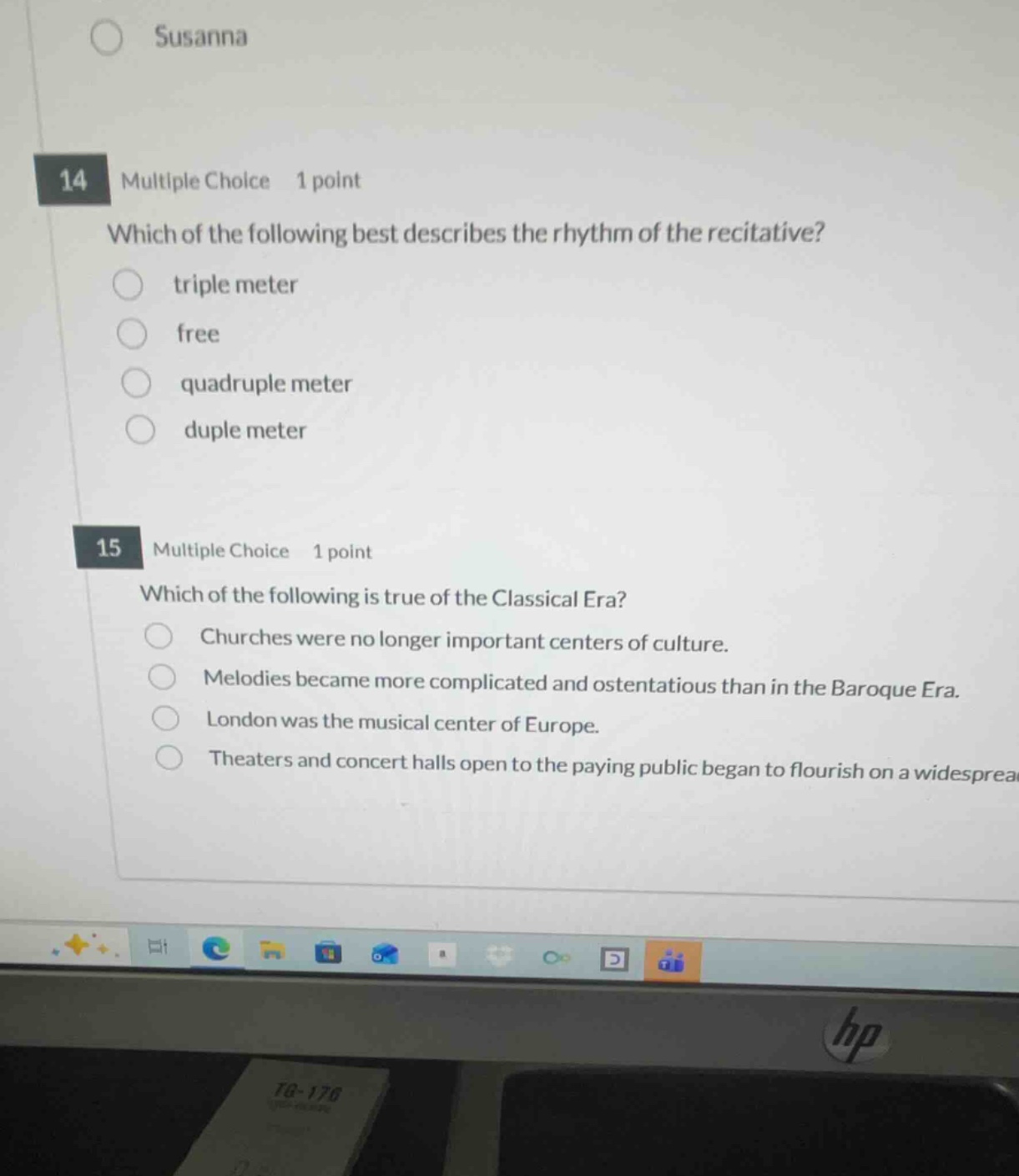
14 multiple choice 1 point
which of the following best describes the rhythm of the recitative?
triple meter
free
quadruple meter
duple meter
15 multiple choice 1 point
which of the following is true of the classical era?
churches were no longer important centers of culture.
melodies became more complicated and ostentatious than in the baroque era.
london was the musical center of europe.
theaters and concert halls open to the paying public began to flourish on a widespread scale.
Analyze the rhythm of recitative
Using the Recitative Style knowledge point
- Recitative mimics natural speech patterns rather than following a strict, regular musical meter.
- Because it imitates the natural inflections and pacing of spoken text, its rhythm is characterized as free or non-metric.
- This allows the singer to deliver dialogue quickly and expressively, unfettered by a steady beat.
Analyze Classical Era historical developments
Using the Classical Era Historical Context knowledge point
- During the Classical Era, music moved increasingly from private aristocratic courts and churches into the public sphere.
- The rise of the middle class led to a significant expansion of public concert life.
- Consequently, public theaters and concert halls open to paying audiences began to flourish on a widespread scale.
- Other options are incorrect: churches remained culturally active, melodies became simpler and more balanced (not more complicated/ostentatious) than Baroque melodies, and Vienna (not London) was the primary musical capital of Europe.

Snap & solve any problem in the app
Get step-by-step solutions on Sovi AI
Photo-based solutions with guided steps
Explore more problems and detailed explanations
Question 14
- (A) triple meter
- (B) free (Correct answer)
- (C) quadruple meter
- (D) duple meter
Question 15
- (A) Churches were no longer important centers of culture.
- (B) Melodies became more complicated and ostentatious than in the Baroque Era.
- (C) London was the musical center of Europe.
- (D) Theaters and concert halls open to the paying public began to flourish on a widespread scale. (Correct answer)