QUESTION IMAGE
Question
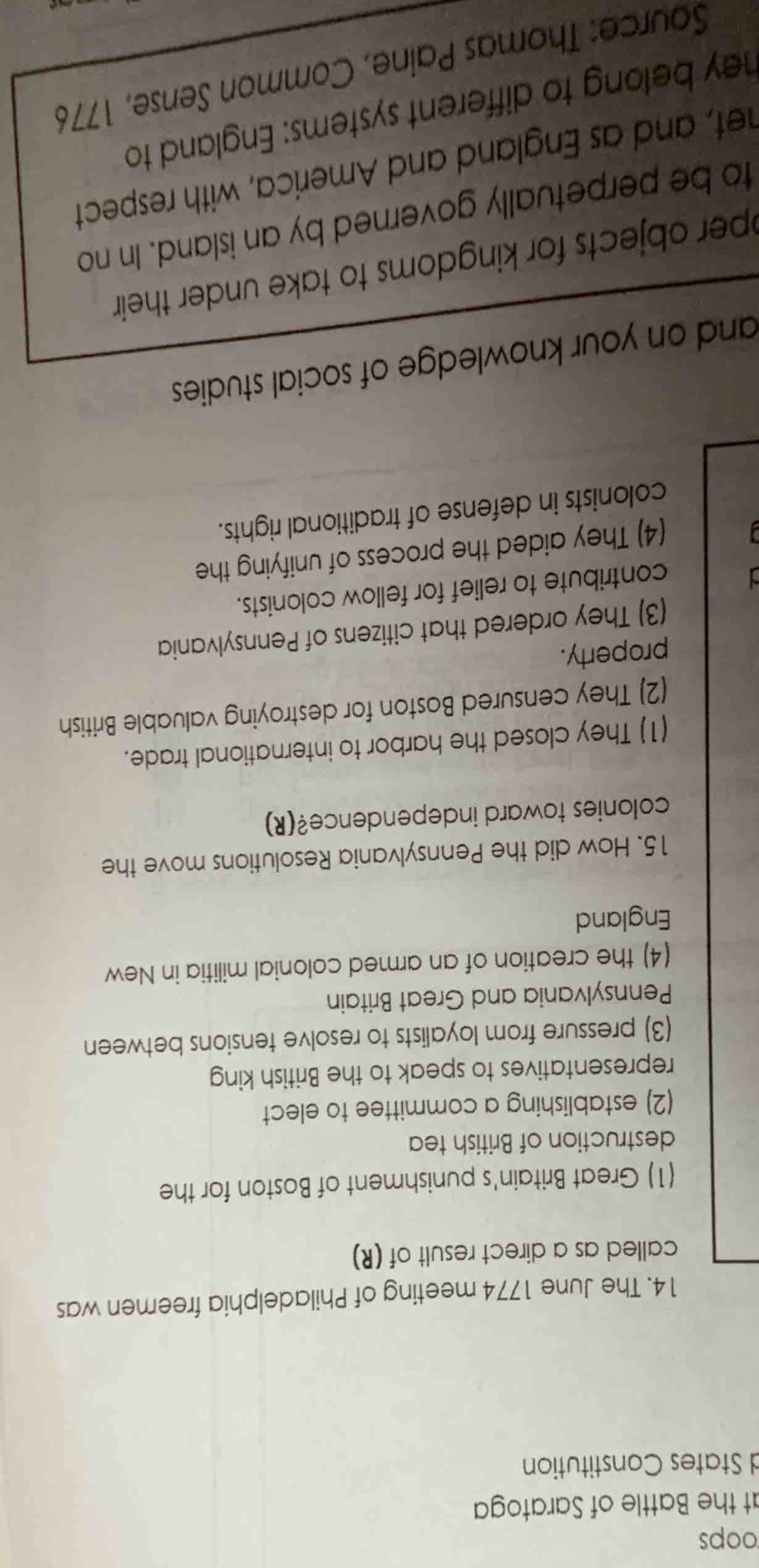
- the june 1774 meeting of philadelphia freemen was called as a direct result of (r)
(1) great britains punishment of boston for the destruction of british tea
(2) establishing a committee to elect representatives to speak to the british king
(3) pressure from loyalists to resolve tensions between pennsylvania and great britain
(4) the creation of an armed colonial militia in new new england
- how did the pennsylvania resolutions move the colonies toward independence? (r)
(1) they closed the harbor to international trade.
(2) they censured boston for destroying valuable british property.
(3) they ordered that citizens of pennsylvania contribute to relief for fellow colonists.
(4) they aided the process of unifying the colonists in defense of traditional rights.
<pre_analysis>
{
"quality": "clear",
"question_count": 2,
"skills_matched": [
"direct_cot",
"multiple_choice_formatter",
"explain_then_answer",
"tutor"
],
"needs_drawing": false,
"concepts_used": [],
"new_concepts": [
"American Revolution",
"Coercive Acts",
"Pennsylvania Resolutions"
],
"current_concepts": [
"American Revolution",
"Coercive Acts",
"Pennsylvania Resolutions"
]
}
</pre_analysis>
<reasoning>
The image is upside down, so we must first rotate and read the text.
The text contains two multiple-choice questions numbered 14 and 15, which refer to a historical context denoted by "(R)".
Let's transcribe and analyze the questions:
Analyze Question 14
Question 14 asks: "14. The June 1774 meeting of Philadelphia freemen was called as a direct result of (R)"
The options are:
(1) Great Britain's punishment of Boston for the destruction of British tea
(2) establishing a committee to elect representatives to speak to the British king
(3) pressure from loyalists to resolve tensions between Pennsylvania and Great Britain
(4) the creation of an armed colonial militia in New England
Analysis:
In June 1774, the meeting of Philadelphia freemen was called in response to the Boston Port Act and other Coercive Acts (Intolerable Acts) passed by the British Parliament to punish Boston for the Boston Tea Party (destruction of British tea in December 1773). Therefore, option (1) is the correct direct cause.
Analyze Question 15
Question 15 asks: "15. How did the Pennsylvania Resolutions move the colonies toward independence?(R)"
The options are:
(1) They closed the harbor to international trade.
(2) They censured Boston for destroying valuable British property.
(3) They ordered that citizens of Pennsylvania contribute to relief for fellow colonists.
(4) They aided the process of unifying the colonists in defense of traditional rights.
Analysis:
The Pennsylvania Resolutions of 1774 expressed solidarity with Boston, condemned the Boston Port Act as unconstitutional, and called for a Continental Congress to coordinate a unified colonial response. By promoting inter-colonial cooperation and unity in defense of their rights, they aided the process of unifying the colonists. Therefore, option (4) is the correct answer.
</reasoning>
<answer>
Question 14
<mcq-correct>(1) Great Britain's punishment of Boston for the destruction of British tea</mcq-correct>
<mcq-option>(2) establishing a committee to elect representatives to speak to the British king</mcq-option>
<mcq-option>(3) pressure from loyalists to resolve tensions between Pennsylvania and Great Britain</mcq-option>
<mcq-option>(4) the creation of an armed colonial militia in New England</mcq-option>
Question 15
<mcq-option>(1) They closed the harbor to international trade.</mcq-option>
<mcq-option>(2) They censured Boston for destroying valuable British property.</mcq-option>
<mcq-option>(3) They ordered that citizens of Pennsylvania contribute to relief for fellow colonists.</mcq-option>
<mcq-correct>(4) They aided the process of unifying the colonists in defense of traditional rights.</mcq-correct>
</answer>
<post_analysis>
{
"subject": "Social Science",
"question_type": "Multiple Choice",
"knowledge_point": [
"Social Science",
"History",
"American Revolution"
]
}
</post_analysis>
Snap & solve any problem in the app
Get step-by-step solutions on Sovi AI
Photo-based solutions with guided steps
Explore more problems and detailed explanations
<pre_analysis>
{
"quality": "clear",
"question_count": 2,
"skills_matched": [
"direct_cot",
"multiple_choice_formatter",
"explain_then_answer",
"tutor"
],
"needs_drawing": false,
"concepts_used": [],
"new_concepts": [
"American Revolution",
"Coercive Acts",
"Pennsylvania Resolutions"
],
"current_concepts": [
"American Revolution",
"Coercive Acts",
"Pennsylvania Resolutions"
]
}
</pre_analysis>
<reasoning>
The image is upside down, so we must first rotate and read the text.
The text contains two multiple-choice questions numbered 14 and 15, which refer to a historical context denoted by "(R)".
Let's transcribe and analyze the questions:
Analyze Question 14
Question 14 asks: "14. The June 1774 meeting of Philadelphia freemen was called as a direct result of (R)"
The options are:
(1) Great Britain's punishment of Boston for the destruction of British tea
(2) establishing a committee to elect representatives to speak to the British king
(3) pressure from loyalists to resolve tensions between Pennsylvania and Great Britain
(4) the creation of an armed colonial militia in New England
Analysis:
In June 1774, the meeting of Philadelphia freemen was called in response to the Boston Port Act and other Coercive Acts (Intolerable Acts) passed by the British Parliament to punish Boston for the Boston Tea Party (destruction of British tea in December 1773). Therefore, option (1) is the correct direct cause.
Analyze Question 15
Question 15 asks: "15. How did the Pennsylvania Resolutions move the colonies toward independence?(R)"
The options are:
(1) They closed the harbor to international trade.
(2) They censured Boston for destroying valuable British property.
(3) They ordered that citizens of Pennsylvania contribute to relief for fellow colonists.
(4) They aided the process of unifying the colonists in defense of traditional rights.
Analysis:
The Pennsylvania Resolutions of 1774 expressed solidarity with Boston, condemned the Boston Port Act as unconstitutional, and called for a Continental Congress to coordinate a unified colonial response. By promoting inter-colonial cooperation and unity in defense of their rights, they aided the process of unifying the colonists. Therefore, option (4) is the correct answer.
</reasoning>
<answer>
Question 14
<mcq-correct>(1) Great Britain's punishment of Boston for the destruction of British tea</mcq-correct>
<mcq-option>(2) establishing a committee to elect representatives to speak to the British king</mcq-option>
<mcq-option>(3) pressure from loyalists to resolve tensions between Pennsylvania and Great Britain</mcq-option>
<mcq-option>(4) the creation of an armed colonial militia in New England</mcq-option>
Question 15
<mcq-option>(1) They closed the harbor to international trade.</mcq-option>
<mcq-option>(2) They censured Boston for destroying valuable British property.</mcq-option>
<mcq-option>(3) They ordered that citizens of Pennsylvania contribute to relief for fellow colonists.</mcq-option>
<mcq-correct>(4) They aided the process of unifying the colonists in defense of traditional rights.</mcq-correct>
</answer>
<post_analysis>
{
"subject": "Social Science",
"question_type": "Multiple Choice",
"knowledge_point": [
"Social Science",
"History",
"American Revolution"
]
}
</post_analysis>