QUESTION IMAGE
Question
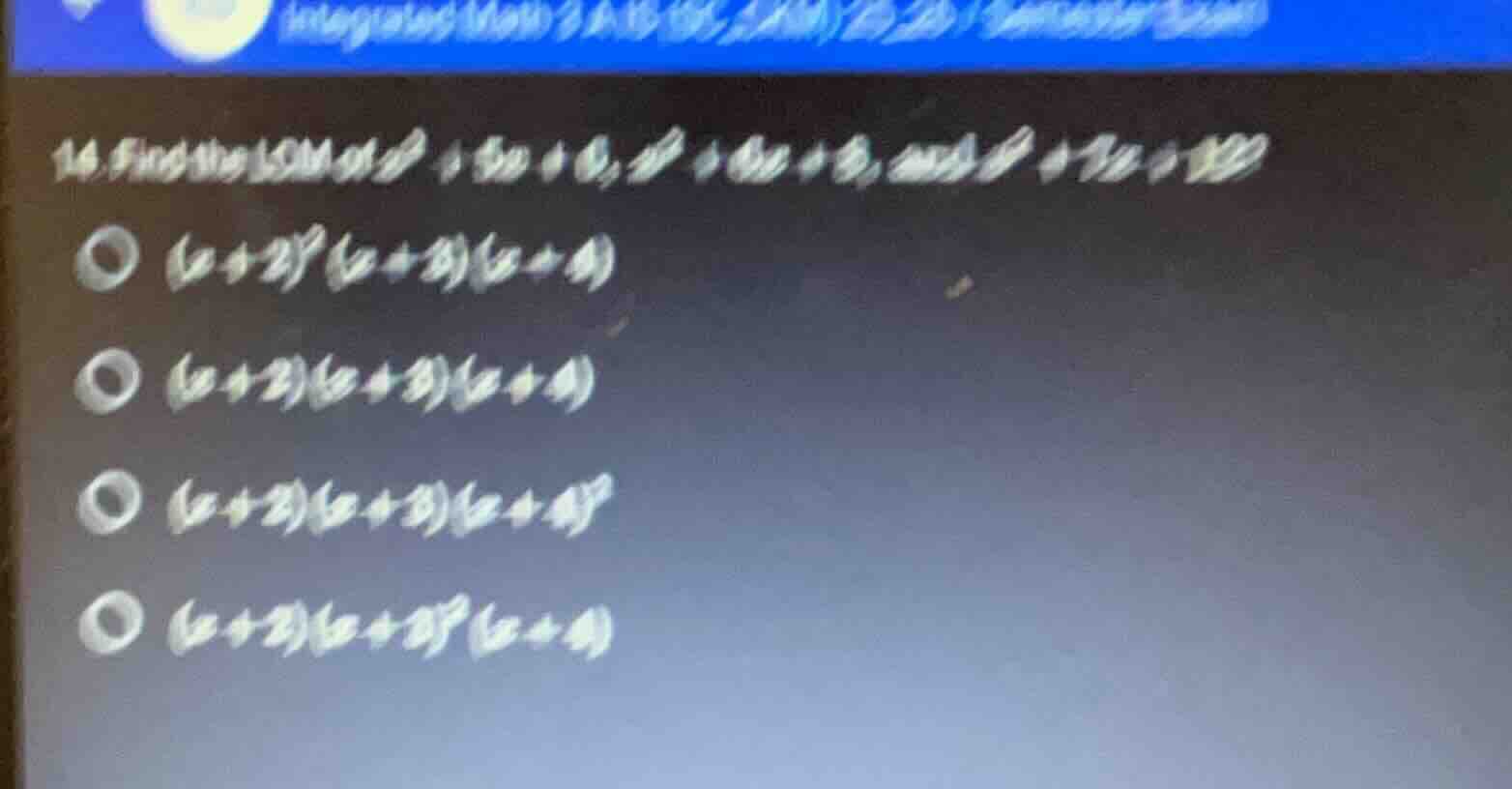
- find the lcm of \\(x^2 + 5x + 6\\), \\(x^2 + 6x + 8\\), and \\(x^2 + 7x + 12\\)
\\((x+2)^2(x+3)(x+4)\\)
\\((x+2)(x+3)(x+4)\\)
\\((x+2)(x+3)(x+4)^2\\)
\\((x+2)(x+3)^2(x+4)\\)
🆕 New Concept Discovered: Least Common Multiple of Polynomials
Finding the shared expression of highest powers
Step 1: Factor the first polynomial
We factor the quadratic expression \(x^2 + 5x + 6\). We look for two numbers that multiply to \(6\) and add to \(5\). These numbers are \(2\) and \(3\):
Step 2: Factor the second polynomial
We factor the quadratic expression \(x^2 + 6x + 8\). We look for two numbers that multiply to \(8\) and add to \(6\). These numbers are \(2\) and \(4\):
Step 3: Factor the third polynomial
We factor the quadratic expression \(x^2 + 7x + 12\). We look for two numbers that multiply to \(12\) and add to \(7\). These numbers are \(3\) and \(4\):
Step 4: Find the Least Common Multiple (LCM)
To find the LCM of the factored polynomials, we take the highest power of each unique linear factor present across all three expressions:
- The factor \((x + 2)\) appears at most once in any single polynomial.
- The factor \((x + 3)\) appears at most once in any single polynomial.
- The factor \((x + 4)\) appears at most once in any single polynomial.
Combining these unique factors gives:

Snap & solve any problem in the app
Get step-by-step solutions on Sovi AI
Photo-based solutions with guided steps
Explore more problems and detailed explanations
\((x + 2)(x + 3)(x + 4)\) (the second option)