QUESTION IMAGE
Question
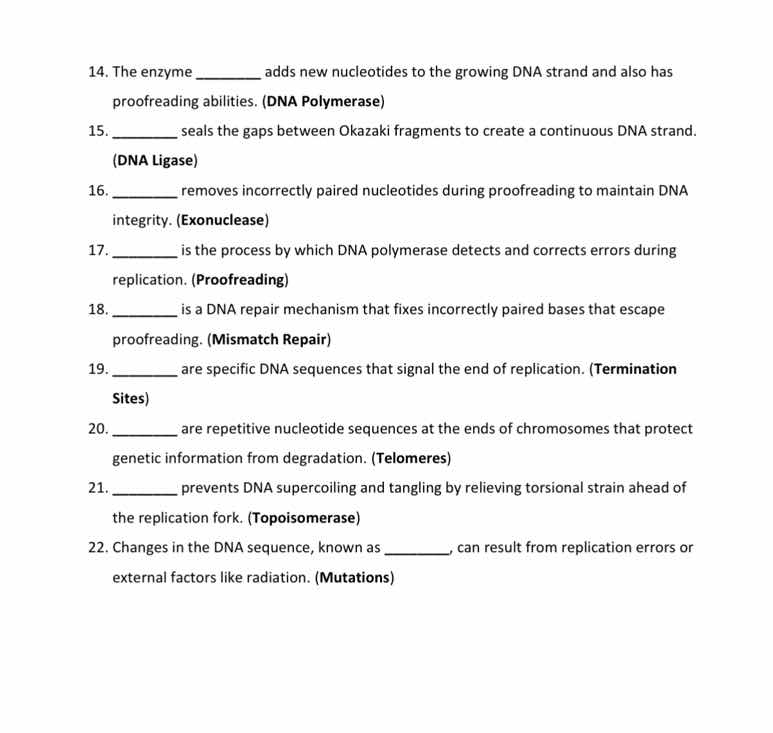
- the enzyme ______ adds new nucleotides to the growing dna strand and also has proofreading abilities. (dna polymerase)
- ______ seals the gaps between okazaki fragments to create a continuous dna strand. (dna ligase)
- ______ removes incorrectly paired nucleotides during proofreading to maintain dna integrity. (exonuclease)
- ______ is the process by which dna polymerase detects and corrects errors during replication. (proofreading)
- ______ is a dna repair mechanism that fixes incorrectly paired bases that escape proofreading. (mismatch repair)
- ______ are specific dna sequences that signal the end of replication. (termination sites)
- ______ are repetitive nucleotide sequences at the ends of chromosomes that protect genetic information from degradation. (telomeres)
- ______ prevents dna supercoiling and tangling by relieving torsional strain ahead of the replication fork. (topoisomerase)
- changes in the dna sequence, known as ______, can result from replication errors or external factors like radiation. (mutations)
Identify replication enzymes and functions
We analyze the roles of key enzymes in DNA replication. DNA polymerase synthesizes new strands and proofreads. DNA ligase seals Okazaki fragments. Exonuclease removes mismatched nucleotides. Topoisomerase relieves torsional strain.
Identify repair mechanisms and processes
We analyze processes maintaining DNA integrity. Proofreading is the immediate correction by DNA polymerase. Mismatch repair corrects errors escaping proofreading. Mutations are permanent changes in the DNA sequence.
Identify structural features of chromosomes
We analyze specific regions of DNA. Termination sites signal the end of replication. Telomeres protect chromosome ends from degradation.

Snap & solve any problem in the app
Get step-by-step solutions on Sovi AI
Photo-based solutions with guided steps
Explore more problems and detailed explanations
Question 14
- The enzyme <blank>DNA Polymerase</blank> adds new nucleotides to the growing DNA strand and also has proofreading abilities.
Question 15
- <blank>DNA Ligase</blank> seals the gaps between Okazaki fragments to create a continuous DNA strand.
Question 16
- <blank>Exonuclease</blank> removes incorrectly paired nucleotides during proofreading to maintain DNA integrity.
Question 17
- <blank>Proofreading</blank> is the process by which DNA polymerase detects and corrects errors during replication.
Question 18
- <blank>Mismatch Repair</blank> is a DNA repair mechanism that fixes incorrectly paired bases that escape proofreading.
Question 19
- <blank>Termination Sites</blank> are specific DNA sequences that signal the end of replication.
Question 20
- <blank>Telomeres</blank> are repetitive nucleotide sequences at the ends of chromosomes that protect genetic information from degradation.
Question 21
- <blank>Topoisomerase</blank> prevents DNA supercoiling and tangling by relieving torsional strain ahead of the replication fork.
Question 22
- Changes in the DNA sequence, known as <blank>Mutations</blank>, can result from replication errors or external factors like radiation.