QUESTION IMAGE
Question
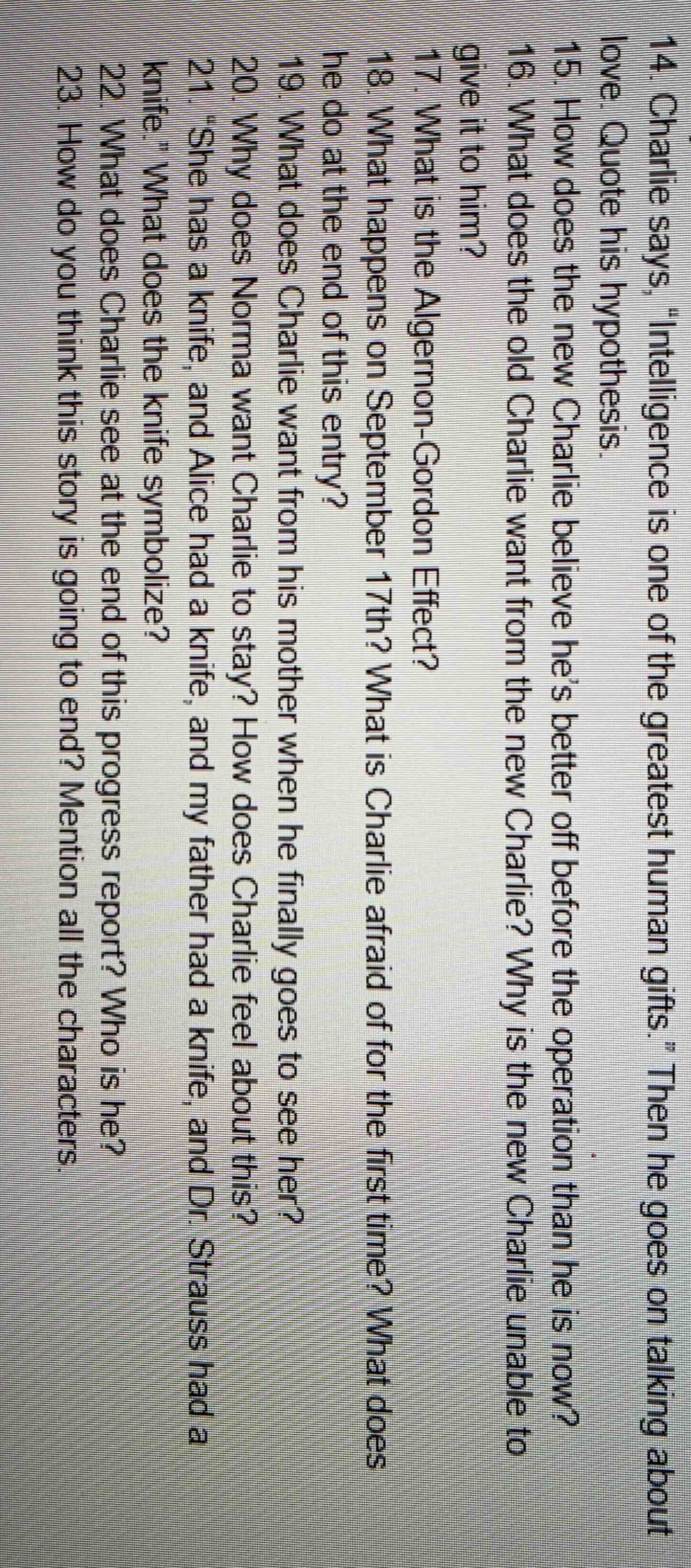
- charlie says, \intelligence is one of the greatest human gifts. then he goes on talking about love. quote his hypothesis.
- how does the new charlie believe he’s better off before the operation than he is now?
- what does the old charlie want from the new charlie? why is the new charlie unable to give it to him?
- what is the algernon - gordon effect?
- what happens on september 17th? what is charlie afraid of for the first time? what does he do at the end of this entry?
- what does charlie want from his mother when he finally goes to see her?
- why does norma want charlie to stay? how does charlie feel about this?
- \she has a knife, and alice had a knife, and my father had a knife, and dr. strauss had a knife.\ what does the knife symbolize?
- what does charlie see at the end of this progress report? who is he?
- how do you think this story is going to end? mention all the characters.
Brief Explanations
These questions refer to Flowers for Algernon. Below are targeted answers based on the text:
- Charlie's hypothesis: "I think it's a good thing to increase your intelligence. It makes you a better person and helps you have more friends."
- The new Charlie believes he was better off before because he was happy, loved, and unaware of others' mockery; now he is isolated, lonely, and aware of how others used him.
- The old Charlie wants the new Charlie's happiness and innocence back. The new Charlie cannot give this because intelligence cannot be reversed to restore that naive joy, and the new Charlie's self-awareness makes that state unreachable.
- The Algernon-Gordon Effect is the discovery that the rate of increase in intelligence is directly proportional to the rate of decrease; the smarter Charlie/Algernon get, the faster their mental faculties will deteriorate.
- On September 17th, Algernon dies. Charlie is afraid of suffering the same rapid mental decline and death that Algernon experienced. At the end of the entry, he panics and destroys his research notes in distress.
- When Charlie visits his mother, he wants acceptance, closure, and to reconcile with his traumatic childhood.
- Norma wants Charlie to stay because she sees him as her brother and wants to make up for their difficult childhood. Charlie feels conflicted—he loves Norma but fears the pain of his past and the impact of his declining mental state on her.
- The knife symbolizes violence, trauma, and the fear of abandonment/harm from Charlie's childhood, as well as the threat of losing his identity and self-control as his intelligence fades.
- At the end of his progress report, Charlie sees a younger version of himself (his old self). This is the naive, happy Charlie he used to be.
- The story will end with Charlie's full mental regression to his pre-operation state. He will return to the Warren State Home, as he fears, leaving behind his research and the connections he made. Key characters involved are Charlie (losing his intelligence), Alice Kinnian (grieving his decline), and the doctors (witnessing the failure of their experiment).

Snap & solve any problem in the app
Get step-by-step solutions on Sovi AI
Photo-based solutions with guided steps
Explore more problems and detailed explanations
- "I think it's a good thing to increase your intelligence. It makes you a better person and helps you have more friends."
- He believes he was happier, loved, and unaware of others' cruelty before; now he is lonely and aware of being used.
- The old Charlie wants the new Charlie's happiness/innocence. The new Charlie cannot give it because intelligence loss can't restore naive joy, and self-awareness blocks that state.
- It is the discovery that the rate of intelligence gain is directly proportional to the rate of intelligence loss (the smarter one gets, the faster they will regress).
- Algernon dies. Charlie is afraid of the same mental decline and death. He panics and destroys his research notes.
- He wants acceptance, closure, and reconciliation with his mother.
- Norma wants Charlie to stay to make up for their childhood. Charlie feels conflicted—he loves her but fears his past and declining state hurting her.
- It symbolizes childhood trauma, violence, and fear of losing his identity/control.
- He sees his younger, naive pre-operation self.
- Charlie will fully regress to his pre-operation state and enter the Warren State Home. Key characters: Charlie (regressing), Alice Kinnian (grieving), the doctors (witnessing the experiment's failure).