Sovi.AI - AI Math Tutor

Scan to solve math questions

QUESTION IMAGE

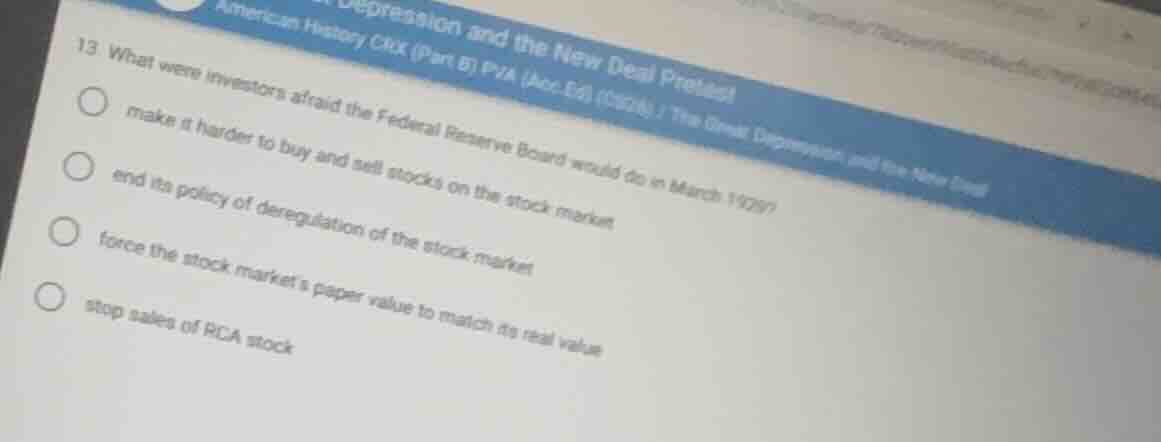
13. what were investors afraid the federal reserve board would do in ma…

Question

  1. what were investors afraid the federal reserve board would do in march 1929?

make it harder to buy and sell stocks on the stock market

end its policy of deregulation of the stock market

force the stock markets paper value to match its real value

stop sales of rca stock

Explanation:

Response

<pre_analysis>
{
"quality": "clear",
"question_count": 1,
"skills_matched": [
"direct_cot",
"multiple_choice_formatter",
"explain_then_answer",
"tutor"
],
"needs_drawing": false,
"concepts_used": [
"Origins of Great Depression"
],
"new_concepts": [
"Federal Reserve 1929 Policy",
"Speculative Bubble Regulation"
],
"current_concepts": [
"Origins of Great Depression",
"Federal Reserve 1929 Policy",
"Speculative Bubble Regulation"
]
}
</pre_analysis>

<reasoning>

Analyze the historical context of March 1929

In early 1929, the United States stock market was experiencing an unprecedented speculative boom. Many investors were purchasing stocks "on margin," meaning they borrowed money to buy shares, expecting prices to keep rising. This speculative bubble raised concerns about financial stability.

Identify the Federal Reserve's concerns

The Federal Reserve Board was deeply concerned about the massive amount of credit flowing into stock market speculation rather than productive commercial enterprises. In February and March of 1929, the Board issued warnings and considered tightening credit to curb speculative lending.

Evaluate investor fears

Investors and Wall Street traders feared that if the Federal Reserve raised interest rates or restricted member banks from lending money for speculative stock purchases, it would dry up the easy credit used for buying on margin. This action would make it significantly harder to buy and sell stocks, potentially causing the market to crash.

Match with the given options

The first option, "make it harder to buy and sell stocks on the stock market," directly reflects this fear of credit restriction and its impact on market liquidity and margin trading. The other options do not accurately represent the regulatory powers or specific policy fears associated with the Federal Reserve Board in March 1929. This relates directly to the Origins of Great Depression concept.
</reasoning>

<answer>
<mcq-correct>(A) make it harder to buy and sell stocks on the stock market</mcq-correct>
<mcq-option>(B) end its policy of deregulation of the stock market</mcq-option>
<mcq-option>(C) force the stock market's paper value to match its real value</mcq-option>
<mcq-option>(D) stop sales of RCA stock</mcq-option>
</answer>

<post_analysis>
{
"subject": "Social Science",
"question_type": "Multiple Choice",
"knowledge_point": [
"Social Science",
"US History",
"Origins of Great Depression"
]
}
</post_analysis>

Answer:

<pre_analysis>
{
"quality": "clear",
"question_count": 1,
"skills_matched": [
"direct_cot",
"multiple_choice_formatter",
"explain_then_answer",
"tutor"
],
"needs_drawing": false,
"concepts_used": [
"Origins of Great Depression"
],
"new_concepts": [
"Federal Reserve 1929 Policy",
"Speculative Bubble Regulation"
],
"current_concepts": [
"Origins of Great Depression",
"Federal Reserve 1929 Policy",
"Speculative Bubble Regulation"
]
}
</pre_analysis>

<reasoning>

Analyze the historical context of March 1929

In early 1929, the United States stock market was experiencing an unprecedented speculative boom. Many investors were purchasing stocks "on margin," meaning they borrowed money to buy shares, expecting prices to keep rising. This speculative bubble raised concerns about financial stability.

Identify the Federal Reserve's concerns

The Federal Reserve Board was deeply concerned about the massive amount of credit flowing into stock market speculation rather than productive commercial enterprises. In February and March of 1929, the Board issued warnings and considered tightening credit to curb speculative lending.

Evaluate investor fears

Investors and Wall Street traders feared that if the Federal Reserve raised interest rates or restricted member banks from lending money for speculative stock purchases, it would dry up the easy credit used for buying on margin. This action would make it significantly harder to buy and sell stocks, potentially causing the market to crash.

Match with the given options

The first option, "make it harder to buy and sell stocks on the stock market," directly reflects this fear of credit restriction and its impact on market liquidity and margin trading. The other options do not accurately represent the regulatory powers or specific policy fears associated with the Federal Reserve Board in March 1929. This relates directly to the Origins of Great Depression concept.
</reasoning>

<answer>
<mcq-correct>(A) make it harder to buy and sell stocks on the stock market</mcq-correct>
<mcq-option>(B) end its policy of deregulation of the stock market</mcq-option>
<mcq-option>(C) force the stock market's paper value to match its real value</mcq-option>
<mcq-option>(D) stop sales of RCA stock</mcq-option>
</answer>

<post_analysis>
{
"subject": "Social Science",
"question_type": "Multiple Choice",
"knowledge_point": [
"Social Science",
"US History",
"Origins of Great Depression"
]
}
</post_analysis>