QUESTION IMAGE
Question
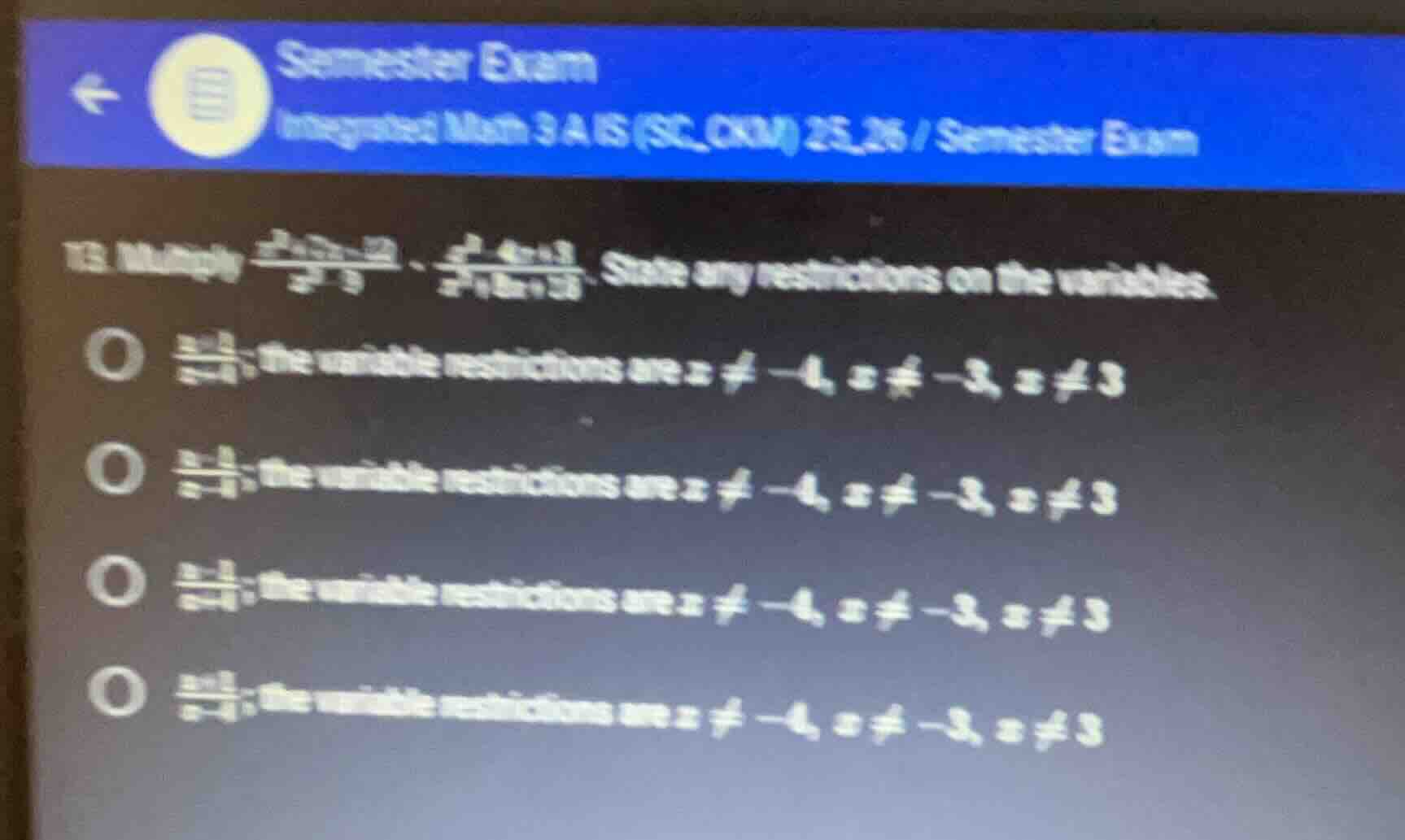
- multiply \\(\frac{x^2+7x+12}{x^2-9} \cdot \frac{x^2-4x+3}{x^2+8x+16}\\). state any restrictions on the variables.
\\(\bigcirc\\) \\(\frac{x-1}{x+4}\\); the variable restrictions are \\(x \
eq -4, x \
eq -3, x \
eq 3\\)
\\(\bigcirc\\) \\(\frac{x+1}{x-4}\\); the variable restrictions are \\(x \
eq -4, x \
eq -3, x \
eq 3\\)
\\(\bigcirc\\) \\(\frac{x-1}{x-4}\\); the variable restrictions are \\(x \
eq -4, x \
eq -3, x \
eq 3\\)
\\(\bigcirc\\) \\(\frac{x+1}{x+4}\\); the variable restrictions are \\(x \
eq -4, x \
eq -3, x \
eq 3\\)
🆕 New Concept Discovered: Multiplying Rational Expressions
Factoring polynomials to simplify products and find domain restrictions.
Step 1: Factor all numerators and denominators
To multiply rational expressions, we first factor each polynomial completely to identify common factors and restrictions.
The given expression is:
Let's factor each part:
- First numerator: \( x^2 + 7x + 12 \)
We look for two numbers that multiply to \( 12 \) and add to \( 7 \). These are \( 3 \) and \( 4 \).
- First denominator: \( x^2 - 9 \)
This is a difference of squares: \( a^2 - b^2 = (a - b)(a + b) \).
- Second numerator: \( x^2 - 4x + 3 \)
We look for two numbers that multiply to \( 3 \) and add to \( -4 \). These are \( -1 \) and \( -3 \).
- Second denominator: \( x^2 + 8x + 16 \)
This is a perfect square trinomial: \( (a + b)^2 = a^2 + 2ab + b^2 \).
Step 2: Identify the variable restrictions
Restrictions on a variable exist because we cannot divide by zero. We find these by setting every factor in the original denominators equal to zero before simplifying.
The denominators are:
Setting each unique factor to zero:
- \( x - 3 = 0 \implies x
eq 3 \)
- \( x + 3 = 0 \implies x
eq -3 \)
- \( x + 4 = 0 \implies x
eq -4 \)
Thus, the restrictions are:
Step 3: Simplify the expression
Now, write the multiplied expression with all factored terms and cancel out common factors that appear in both the numerator and the denominator:
Combine into a single fraction:
Cancel the common factors:
- Cancel \( (x + 3) \) from the top and bottom.
- Cancel \( (x - 3) \) from the top and bottom.
- Cancel one factor of \( (x + 4) \) from the top and bottom.
This leaves:

Snap & solve any problem in the app
Get step-by-step solutions on Sovi AI
Photo-based solutions with guided steps
Explore more problems and detailed explanations
*(Note: The options in the image contain a small typographical error where the variable \( x \) is written as \( z \) in the restrictions list: \( z
eq -4, z
eq -3, z
eq 3 \). The correct option is the one showing the simplified expression \( \frac{x-1}{x+4} \).)*