QUESTION IMAGE
Question
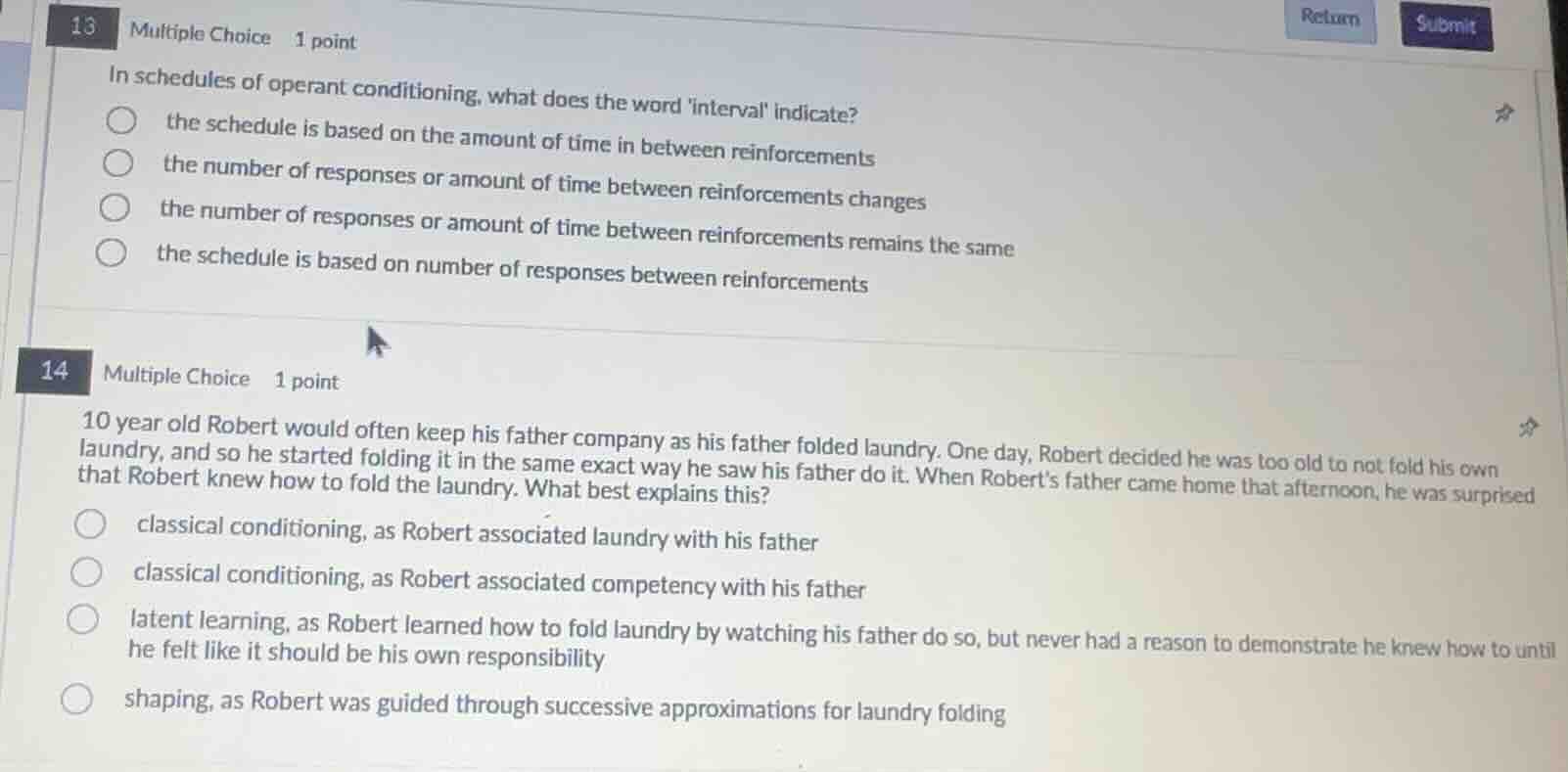
13 multiple choice 1 point
in schedules of operant conditioning, what does the word interval indicate?
the schedule is based on the amount of time in between reinforcements
the number of responses or amount of time between reinforcements changes
the number of responses or amount of time between reinforcements remains the same
the schedule is based on number of responses between reinforcements
14 multiple choice 1 point
10 year old robert would often keep his father company as his father folded laundry. one day, robert decided he was too old to not fold his own laundry, and so he started folding it in the same exact way he saw his father do it. when roberts father came home that afternoon, he was surprised that robert knew how to fold the laundry. what best explains this?
classical conditioning, as robert associated laundry with his father
classical conditioning, as robert associated competency with his father
latent learning, as robert learned how to fold laundry by watching his father do so, but never had a reason to demonstrate he knew how to until he felt like it should be his own responsibility
shaping, as robert was guided through successive approximations for laundry folding
Analyze Question 13
The term "interval" in operant conditioning schedules refers to the passage of time. Therefore, an interval schedule is one where reinforcement is delivered based on the amount of time that has elapsed between reinforcements.
Analyze Question 14
Robert learned how to fold laundry by watching his father, but did not demonstrate this knowledge until he had a reason to do so (feeling too old not to fold his own laundry). This is a classic example of latent learning, which is learning that occurs without immediate reinforcement and is not demonstrated until there is motivation to do so.

Snap & solve any problem in the app
Get step-by-step solutions on Sovi AI
Photo-based solutions with guided steps
Explore more problems and detailed explanations
Question 13
- (A) the schedule is based on the amount of time in between reinforcements (Correct answer)
- (B) the number of responses or amount of time between reinforcements changes
- (C) the number of responses or amount of time between reinforcements remains the same
- (D) the schedule is based on number of responses between reinforcements
Question 14
- (A) classical conditioning, as Robert associated laundry with his father
- (B) classical conditioning, as Robert associated competency with his father
- (C) latent learning, as Robert learned how to fold laundry by watching his father do so, but never had a reason to demonstrate he knew how to until he felt like it should be his own responsibility (Correct answer)
- (D) shaping, as Robert was guided through successive approximations for laundry folding