QUESTION IMAGE
Question
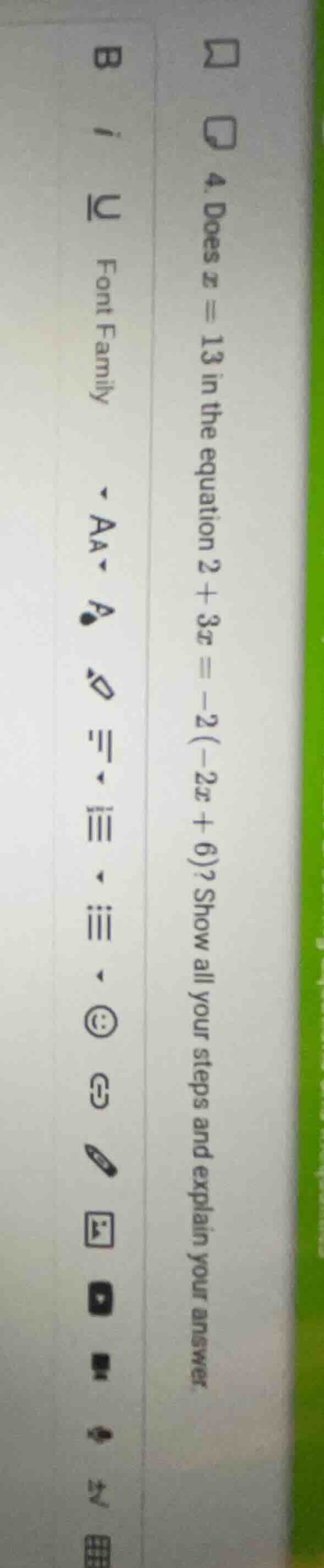
- does x = 13 in the equation 2 + 3x = -2(-2x + 6)? show all your steps and explain your answer.
Step1: Substitute \( x = 13 \) into left - hand side (LHS)
The left - hand side of the equation \( 2 + 3x \). Substitute \( x = 13 \) into it:
\( LHS=2 + 3\times13=2 + 39 = 41\)
Step2: Simplify the right - hand side (RHS) of the equation
The right - hand side of the equation is \( - 2(-2x + 6) \). First, use the distributive property \( a(b + c)=ab+ac \), here \( a=-2 \), \( b=-2x \), \( c = 6 \).
\( RHS=-2\times(-2x)-2\times6=4x-12 \)
Now substitute \( x = 13 \) into \( 4x-12 \):
\( 4\times13-12=52 - 12=40 \)
Step3: Compare LHS and RHS
We found that when \( x = 13 \), \( LHS = 41 \) and \( RHS=40 \). Since \( 41
eq40 \), \( x = 13 \) does not satisfy the equation.

Snap & solve any problem in the app
Get step-by-step solutions on Sovi AI
Photo-based solutions with guided steps
Explore more problems and detailed explanations
\( x = 13 \) is not a solution to the equation \( 2 + 3x=-2(-2x + 6) \)