QUESTION IMAGE
Question
13
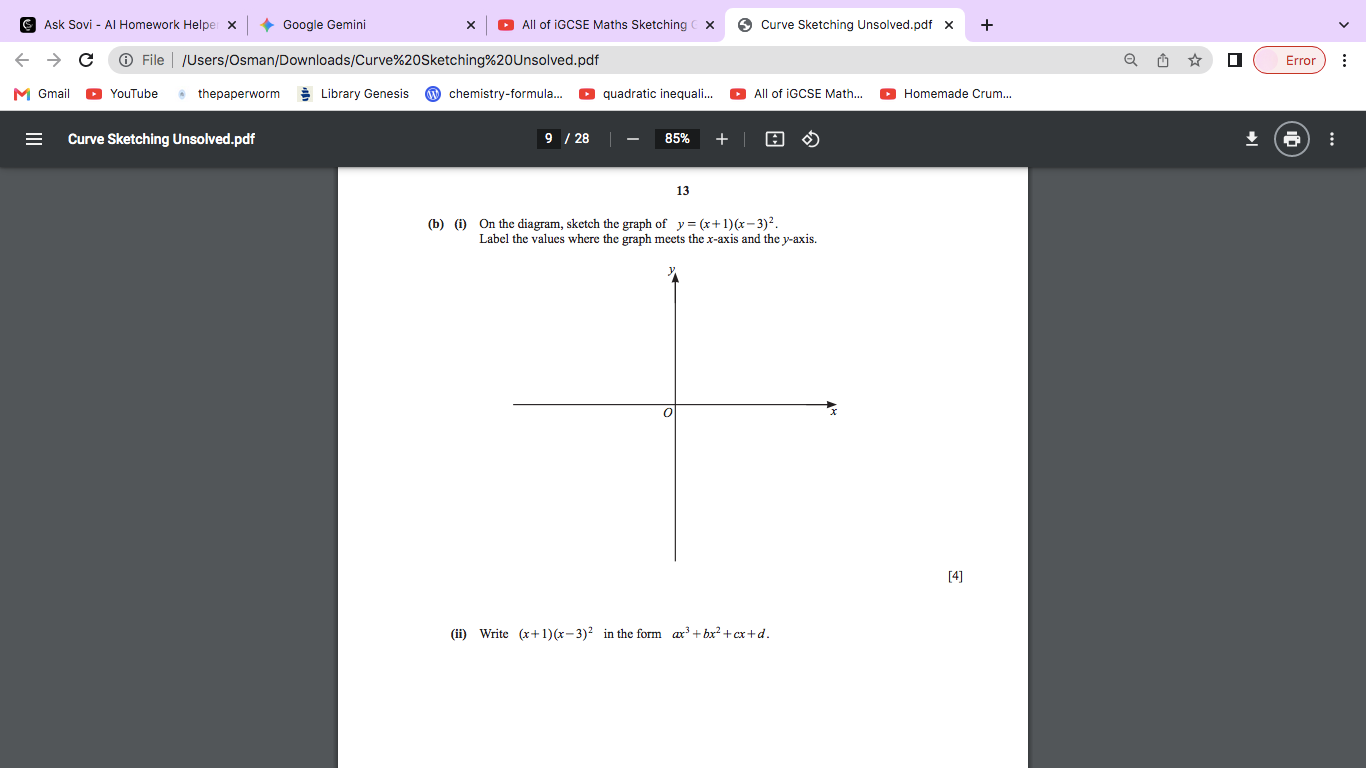
(b) (i) on the diagram, sketch the graph of (y = (x + 1)(x - 3)^2).
label the values where the graph meets the (x)-axis and the (y)-axis.
(ii) write ((x + 1)(x - 3)^2) in the form (ax^3 + bx^2 + cx + d).
🆕 New Concept Discovered: Polynomial Curve Sketching
Analyzing roots, multiplicity, and intercepts to draw curves
---
Step 1: Find the intercepts
To sketch the graph of \( y = (x+1)(x-3)^2 \), we first find where it crosses or touches the axes.
- \( y \)-intercept: Set \( x = 0 \).
So, the graph crosses the \( y \)-axis at \( (0, 9) \).
- \( x \)-intercepts: Set \( y = 0 \).
This gives two roots:
- \( x = -1 \) (with multiplicity 1)
- \( x = 3 \) (with multiplicity 2)
---
Step 2: Determine the behavior at the roots and end behavior
- Behavior at \( x = -1 \): Since the factor \( (x+1) \) has an odd power (power of 1), the graph crosses straight through the \( x \)-axis at \( x = -1 \).
- Behavior at \( x = 3 \): Since the factor \( (x-3)^2 \) has an even power (power of 2), the graph is tangent to the \( x \)-axis at \( x = 3 \). This means it touches the axis and turns back around (forming a local minimum).
- End behavior: Expanding the expression gives a leading term of \( x^3 \). Since the degree is odd and the leading coefficient is positive, the graph goes down to negative infinity on the far left (\( x \to -\infty, y \to -\infty \)) and up to positive infinity on the far right (\( x \to \infty, y \to \infty \)).
---
Step 3: Sketch the curve
Using the information gathered:
- Start in the bottom-left quadrant.
- Go up and cross the \( x \)-axis at \( -1 \).
- Continue upwards, passing through the \( y \)-axis at \( 9 \), reaching a local maximum peak to the right of the \( y \)-axis.
- Turn downwards to touch the \( x \)-axis at \( 3 \) (tangent point).
- Turn back upwards and head towards positive infinity on the right.
(See the final answer section for the visual representation of this sketch.)
---
Step 4: Expand the expression for part (ii)
We need to write \( (x+1)(x-3)^2 \) in the expanded form \( ax^3 + bx^2 + cx + d \).
First, expand the squared term:
Next, multiply this result by \( (x+1) \):
Now, group and combine the like terms:
---

Snap & solve any problem in the app
Get step-by-step solutions on Sovi AI
Photo-based solutions with guided steps
Explore more problems and detailed explanations
(b) (i) Sketch of the graph:
Below is the sketch of the curve \( y = (x+1)(x-3)^2 \):
          y
          ^
          |          * (local max)
          |        *   *
        9 +      *       *
          |    *           *
          |  *               *
   -------*-------------------*-------> x
        -1|                  3
|- Key features to label on your diagram:
- The curve crosses the \( x \)-axis at \( -1 \).
- The curve crosses the \( y \)-axis at \( 9 \).
- The curve touches and turns around (is tangent to) the \( x \)-axis at \( 3 \).
---