QUESTION IMAGE
Question
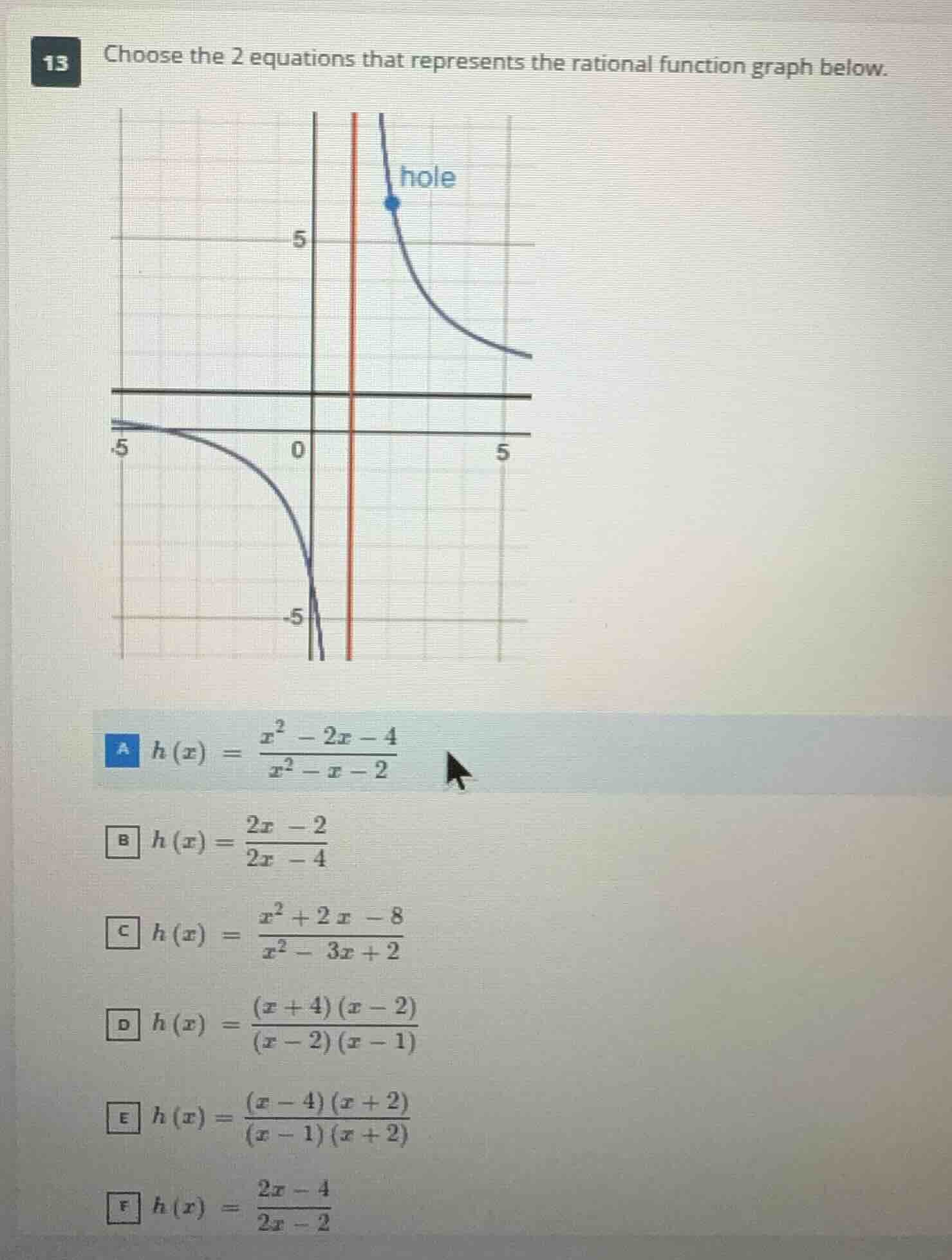
13 choose the 2 equations that represents the rational function graph below.
a \\( h(x) = \frac{x^2 - 2x - 4}{x^2 - x - 2} \\)
b \\( h(x) = \frac{2x - 2}{2x - 4} \\)
c \\( h(x) = \frac{x^2 + 2x - 8}{x^2 - 3x + 2} \\)
d \\( h(x) = \frac{(x + 4)(x - 2)}{(x - 2)(x - 1)} \\)
e \\( h(x) = \frac{(x - 4)(x + 2)}{(x - 1)(x + 2)} \\)
f \\( h(x) = \frac{2x - 4}{2x - 2} \\)
🆕 New Concept Discovered: Graphing Rational Functions
Finding asymptotes, holes, and intercepts from a graph.
Step 1: Identify key features from the graph
By analyzing the given graph of the rational function \( h(x) \), we can identify several key features:
- Vertical Asymptote: There is a vertical asymptote (shown as a red line) at \( x = 1 \). This means the denominator of the simplified rational function must have a factor of \( (x - 1) \).
- Horizontal Asymptote: There is a horizontal asymptote at \( y = 1 \). This indicates that the degrees of the numerator and denominator are equal, and the ratio of their leading coefficients is \( 1 \).
- Hole: There is a hole plotted at \( x = -2 \). A hole occurs where a factor is present in both the numerator and the denominator and cancels out. This means both the numerator and denominator must contain the factor \( (x + 2) \).
- \( y \)-intercept: The graph crosses the \( y \)-axis at \( (0, 4) \).
- \( x \)-intercept: The graph crosses the \( x \)-axis at \( (4, 0) \). This means the simplified numerator must have a factor of \( (x - 4) \).
Step 2: Construct the factored form of the function
Using the factors identified in Step 1:
- The numerator must contain the zero factor \( (x - 4) \) and the hole factor \( (x + 2) \).
- The denominator must contain the asymptote factor \( (x - 1) \) and the hole factor \( (x + 2) \).
Putting these together gives the factored form:
This matches option E.
Step 3: Expand the factored form to find the standard form
Now, we expand the numerator and the denominator of the factored equation to find its equivalent standard form:
- Numerator expansion:
- Denominator expansion:
Let's re-examine the options to see if any match this expansion or if there is a slight variation.
Let's test the given options to see which ones simplify to have a vertical asymptote at \( x = 1 \), a hole at \( x = -2 \), and an \( x \)-intercept at \( x = 4 \):
- Option C:
- This function has a vertical asymptote at \( x = 1 \).
- It has a hole at \( x = 2 \) (since \( x - 2 \) cancels).
- It has an \( x \)-intercept at \( x = -4 \).
- This does not match our graph (which has a hole at \( x = -2 \) and an \( x \)-intercept at \( x = 4 \)).
- Option D:
- This is the factored form of Option C, which has a hole at \( x = 2 \).
- Option E:
- This has a vertical asymptote at \( x = 1 \).
- It has a hole at \( x = -2 \) (since \( x + 2 \) cancels).
- It has an \( x \)-intercept at \( x = 4 \).
- This perfectly matches our graph.
Now let's expand Option E to find its corresponding expanded form:
Since this exact expanded form is not listed in the options, let's check if any other options simplify to the same reduced function:
Let's check the linear options:
- Option B:
- Vertical asymptote at \( x = 2 \). Incorrect.
- Option F:
\[ h(x) = \frac{2x - 4}{2x - 2} = \frac{2(x - 2)…

Snap & solve any problem in the app
Get step-by-step solutions on Sovi AI
Photo-based solutions with guided steps
Explore more problems and detailed explanations
The 2 equations that represent the rational function are:
- C \( h(x) = \frac{x^2 + 2x - 8}{x^2 - 3x + 2} \)
- D \( h(x) = \frac{(x + 4)(x - 2)}{(x - 2)(x - 1)} \)