QUESTION IMAGE
Question
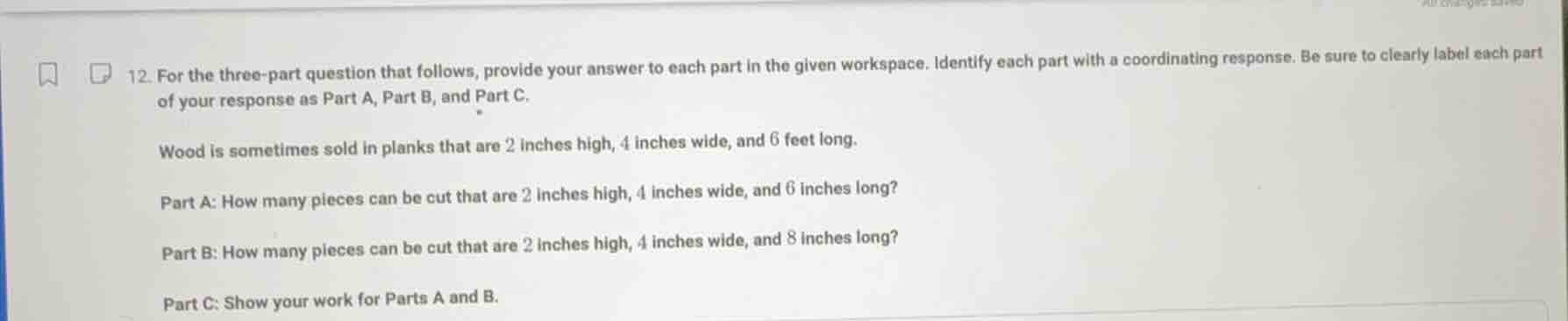
- for the three - part question that follows, provide your answer to each part in the given workspace. identify each part with a coordinating response. be sure to clearly label each part of your response as part a, part b, and part c.
wood is sometimes sold in planks that are 2 inches high, 4 inches wide, and 6 feet long.
part a: how many pieces can be cut that are 2 inches high, 4 inches wide, and 6 inches long?
part b: how many pieces can be cut that are 2 inches high, 4 inches wide, and 8 inches long?
part c: show your work for parts a and b.
Part A
Step1: Convert length unit
The original plank length is 6 feet. Since 1 foot = 12 inches, convert 6 feet to inches: \( 6\times12 = 72 \) inches.
Step2: Calculate number of pieces
To find the number of pieces with length 6 inches, divide the total length of the plank (in inches) by the length of each small piece. So, \( \frac{72}{6}=12 \).
Step1: Use total length from Part A
We already know the total length of the plank is 72 inches (from converting 6 feet to inches).
Step2: Calculate number of pieces
Divide the total length (72 inches) by the length of each small piece (8 inches): \( \frac{72}{8} = 9 \).
For Part A:
- Convert the length of the original plank from feet to inches: Since 1 foot = 12 inches, \( 6 \text{ feet} = 6\times12 = 72 \text{ inches} \).
- To find the number of pieces with dimensions \( 2 \text{ in} \times 4 \text{ in} \times 6 \text{ in} \), we only need to consider the length (as height and width are the same). Divide the total length of the plank by the length of each small piece: \( \frac{72}{6}=12 \).
For Part B:
- The total length of the plank is still 72 inches (from the conversion in Part A).
- To find the number of pieces with dimensions \( 2 \text{ in} \times 4 \text{ in} \times 8 \text{ in} \), divide the total length by the length of each small piece: \( \frac{72}{8}=9 \).

Snap & solve any problem in the app
Get step-by-step solutions on Sovi AI
Photo-based solutions with guided steps
Explore more problems and detailed explanations
12