QUESTION IMAGE
Question
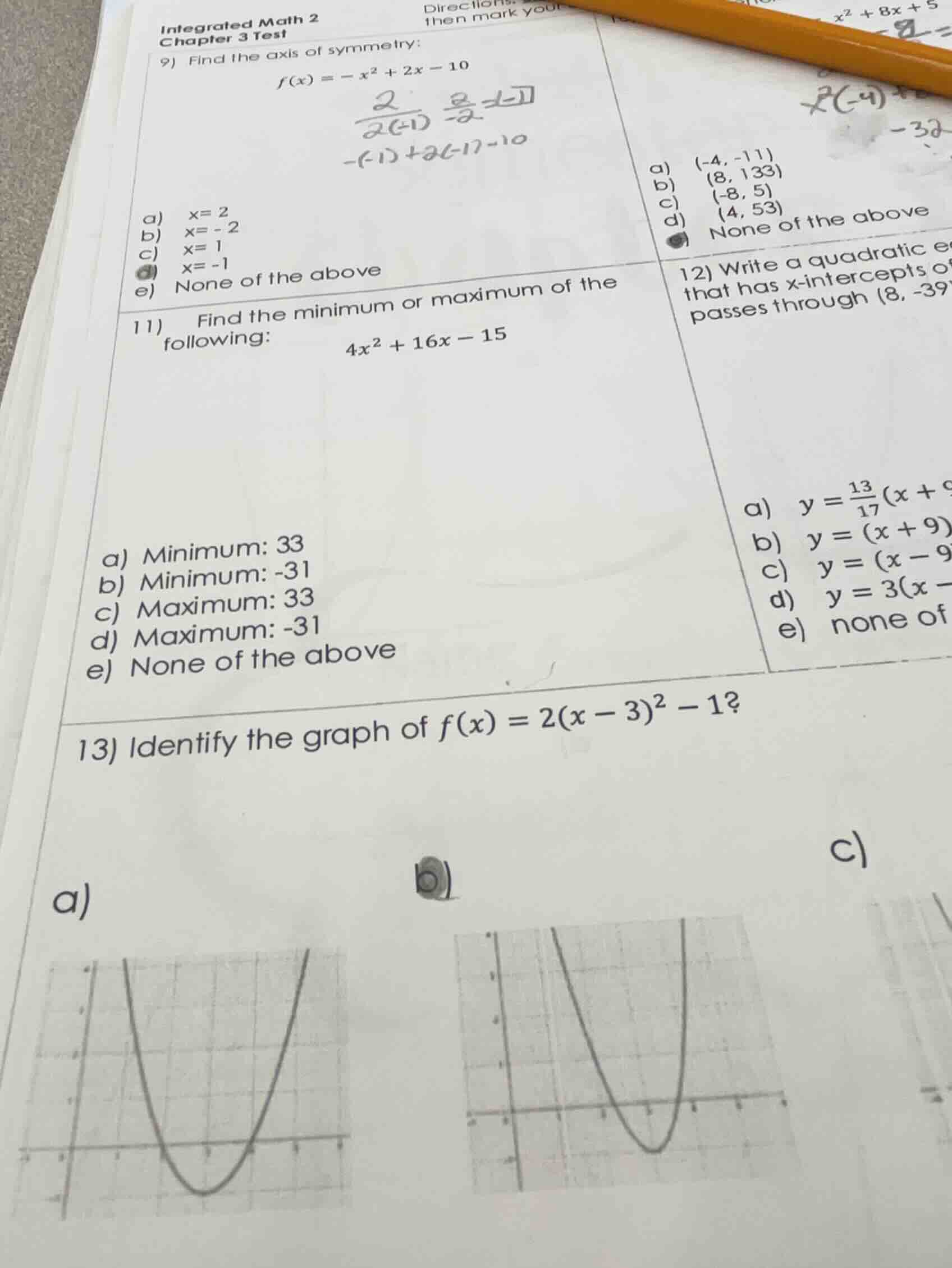
- find the minimum or maximum of the following:
\\4x^2 + 16x - 15\\
a) minimum: 33
b) minimum: -31
c) maximum: 33
d) maximum: -31
e) none of the above
<pre_analysis>
{
"quality": "clear",
"question_count": 4,
"skills_matched": [
"step_cot",
"table_formatter",
"explain_then_answer",
"tutor",
"mastery_adaptive_brevity"
],
"needs_drawing": false,
"concepts_used": [
"Axis of Symmetry",
"Parabola Vertex Form"
],
"new_concepts": [
"Quadratic Extremum",
"Quadratic Vertex"
],
"current_concepts": [
"Axis of Symmetry",
"Parabola Vertex Form",
"Quadratic Extremum",
"Quadratic Vertex"
]
}
</pre_analysis>
<reasoning>
Find the axis of symmetry for Question 9
Using the Axis of Symmetry knowledge point
\[
\]
Find the extremum for Question 11
Identify the direction and vertex of the parabola \(g(x) = 4x^2 + 16x - 15\).
Since the leading coefficient \(a = 4 > 0\), the parabola opens upward, meaning it has a minimum value at its vertex.
We find the \(x\)-coordinate of the vertex:
\[
x = -\frac{b}{2a} = -\frac{16}{2(4)} = -2
\]
Now, evaluate the function at \(x = -2\) to find the minimum value:
\[
\]
Thus, the minimum value is \(-31\).
Identify the vertex and graph for Question 13
Using the Parabola Vertex Form knowledge point
\[
\]
Looking at the options:
- Graph (a) has its vertex in the fourth quadrant at \((3, -1)\).
- Graph (b) has its vertex in the fourth quadrant but shifted further right or down, specifically at \((4, -3)\) or similar. Let's inspect the grid:
- In graph (a), the vertex is located at \(x = 3\), \(y = -1\).
- In graph (b), the vertex is located at \(x = 5\), \(y = -2\).
Therefore, graph (a) represents the function \(f(x) = 2(x - 3)^2 - 1\).
</reasoning>
<answer>
| No. | Answer |
|---|---|
| 11 | (b) Minimum: -31 |
| 13 | (a) |
</answer>
<post_analysis>
{
"subject": "Mathematics",
"question_type": "Multi-part",
"knowledge_point": [
"Mathematics",
"Algebra",
"Parabola Vertex Form"
]
}
</post_analysis>
Snap & solve any problem in the app
Get step-by-step solutions on Sovi AI
Photo-based solutions with guided steps
Explore more problems and detailed explanations
<pre_analysis>
{
"quality": "clear",
"question_count": 4,
"skills_matched": [
"step_cot",
"table_formatter",
"explain_then_answer",
"tutor",
"mastery_adaptive_brevity"
],
"needs_drawing": false,
"concepts_used": [
"Axis of Symmetry",
"Parabola Vertex Form"
],
"new_concepts": [
"Quadratic Extremum",
"Quadratic Vertex"
],
"current_concepts": [
"Axis of Symmetry",
"Parabola Vertex Form",
"Quadratic Extremum",
"Quadratic Vertex"
]
}
</pre_analysis>
<reasoning>
Find the axis of symmetry for Question 9
Using the Axis of Symmetry knowledge point
\[
\]
Find the extremum for Question 11
Identify the direction and vertex of the parabola \(g(x) = 4x^2 + 16x - 15\).
Since the leading coefficient \(a = 4 > 0\), the parabola opens upward, meaning it has a minimum value at its vertex.
We find the \(x\)-coordinate of the vertex:
\[
x = -\frac{b}{2a} = -\frac{16}{2(4)} = -2
\]
Now, evaluate the function at \(x = -2\) to find the minimum value:
\[
\]
Thus, the minimum value is \(-31\).
Identify the vertex and graph for Question 13
Using the Parabola Vertex Form knowledge point
\[
\]
Looking at the options:
- Graph (a) has its vertex in the fourth quadrant at \((3, -1)\).
- Graph (b) has its vertex in the fourth quadrant but shifted further right or down, specifically at \((4, -3)\) or similar. Let's inspect the grid:
- In graph (a), the vertex is located at \(x = 3\), \(y = -1\).
- In graph (b), the vertex is located at \(x = 5\), \(y = -2\).
Therefore, graph (a) represents the function \(f(x) = 2(x - 3)^2 - 1\).
</reasoning>
<answer>
| No. | Answer |
|---|---|
| 11 | (b) Minimum: -31 |
| 13 | (a) |
</answer>
<post_analysis>
{
"subject": "Mathematics",
"question_type": "Multi-part",
"knowledge_point": [
"Mathematics",
"Algebra",
"Parabola Vertex Form"
]
}
</post_analysis>