QUESTION IMAGE
Question
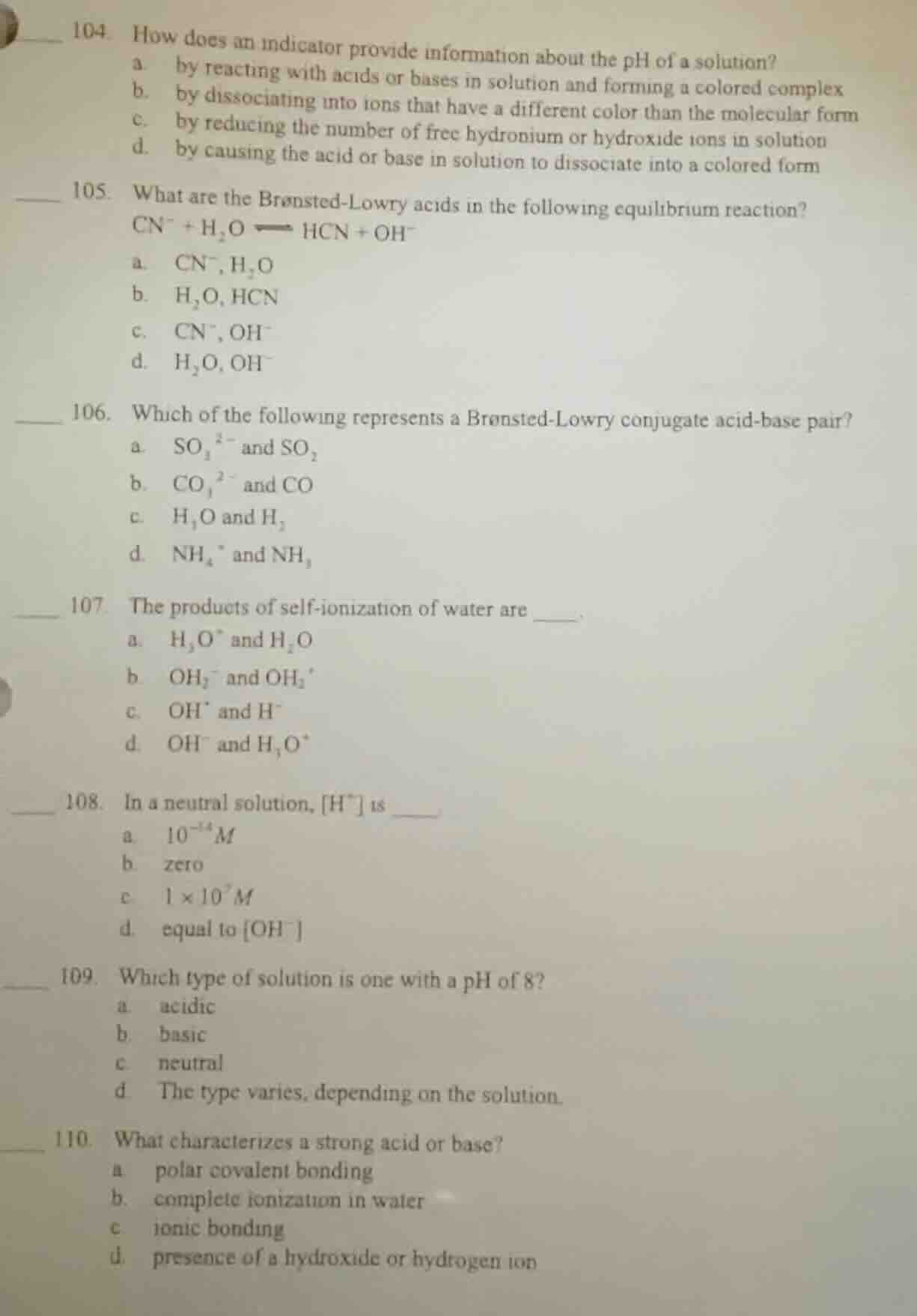
- how does an indicator provide information about the ph of a solution?
a. by reacting with acids or bases in solution and forming a colored complex
b. by dissociating into ions that have a different color than the molecular form
c. by reducing the number of free hydronium or hydroxide ions in solution
d. by causing the acid or base in solution to dissociate into a colored form
- what are the brønsted-lowry acids in the following equilibrium reaction?
\\(\text{cn}^- + \text{h}_2\text{o} \
ightleftharpoons \text{hcn} + \text{oh}^-\\)
a. \\(\text{cn}^-, \text{h}_2\text{o}\\)
b. \\(\text{h}_2\text{o}, \text{hcn}\\)
c. \\(\text{cn}^-, \text{oh}^-\\)
d. \\(\text{h}_2\text{o}, \text{oh}^-\\)
- which of the following represents a brønsted-lowry conjugate acid-base pair?
a. \\(\text{so}_3^{2-}\\) and \\(\text{so}_2\\)
b. \\(\text{co}_3^{2-}\\) and \\(\text{co}\\)
c. \\(\text{h}_2\text{o}\\) and \\(\text{h}_2\\)
d. \\(\text{nh}_4^+\\) and \\(\text{nh}_3\\)
- the products of self-ionization of water are ______.
a. \\(\text{h}_3\text{o}^+\\) and \\(\text{h}_2\text{o}\\)
b. \\(\text{oh}_2^-\\) and \\(\text{oh}_2^+\\)
c. \\(\text{oh}^+\\) and \\(\text{h}^-\\)
d. \\(\text{oh}^-\\) and \\(\text{h}_3\text{o}^+\\)
- in a neutral solution, \\(\text{h}^+\\) is ______.
a. \\(10^{-14}\text{ m}\\)
b. zero
c. \\(1 \times 10^7\text{ m}\\)
d. equal to \\(\text{oh}^-\\)
- which type of solution is one with a ph of 8?
a. acidic
b. basic
c. neutral
d. the type varies, depending on the solution.
- what characterizes a strong acid or base?
a. polar covalent bonding
b. complete ionization in water
c. ionic bonding
d. presence of a hydroxide or hydrogen ion
<pre_analysis>
{
"quality": "clear",
"question_count": 7,
"skills_matched": [
"direct_cot",
"table_formatter",
"explain_then_answer",
"tutor",
"mastery_adaptive_brevity"
],
"needs_drawing": false,
"concepts_used": [
"Acid-Base Indicators",
"Bronsted-Lowry Theory",
"Conjugate Acid-Base Pairs"
],
"new_concepts": [
"Self-Ionization of Water",
"Neutral Solution pH",
"Strong Acids and Bases"
],
"current_concepts": [
"Acid-Base Indicators",
"Bronsted-Lowry Theory",
"Conjugate Acid-Base Pairs",
"Self-Ionization of Water",
"Neutral Solution pH",
"Strong Acids and Bases"
]
}
</pre_analysis>
<reasoning>
Analyze indicator behavior
Using the Acid-Base Indicators knowledge point
An indicator is a weak acid or weak base that dissociates in water. The molecular form (\(\text{HIn}\)) and its conjugate base form (\(\text{In}^-\)) have different colors. As the pH changes, the equilibrium shifts, changing the ratio of these two forms and thus the color of the solution.
- Option a: Incorrect. It does not form a complex.
- Option b: Correct. It dissociates into ions that have a different color than the molecular form.
- Option c: Incorrect. It does not significantly alter the hydronium concentration.
- Option d: Incorrect. It does not cause the analyte to dissociate into a colored form.
Identify Brønsted-Lowry acids
Using the Bronsted-Lowry Theory knowledge point
According to the Brønsted-Lowry theory, an acid is a proton (\(\text{H}^+\)) donor. Let's analyze the equilibrium:
\[\text{CN}^- + \text{H}_2\text{O}
ightleftharpoons \text{HCN} + \text{OH}^-\]
- In the forward direction, \(\text{H}_2\text{O}\) donates a proton to \(\text{CN}^-\), so \(\text{H}_2\text{O}\) is the acid.
- In the reverse direction, \(\text{HCN}\) donates a proton to \(\text{OH}^-\), so \(\text{HCN}\) is the acid.
Therefore, the Brønsted-Lowry acids are \(\text{H}_2\text{O}\) and \(\text{HCN}\). This corresponds to option b.
Identify conjugate acid-base pairs
Using the Conjugate Acid-Base Pairs knowledge point
A conjugate acid-base pair consists of two substances that differ by exactly one proton (\(\text{H}^+\)). The acid has one more proton than its conjugate base.
- Option a: \(\text{SO}_3^{2-}\) and \(\text{SO}_2\) differ by an oxygen atom, not a proton.
- Option b: \(\text{CO}_3^{2-}\) and \(\text{CO}\) differ by oxygen atoms, not a proton.
- Option c: \(\text{H}_3\text{O}^+\) and \(\text{H}_2\) differ by a proton and an electron balance, but the correct pair is \(\text{H}_3\text{O}^+\) and \(\text{H}_2\text{O}\).
- Option d: \(\text{NH}_4^+\) and \(\text{NH}_3\) differ by exactly one proton (\(\text{H}^+\)). This is a conjugate pair.
Determine products of water self-ionization
Water molecules undergo self-ionization (autoionization) where one water molecule transfers a proton to another:
\[\text{H}_2\text{O} + \text{H}_2\text{O}
ightleftharpoons \text{H}_3\text{O}^+ + \text{OH}^-\]
The products are the hydronium ion (\(\text{H}_3\text{O}^+\)) and the hydroxide ion (\(\text{OH}^-\)). This corresponds to option d.
Analyze neutral solution properties
In any aqueous solution, neutrality is defined by having equal concentrations of hydronium and hydroxide ions:
\[[\text{H}^+] = [\text{OH}^-]\]
At \(25^\circ\text{C}\), this concentration is exactly \(1 \times 10^{-7}\text{ M}\). Since temperature is not specified, the fundamental definition of neutrality is always that \([\text{H}^+]\) is equal to \([\text{OH}^-]\).…
Snap & solve any problem in the app
Get step-by-step solutions on Sovi AI
Photo-based solutions with guided steps
Explore more problems and detailed explanations
<pre_analysis>
{
"quality": "clear",
"question_count": 7,
"skills_matched": [
"direct_cot",
"table_formatter",
"explain_then_answer",
"tutor",
"mastery_adaptive_brevity"
],
"needs_drawing": false,
"concepts_used": [
"Acid-Base Indicators",
"Bronsted-Lowry Theory",
"Conjugate Acid-Base Pairs"
],
"new_concepts": [
"Self-Ionization of Water",
"Neutral Solution pH",
"Strong Acids and Bases"
],
"current_concepts": [
"Acid-Base Indicators",
"Bronsted-Lowry Theory",
"Conjugate Acid-Base Pairs",
"Self-Ionization of Water",
"Neutral Solution pH",
"Strong Acids and Bases"
]
}
</pre_analysis>
<reasoning>
Analyze indicator behavior
Using the Acid-Base Indicators knowledge point
An indicator is a weak acid or weak base that dissociates in water. The molecular form (\(\text{HIn}\)) and its conjugate base form (\(\text{In}^-\)) have different colors. As the pH changes, the equilibrium shifts, changing the ratio of these two forms and thus the color of the solution.
- Option a: Incorrect. It does not form a complex.
- Option b: Correct. It dissociates into ions that have a different color than the molecular form.
- Option c: Incorrect. It does not significantly alter the hydronium concentration.
- Option d: Incorrect. It does not cause the analyte to dissociate into a colored form.
Identify Brønsted-Lowry acids
Using the Bronsted-Lowry Theory knowledge point
According to the Brønsted-Lowry theory, an acid is a proton (\(\text{H}^+\)) donor. Let's analyze the equilibrium:
\[\text{CN}^- + \text{H}_2\text{O}
ightleftharpoons \text{HCN} + \text{OH}^-\]
- In the forward direction, \(\text{H}_2\text{O}\) donates a proton to \(\text{CN}^-\), so \(\text{H}_2\text{O}\) is the acid.
- In the reverse direction, \(\text{HCN}\) donates a proton to \(\text{OH}^-\), so \(\text{HCN}\) is the acid.
Therefore, the Brønsted-Lowry acids are \(\text{H}_2\text{O}\) and \(\text{HCN}\). This corresponds to option b.
Identify conjugate acid-base pairs
Using the Conjugate Acid-Base Pairs knowledge point
A conjugate acid-base pair consists of two substances that differ by exactly one proton (\(\text{H}^+\)). The acid has one more proton than its conjugate base.
- Option a: \(\text{SO}_3^{2-}\) and \(\text{SO}_2\) differ by an oxygen atom, not a proton.
- Option b: \(\text{CO}_3^{2-}\) and \(\text{CO}\) differ by oxygen atoms, not a proton.
- Option c: \(\text{H}_3\text{O}^+\) and \(\text{H}_2\) differ by a proton and an electron balance, but the correct pair is \(\text{H}_3\text{O}^+\) and \(\text{H}_2\text{O}\).
- Option d: \(\text{NH}_4^+\) and \(\text{NH}_3\) differ by exactly one proton (\(\text{H}^+\)). This is a conjugate pair.
Determine products of water self-ionization
Water molecules undergo self-ionization (autoionization) where one water molecule transfers a proton to another:
\[\text{H}_2\text{O} + \text{H}_2\text{O}
ightleftharpoons \text{H}_3\text{O}^+ + \text{OH}^-\]
The products are the hydronium ion (\(\text{H}_3\text{O}^+\)) and the hydroxide ion (\(\text{OH}^-\)). This corresponds to option d.
Analyze neutral solution properties
In any aqueous solution, neutrality is defined by having equal concentrations of hydronium and hydroxide ions:
\[[\text{H}^+] = [\text{OH}^-]\]
At \(25^\circ\text{C}\), this concentration is exactly \(1 \times 10^{-7}\text{ M}\). Since temperature is not specified, the fundamental definition of neutrality is always that \([\text{H}^+]\) is equal to \([\text{OH}^-]\). This corresponds to option d.
Classify solution by pH
The pH scale at \(25^\circ\text{C}\) ranges from 0 to 14:
- \(\text{pH} < 7\) is acidic.
- \(\text{pH} = 7\) is neutral.
- \(\text{pH} > 7\) is basic.
A solution with a pH of 8 is greater than 7, making it basic. This corresponds to option b.
Characterize strong acids and bases
Strong acids and strong bases are defined by their behavior in aqueous solutions: they undergo complete ionization (or dissociation) in water.
- Option a: Polar covalent bonding is present in many weak acids as well.
- Option b: Complete ionization in water is the defining characteristic of strong acids and bases.
- Option c: Ionic bonding is not a requirement (e.g., \(\text{HCl}\) is covalent but a strong acid).
- Option d: Weak bases also produce hydroxide ions, and weak acids produce hydrogen ions.
</reasoning>
<answer>
| No. | Answer |
|---|---|
| 105 | (b) \(\text{H}_2\text{O}\), \(\text{HCN}\) |
| 106 | (d) \(\text{NH}_4^+\) and \(\text{NH}_3\) |
| 107 | (d) \(\text{OH}^-\) and \(\text{H}_3\text{O}^+\) |
| 108 | (d) equal to \([\text{OH}^-]\) |
| 109 | (b) basic |
| 110 | (b) complete ionization in water |
</answer>
<post_analysis>
{
"subject": "Natural Science",
"question_type": "Multi-part",
"knowledge_point": [
"Natural Science",
"Chemistry",
"Acids and Bases"
]
}
</post_analysis>