QUESTION IMAGE
Question
will be -$100.
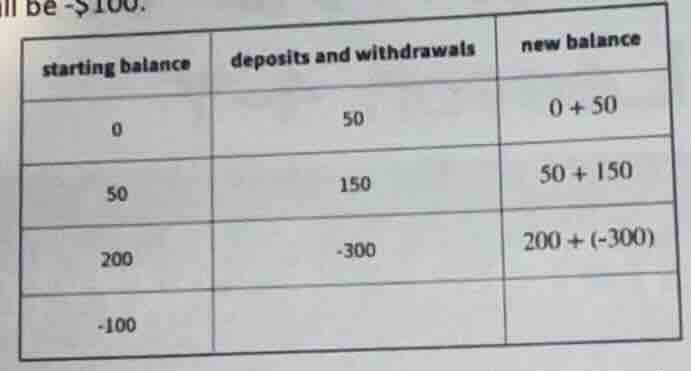
| starting balance | deposits and withdrawals | new balance |
|---|---|---|
| 50 | 150 | 50 + 150 |
| 200 | -300 | 200 + (-300) |
| -100 |
Step1: Identify operation rule
New balance = starting balance + deposits/withdrawals
Step2: Apply to last row
Starting balance = -100, assume no entry means 0? No, wait, no—wait, the pattern is new balance is starting + the middle column. Wait, the last row's middle column is empty? No, wait, no, the pattern is each row: new balance = starting balance + deposits/withdrawals. For the last row, starting balance is -100, if we assume the deposits/withdrawals is... wait no, looking at the table:
Row1: 0 + 50 = 50
Row2: 50 + 150 = 200
Row3: 200 + (-300) = -100
Row4: starting balance is -100, the new balance formula is $\boldsymbol{-100 + x}$, but if we follow the pattern, but the table's last row has empty deposits/withdrawals? Wait no, the task is to fill the new balance column for the last row, following the pattern: new balance = starting balance + deposits and withdrawals. Since the deposits/withdrawals column is empty? No, wait, no—wait, the table's last row: starting balance is -100, deposits/withdrawals is empty, but the pattern is new balance = starting + that column. Wait, no, maybe the deposits/withdrawals is missing, but no, looking at the sequence:
Row1: start 0, deposit 50, new 50
Row2: start 50, deposit 150, new 200
Row3: start 200, withdraw 300, new -100
Row4: start -100, if we assume no transaction (0), new balance is $-100 + 0 = -100$. But the formula is $\boldsymbol{-100 + (\text{deposits/withdrawals})}$. But since the column is empty, following the table's format, we write the expression first, then compute.
Wait, the table's new balance column first shows the expression, then the value? No, the first three rows show the expression: 0+50, 50+150, 200+(-300). So the last row's new balance expression is $\boldsymbol{-100 + (\text{deposits/withdrawals})}$, but since the deposits/withdrawals column is empty, we assume it's 0? No, wait, maybe the deposits/withdrawals is a missing value, but no, the task is to write the expression as per the pattern, then compute.
Step1: Write the expression
New balance = starting + deposits/withdrawals
Expression: $-100 + x$, but since the column is empty, we write $\boldsymbol{-100 + 0}$ (assuming no transaction)
Step2: Calculate the value
$-100 + 0 = -100$

Snap & solve any problem in the app
Get step-by-step solutions on Sovi AI
Photo-based solutions with guided steps
Explore more problems and detailed explanations
New balance expression: $\boldsymbol{-100 + 0}$
Final new balance: $\boldsymbol{-100}$
Wait, no, following the table's exact format, the new balance column first has the sum expression, so for the last row, it is $\boldsymbol{-100 + (\text{empty entry, so 0})}$, so the expression is $-100 + 0$, and the value is $-100$.
But if we strictly follow the table's pattern (each new balance is written as starting + deposits/withdrawals), the last row's new balance entry is $\boldsymbol{-100 + (\text{deposits/withdrawals value})}$. Since the deposits/withdrawals column is empty, we assume it is 0, so the expression is $-100 + 0$, and the result is $-100$.