QUESTION IMAGE
Question
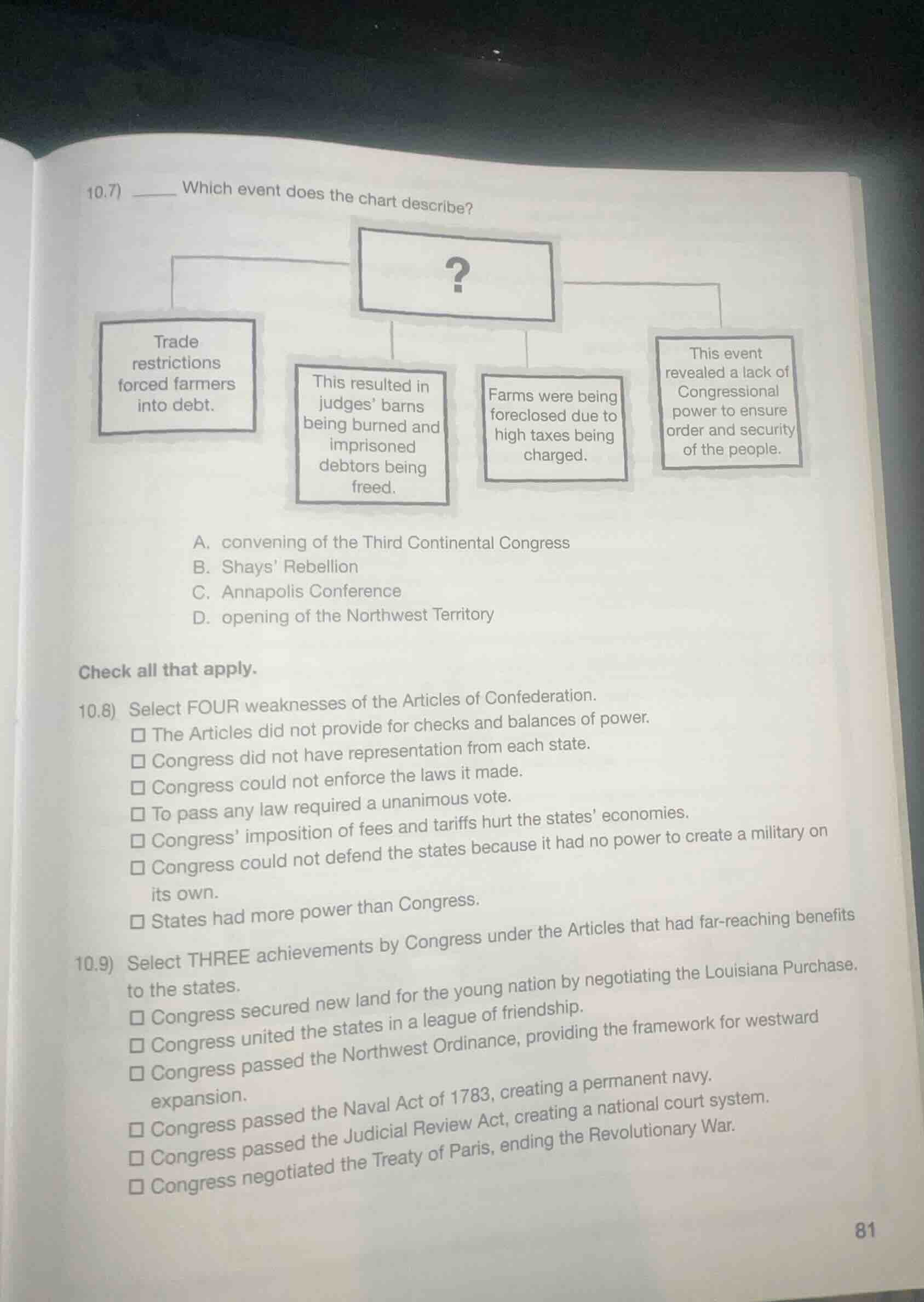
10.7) \\_\\_\\_\\_\\_ which event does the chart describe?
?
- trade restrictions forced farmers into debt.
- this resulted in judges barns being burned and imprisoned debtors being freed.
- farms were being foreclosed due to high taxes being charged.
- this event revealed a lack of congressional power to ensure order and security of the people.
a. convening of the third continental congress
b. shays rebellion
c. annapolis conference
d. opening of the northwest territory
check all that apply.
10.8) select four weaknesses of the articles of confederation.
- the articles did not provide for checks and balances of power.
- congress did not have representation from each state.
- congress could not enforce the laws it made.
- to pass any law required a unanimous vote.
- congress imposition of fees and tariffs hurt the states economies.
- congress could not defend the states because it had no power to create a military on its own.
- states had more power than congress.
10.9) select three achievements by congress under the articles that had far-reaching benefits to the states.
- congress secured new land for the young nation by negotiating the louisiana purchase.
- congress united the states in a league of friendship.
- congress passed the northwest ordinance, providing the framework for westward expansion.
- congress passed the naval act of 1783, creating a permanent navy.
- congress passed the judicial review act, creating a national court system.
- congress negotiated the treaty of paris, ending the revolutionary war.
Analyze the flowchart for Question 10.7
The flowchart describes trade restrictions forcing farmers into debt, judges' barns being burned, debtors freed, farms foreclosed due to high taxes, and a lack of Congressional power to maintain order. These details describe Shays' Rebellion.
Evaluate weaknesses for Question 10.8
Under the Articles of Confederation:
- There was no executive or judicial branch, meaning no checks and balances.
- Congress could pass laws but had no power to enforce them.
- Congress had no power to draft soldiers or establish a national military on its own.
- States retained sovereignty, meaning states had more power than Congress.
- (Note: Representation existed for each state; passing laws required 9 of 13 states, not a unanimous vote; Congress could not impose tariffs/taxes).
Evaluate achievements for Question 10.9
Achievements under the Articles of Confederation include:
- Uniting the states in a league of friendship.
- Passing the Northwest Ordinance of 1787 to organize westward expansion.
- Negotiating the Treaty of Paris (1783) to end the Revolutionary War.
- (Note: The Louisiana Purchase, Naval Act of 1783, and Judicial Review Act did not occur under the Articles of Confederation).

Snap & solve any problem in the app
Get step-by-step solutions on Sovi AI
Photo-based solutions with guided steps
Explore more problems and detailed explanations
Question 10.7
- A. convening of the Third Continental Congress
- B. Shays' Rebellion (Correct answer)
- C. Annapolis Conference
- D. opening of the Northwest Territory
Question 10.8
- The Articles did not provide for checks and balances of power. (Correct answer)
- Congress did not have representation from each state.
- Congress could not enforce the laws it made. (Correct answer)
- To pass any law required a unanimous vote.
- Congress' imposition of fees and tariffs hurt the states' economies.
- Congress could not defend the states because it had no power to create a military on its own. (Correct answer)
- States had more power than Congress. (Correct answer)
Question 10.9
- Congress secured new land for the young nation by negotiating the Louisiana Purchase.
- Congress united the states in a league of friendship. (Correct answer)
- Congress passed the Northwest Ordinance, providing the framework for westward expansion. (Correct answer)
- Congress passed the Naval Act of 1783, creating a permanent navy.
- Congress passed the Judicial Review Act, creating a national court system.
- Congress negotiated the Treaty of Paris, ending the Revolutionary War. (Correct answer)