QUESTION IMAGE
Question
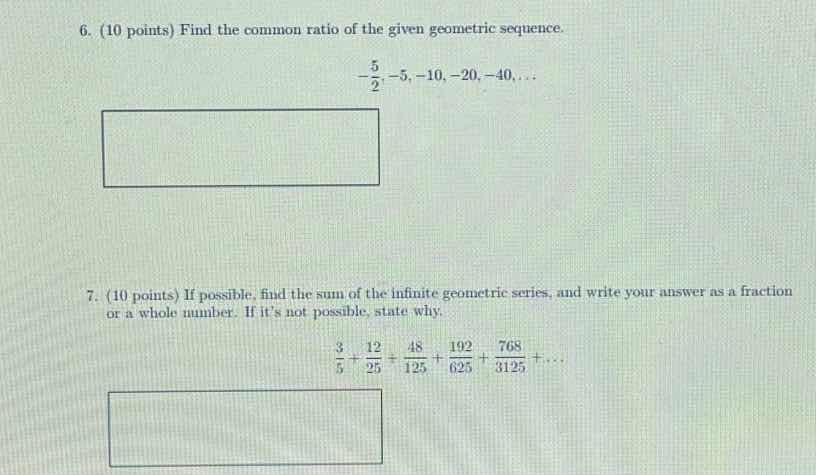
- (10 points) find the common ratio of the given geometric sequence.
\\ -\frac{5}{2}, -5, -10, -20, -40, \dots \\
- (10 points) if possible, find the sum of the infinite geometric series, and write your answer as a fraction or a whole number. if its not possible, state why.
\\ \frac{3}{5} + \frac{12}{25} + \frac{48}{125} + \frac{192}{625} + \frac{768}{3125} + \dots \\
Step1: Identify consecutive terms for question 6
$$a_1 = -\frac{5}{2}, \quad a_2 = -5$$
Step2: Calculate the common ratio for question 6
$$r = \frac{a_2}{a_1} = \frac{-5}{-\frac{5}{2}} = 2$$
Step3: Identify the first term for question 7
$$a = \frac{3}{5}$$
Step4: Calculate the common ratio for question 7
$$r = \frac{\frac{12}{25}}{\frac{3}{5}} = \frac{4}{5}$$
Step5: Check convergence and calculate the sum
$$|r| = \frac{4}{5} < 1, \quad S = \frac{a}{1-r} = \frac{\frac{3}{5}}{1-\frac{4}{5}} = 3$$

Snap & solve any problem in the app
Get step-by-step solutions on Sovi AI
Photo-based solutions with guided steps
Explore more problems and detailed explanations
- \(2\)
- Not possible because the common ratio is \(r = \frac{4}{5}\), which is less than \(1\), so the sum is \(3\).