QUESTION IMAGE
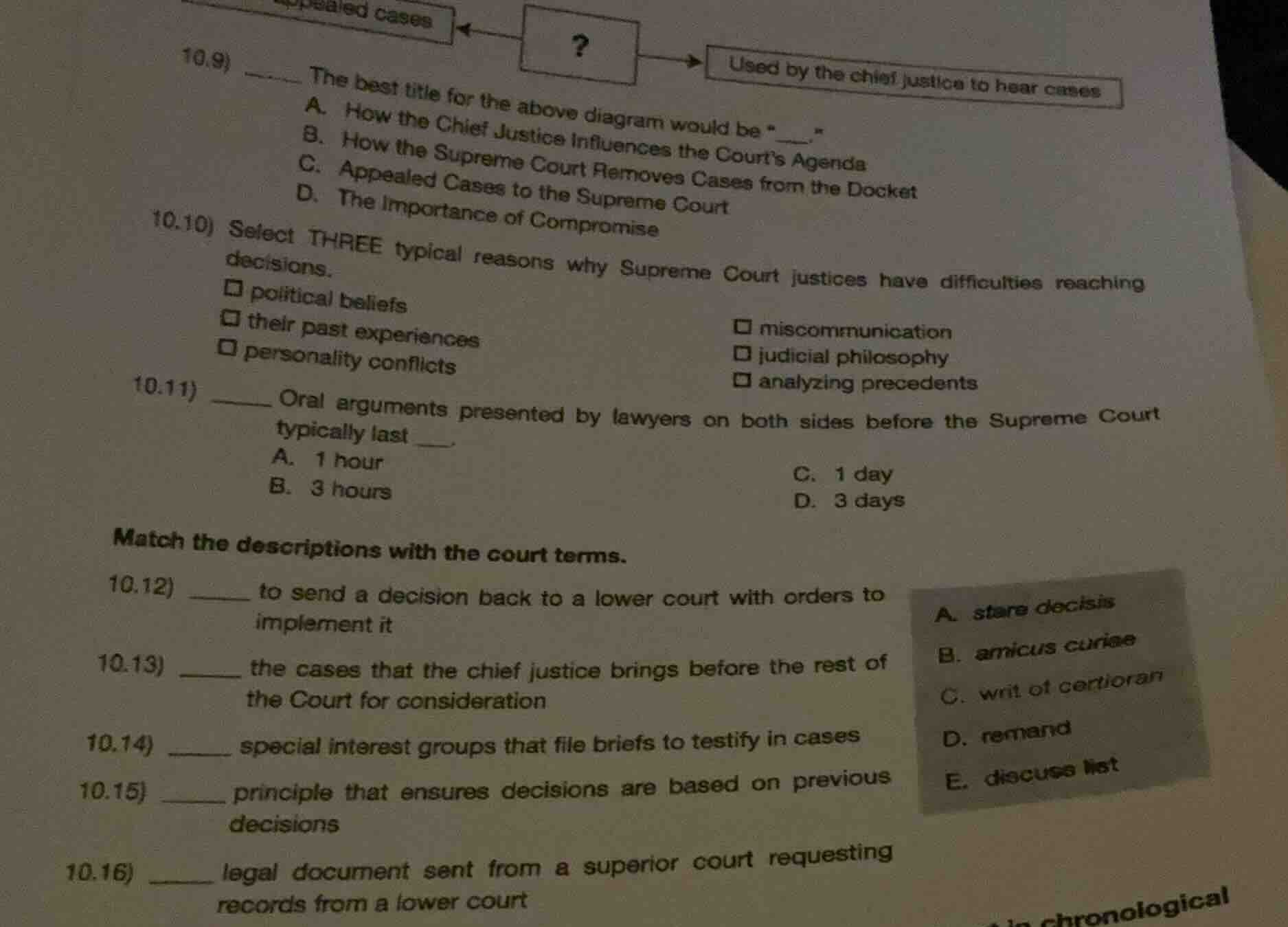
Question
10.9) __ the best title for the above diagram would be “_.”
a. how the chief justice influences the court’s agenda
b. how the supreme court removes cases from the docket
c. appealed cases to the supreme court
d. the importance of compromise
10.10) select three typical reasons why supreme court justices have difficulties reaching decisions.
☐ political beliefs ☐ miscommunication
☐ their past experiences ☐ judicial philosophy
☐ personality conflicts ☐ analyzing precedents
10.11) __ oral arguments presented by lawyers on both sides before the supreme court typically last _.
a. 1 hour c. 1 day
b. 3 hours d. 3 days
match the descriptions with the court terms.
10.12) ____ to send a decision back to a lower court with orders to implement it
10.13) ____ the cases that the chief justice brings before the rest of the court for consideration
10.14) ____ special interest groups that file briefs to testify in cases
10.15) ____ principle that ensures decisions are based on previous decisions
10.16) ____ legal document sent from a superior court requesting records from a lower court
a. stare decisis
b. amicus curiae
c. writ of certiorari
d. remand
e. discuss list
10.9: The diagram shows a process linked to appealed cases and the chief justice using it to hear cases, which relates to the chief justice shaping the court's agenda.
10.10: Supreme Court justices face decision challenges due to differing core views, backgrounds, and approaches to judging. Political beliefs, judicial philosophy, and past experiences are key substantive factors, while the others are less typical core reasons.
10.11: Standard Supreme Court oral argument rules allocate 30 minutes per side, totaling 1 hour.
10.12: The term for sending a decision back to a lower court with implementation orders is defined as remand.
10.13: The chief justice presents the discuss list of cases to the court for consideration.
10.14: Amicus curiae refers to special interest groups that file briefs to provide input in cases.
10.15: Stare decisis is the principle of relying on previous court decisions for rulings.
10.16: A writ of certiorari is the legal document a superior court uses to request lower court records.

Snap & solve any problem in the app
Get step-by-step solutions on Sovi AI
Photo-based solutions with guided steps
Explore more problems and detailed explanations
10.9) A. How the Chief Justice Influences the Court's Agenda
10.10)
- political beliefs
- judicial philosophy
- their past experiences
10.11) A. 1 hour
10.12) D. remand
10.13) E. discuss list
10.14) B. amicus curiae
10.15) A. stare decisis
10.16) C. writ of certiorari