QUESTION IMAGE
Question
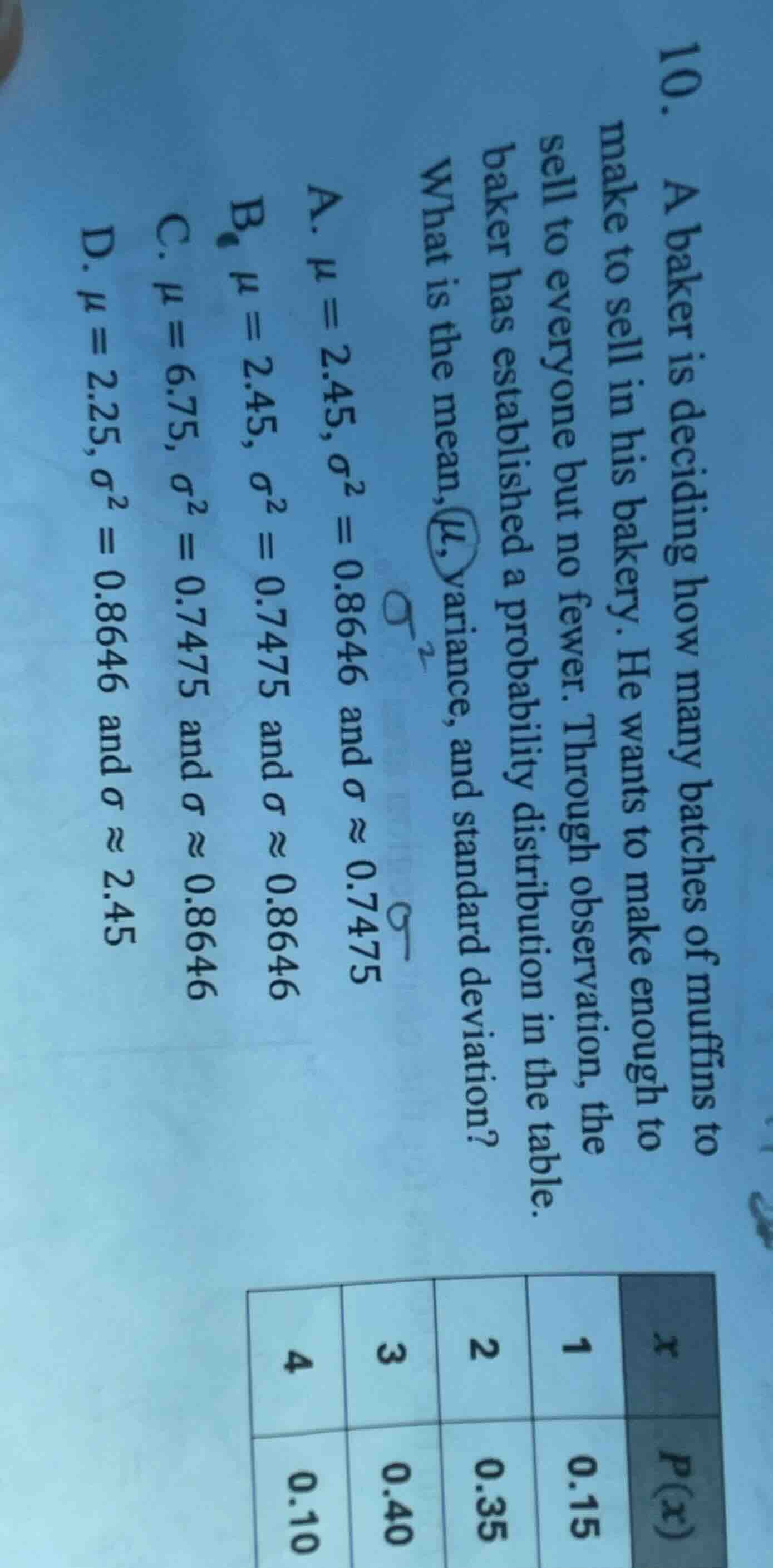
- a baker is deciding how many batches of muffins to make to sell in his bakery. he wants to make enough to sell to everyone but no fewer. through observation, the baker has established a probability distribution in the table. what is the mean, \\(\mu\\), variance, and standard deviation?
\\
\
\\
a. \\(\mu = 2.45\\), \\(\sigma^2 = 0.8646\\) and \\(\sigma \approx 0.7475\\)
b. \\(\mu = 2.45\\), \\(\sigma^2 = 0.7475\\) and \\(\sigma \approx 0.8646\\)
c. \\(\mu = 6.75\\), \\(\sigma^2 = 0.7475\\) and \\(\sigma \approx 0.8646\\)
d. \\(\mu = 2.25\\), \\(\sigma^2 = 0.8646\\) and \\(\sigma \approx 2.45\\)
🆕 New Concept Discovered: Discrete Probability Distributions
Expected value, variance, and standard deviation of discrete variables.
Step 1: Calculate the Mean (\(\mu\))
The mean (expected value) of a discrete probability distribution is calculated using:
Using the values from the table:
---
Step 2: Calculate the Variance (\(\sigma^2\))
The variance is calculated using:
Substitute \(\mu = 2.45\) and calculate each term:
Sum these values to find the variance:
---
Step 3: Calculate the Standard Deviation (\(\sigma\))
The standard deviation is the square root of the variance:
Rounding to four decimal places:
---

Snap & solve any problem in the app
Get step-by-step solutions on Sovi AI
Photo-based solutions with guided steps
Explore more problems and detailed explanations
B (\(\mu = 2.45\), \(\sigma^2 = 0.7475\) and \(\sigma \approx 0.8646\))